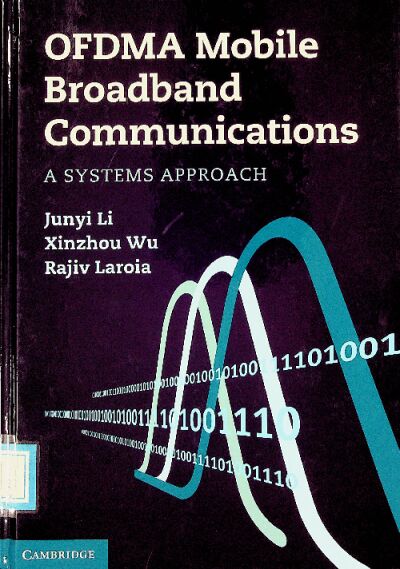
书名:OFDMA mobile broadband communications
责任者:Junyi Li | Xinzhou Wu | Rajiv Laroia.
ISBN\ISSN:9781107001602,1107001609
出版时间:2013
出版社:Cambridge University Press,
摘要
Written by the pioneers of Flash-OFDM, arguably the first commercially developed OFDMA-based mobile broadband system in the world, this book teaches OFDMA from first principles, enabling readers to understand mobile broadband as a whole.
The book examines the key requirements for data-centric mobile; how OFDMA fits well with data networks; why mobile broadband needs to be IP-based; and how to bridge communications theory to real-world air interface design and make a good system choice between performance and complexity. It also explores the future of wireless technologies beyond conventional cellular architecture.
One of the key challenges faced by newcomers to this field is how to apply the wireless communications theory and principles to the real world and how to understand sophisticated commercial systems such as LTE. The authors use their firsthand experience to help graduate students, researchers and professionals working on 4G to bridge the gap between theory and practice.
查看更多
前言
Why we wrote this book
Back in the late1990s, when CDMA was widely considered the dominant technology for cellular 3G, two of the authors and a few colleagues in Bell Laboratories designed an alternative technology called Flash-OFDM with two basic yet fundamental ideas: OFDMA-based airlink and all IP-based network architecture. In early 2000, we founded a startup company, Flarion Technologies, to prove Flash-OFDM in the market by building terminals and base stations, and testing and deploying the networks in a wide variety of locations, configurations, and frequency bands. As arguably the first commercially deployed OFDMA/IP-based cellular system, Flash-OFDM helped make those two ideas the key enabling features in4G mobile broadband LTE.
From the remarkable journey of designing, developing, and deploying Flash-OFDM, we have learned, and in some cases "unlearned," a few important lessons:
While early cellular wireless communications design focuses predominantly on the physical layer, mobile broadband requires more system-level thinking across different protocol layers than just the physical layer. For example, OFDMA, in comparison with CDMA, more readily facilitates a simplified IP-based network architecture design, where air interface specific technology functions and processing are collapsed into a base station and I Player protocols are used for handoff.
Conventional wisdom developed in early cellular wireless communications needs to be reexamined from first principles. For example, the wireless channel is conventionally
查看更多
目录
Foreword page xiii
Preface xiv
List of Notation xvii
List of Abbreviations xix
1 Introduction 1
1.1 Evolution towards mobile broadband communications 1
1.2 System design principles of wireless communications 3
1.3 Why OFDMA for mobile broadband? 4
1.4 Systems approach and outline of the book 6
2 Elements of OFDMA 9
2.1 OFDM 9
2.1.1 Tone signals 9
2.1.2 Cyclic prefix 10
2.1.3 Time-frequency resource 13
2.1.4 Block signal processing 14
Discussion notes 2.1 FFT/IFFT 15
Discussion notes 2.2 Filtering 16
Discussion notes 2.3 Equalization 17
2.2 From OFDM to OFDMA 18
2.2.1 Basic principles 18
2.2.2 Comparison: OFDMA, CDMA, and FDMA 21
2.2.3 Inter-cell interference averaging: OFDMA versus CDMA 21
2.2.4 Tone hopping: averaging versus peaking 24
Practical example 2.1 Physical resource block allocation and hopping in LTE data channels 26
2.2.5 Time-frequency synchronization and control 30
2.2.6 Block signal processing 33
Discussion notes 2.4 Block front-end processing at the base station 34
Discussion notes 2.5 Wideband processing at the user 34
2.3 Peak-to-average power ratio and SC-FDMA 34
2.3.1 PAPR problem 34
2.3.2 PAPR of OFDMA 35
2.3.3 SC-FDMA and PAPR reduction 35
2.3.4 Frequency domain equalization at the SC-FDMA receiver 40
Discussion notes 2.6 SINR degradation in SC-FDMA 42
2.3.5 System aspects of SC-FDMA 45
Practical example 2.2 Uplink data and control channels in LTE 46
2.4 Real-world impairments 52
2.4.1 Carrier frequency offset and Doppler effect 52
2.4.2 Arrival time beyond the cyclic prefix 55
2.4.3 Sampling rate mismatch 56
2.4.4 I/Q imbalance 60
2.4.5 Power amplifier nonlinear distortion 61
Discussion notes 2.7 Determination of OFDMA parameters 61
2.5 Cross interference and self-noise models 63
2.5.1 Cross interference and self-noise due to ICI 63
2.6 Self-noise due to imperfect channel estimation 64
2.6.1 Self-noise measurement via null pilot 67
2.7 Summary of key ideas 68
3 System design principles 70
3.1 System benefits of OFDMA 70
3.2 Fading channel mitigation and exploitation 74
3.2.1 Fading mitigation 75
3.2.2 Fading exploitation 75
3.2.3 Mitigation or exploitation? 77
3.3 Intra-cell user multiplexing 77
3.4 Inter-cell interference management 80
3.4.1 Interference averaging and active control 81
3.4.2 Universal versus fractional frequency reuse 82
3.5 Multiple antenna techniques 84
3.5.1 System benefits 84
3.5.2 OFDMA advantages 86
3.6 Scheduling 87
3.7 Network architecture and airlink support 89
3.7.1 Unplanned deployment of base stations 90
3.7.2 Mobile IP-based handoff 91
3.8 Summary of key ideas: evolution of system design principles 92
4 Mitigation and exploitation of multipath fading 94
4.1 Multipath fading channel 97
4.1.1 Impulse response model 97
4.1.2 Amplitude statistics 99
4.1.3 Channel variation in time 100
4.1.4 Channel variation in frequency 103
4.1.5 Gaussian-Markov model 105
4.2 Communications over a fading channel: the single-user case 106
4.2.1 Performance penalty due to multipath fading 106
4.2.2 Mitigation of fading via channel state feedback 108
Discussion notes 4.1 Practical consideration of feedback-based approaches 112
4.2.3 Mitigation of fading via diversity 115
Discussion notes 4.2 Tradeoff considerations for achieving diversity 122
4.2.4 Feedback or diversity 123
4.3 Communications over a fading channel: the multiuser case 126
4.3.1 Fading channel and multiuser diversity 126
Practical example 4.1 Multiuser diversity in the downlink: EV-DO 130
Practical example 4.2 Multiuser diversity in the uplink: Flash-OFDM and LTE 133
4.3.2 Exploring multiuser diversity in frequency and space 135
4.3.3 Multiuser or single-user diversity 144
4.4 Summary of key ideas 148
5 Intra-cell user multiplexing 150
5.1 Orthogonal multiplexing 151
5.1.1 Orthogonal multiplexing in the perfect model 151
Discussion notes 5.1 An analysis of optimal power and bandwidth allocation in a cellular downlink 157
Practical example 5.1 Downlink user multiplexing: EV-DO, HSDPA,and LTE 160
5.1.2 Orthogonal multiplexing in the cross interference model 167
Discussion notes 5.2 An analysis of optimal power and bandwidth allocation for orthogonal uplink multiplexing with cross
interference in the power limited regime 169
5.1.3 Orthogonal multiplexing in the self-noise model 172
5.2 Non-orthogonal multiplexing 174
5.2.1 Non-orthogonal multiplexing in the perfect model 176
5.2.2 Non-orthogonal multiplexing in the cross interference and self-noise models 180
5.2.3 Superposition-by-position coding 183
5.3 Inter-sector interference management 189
5.3.1 Sectorization 189
5.3.2 Synchronized sectors 190
5.3.3 Users at sector edge 192
5.4 Summary of key ideas 195
6 Inter-cell interference management 196
6.1 Analysis of SIR distributions 198
6.1.1 Downlink SIR 199
Discussion notes 6.1 An analysis of C/I distribution with randomly-placed base stations 202
6.1.2 Uplink SIR 205
6.2 Uplink power control and SINR assignment in OFDMA 209
6.2.1 SINR feasibility region 210
6.2.2 Distributed power control 211
6.2.3 SINR assignment 212
6.2.4 Joint bandwidth and SINR assignment 215
6.2.5 Utility maximization in SINR assignment 216
Practical example 6.1 Uplink power control in LTE 217
6.3 Fractional frequency reuse 219
6.3.1 A two-cell analysis 220
Discussion notes 6.2 Motivation of fractional frequency reuse from a different angle 225
6.3.2 Static FFR in a multi-cell scenario 226
6.3.3 Breathing cells: FFR in the time domain 230
6.3.4 Adaptive FFR 233
Practical example 6.2 Inter-cell interference coordination in LTE 236
6.4 Summary of key ideas 237
7 Use of multiple antennas 239
7.1 MIMO channel modeling 240
7.1.1 Linear antenna arrays 241
7.1.2 Polarized antennas 247
7.2 SU-MIMO techniques 251
7.2.1 Channel state information at both transmitter and receiver 251
7.2.2 Channel state information only at receiver 252
7.2.3 Multiplexing with polarized antennas 254
7.3 Multiuser MIMO techniques 254
7.3.1 Uplink SDMA 256
7.3.2 Downlink beamforming 261
7.4 Multi-cell MIMO techniques 267
7.4.1 Coordinated beamforming 268
7.4.2 Inter-sector beamforming 271
7.4.3 Inter-cell interference avoidance with polarized antennas 273
Practical example 7.1 Multiple antenna techniques in LTE 273
7.5 Summary of key ideas 280
8 Scheduling 282
8.1 Scheduling for infinitely backlogged traffic 283
8.1.1 Fairness based on utility functions 283
8.1.2 Gradient-based scheduling schemes 286
8.2 Scheduling for elastic traffic 289
8.2.1 Congestion control and scheduling 290
Discussion notes 8.1 TCP performance over wireless 292
8.3 Scheduling for inelastic traffic 293
8.3.1 Throughput optimal scheduling 294
8.3.2 Tradeoff between queue-awareness and channel-awareness 296
8.3.3 Admission control 299
8.4 Multi-class scheduling 300
8.5 Flow level scheduling 301
8.6 Signaling for scheduling 304
8.6.1 Dynamic packet scheduling 304
Practical example 8.1 Signaling for scheduling in LTE 307
8.6.2 Semi-persistent scheduling 310
Practical example 8.2 Semi-persistent scheduling in LTE for VoIP 311
8.6.3 MAC state scheduling 311
Practical example 8.3 LTE DRX mode and Flash-OFDM HOLD state 312
8.7 Summary of key ideas 313
9 Handoff in IP-based network architecture 315
9.1 IP-based cellular network architecture 317
9.1.1 Motivation for IP-based cellular network architecture 317
9.1.2 Description of IP-based cellular networks 317
9.2 Soft handoff in CDMA 319
9.3 Make-before-break handoff in OFDMA 323
9.3.1 Parallel independent links to multiple base stations 324
9.3.2 Mobile IP-based MBB handoff procedure 327
9.3.3 Uplink macro-diversity 328
9.3.4 Downlink macro-diversity 333
9.3.5 MBB handoff in an FFR or multi-carrier scenario 335
9.4 Break-before-make handoff in OFDMA 337
9.4.1 BBM handoff in an FFR or multi-carrier scenario 338
9.4.2 Expedited BBM handoff 339
9.5 Handoff initiation 342
9.5.1 The universal frequency reuse case 342
Practical example 9.1 Flash signaling in Flash-OFDM 351
Practical example 9.2 Handoff in a railway Flash-OFDM network 353
9.5.2 The non-universal frequency reuse cases 354
9.6 Mobile-controlled versus network-controlled handoff 356
Practical example 9.3 Cell search and random access in LTE handoff 357
9.7 Summary of key ideas 363
10 Beyond conventional cellular frameworks 365
10.1 Heterogeneous topology 366
10.1.1 Relays 367
10.1.2 Femtocells 383
10.1.3 Device-to-device communications 398
Discussion notes 10.1 Gaussian interference channel capacity 412
10.2 Cooperative communication 415
10.2.1 User cooperation 417
10.2.2 Network cooperation 425
10.3 Cognitive radio 431
10.3.1 Spectrum sensing 433
10.3.2 Spectrum sharing 438
Practical example 10.1 LTE-Advanced 444
Practical example 10.2 Cognitive radio RAN in TV white spaces (IEEE 802.22) 456
10.4 Summary of key ideas 458
A Overview of system operations 461
A.l Cell search, synchronization, and identification 461
A.2 Link establishment 462
A.3 Traffic control and transmission 463
A.4 Sleep state 465
A.5 Handoff 465
B OFDM point-to-point communications 467
B.1 Signal-presence detection 467
B.2 Synchronization 471
B.3 Channel estimation 477
B.4 Error correction 487
C Brief review of channel capacity 495
C.l AWGN channel 495
C.2 Flat fading channel 496
C.2.1 Channel side information only at receiver 496
C.2.2 Channel side information at both receiver and transmitter 497
C.3 Frequency selective fading channel 499
C.4 Multiuser capacity 499
References 503
Index 514
查看更多
作者简介
Rajiv Laroia is Senior Vice President of Engineering and CTO at Sonus Networks. He was the founder and CTO of Flarion Technologies and then Senior Vice President of Engineering at Qualcomm. He is widely recognized as a pioneer of OFDMA-based cellular technologies.
查看更多
馆藏单位
中科院文献情报中心