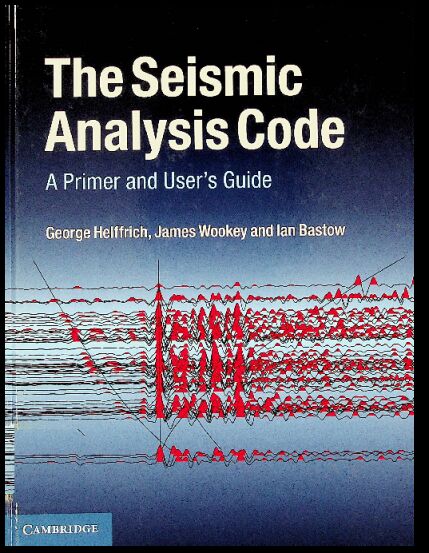
书名:The seismic analysis code
责任者:George Helffrich | James Wookey | Ian Bastow. | Bastow, Ian,
ISBN\ISSN:9781107045453,1107045452,9781107613195,1107613191
出版时间:2013
出版社:Cambridge University Press,
前言
The Seismic Analysis Code (SAC) is one of the most widely used analysis packages for regional and teleseismic seismic data. For the first time, this book provides users at introductory and advanced levels with a complete guide to SAC. It leads new users of SAC through the steps of learning basic commands, describes the SAC processing philosophy, and presents its macro language in full, supported throughout with example inputs and outputs from SAC. For more experienced practitioners, the book describes SAC's many hidden features, including advanced graphics aspects, its file structure, how to write independent programs to access and create files, and much more. Tutorial exercises engage users with newly acquired skills, providing data and code to implement the standard methods of teleseismic shear-wave splitting and receiver function analysis. Methodical and authoritative, this is a key resource for researchers and graduate students in global seismology, earthquake seismology and geophysics.
查看更多
目录
Preface page ix
Acknowledgements xi
1 Introduction 1
1.1 What is SAC? 1
1.2 History and development 2
1.3 Alternatives to SAC 2
1.4 SAC variants 3
1.5 Requirements and installation 4
1.6 Scope of this book 4
2 The SAC data format 5
2.1 Philosophy and structure 5
SAC file format 5
Alphanumeric and binary forms 5
Interconversion of formats 6
2.2 Conversion from other data formats 6
GSE files 6
SEG Y, MSEED, GCF and CSS formats 7
2.3 Byte-order issues 8
2.4 SAC file layout 1 0
3 The SAC processing philosophy 1 1
3.1 Phases of a typical analysis task 1 1
Organize 1 1
Interact 1 3
Process 1 4
Display 1 4
3.2 Command summary for each phase 1 4
3.3 Further information about SAC commands 1 5
4 Basic SAC commands 1 7
4.1 Command style 1 7
4.2 Command history 1 7
4.3 Reading and writing data 1 8
Reading examples 1 8
Writing data 1 9
4.4 Plotting and cutting 1 9
Devices 1 9
Windows and window placement 20
Plotting data 21
Cutting data 24
Permanent plots 24
4.5 Picking 25
4.6 The file header 25
Time representation 27
Listing 27
Changing 28
Writing 29
4.7 Trace preparation and resampling 29
De-glitching 29
Mean and trend removal 30
Resampling 30
4.8 Rotation 31
4.9 Frequency-domain operations and filtering 32
Filtering 34
Designing filtering strategies 35
4.11 SAC utility programs 37
5 SAC macros 38
5.1 Macros and invoking them 38
5.2 Writing a simple macro 39
5.3 Tracing macro operations 39
5.4 Searching for macros 40
5.5 Decision making in macros 40
5.6 Variables in macros 41
Types and scope 41
Setting 41
5.7 Expressions 42
Syntax 43
Built-in functions 43
Escape character 48
Evaluation order 48
Conditions 49
5.8 Suspension, resumption and escape from macros 50
5.9 Operating system interaction 51
5.1 0 Looping commands 52
WHILE 53
WHILE READ 54
Escaping from loops 54
DO 55
5.1 1 Macro parameters 57
Positional 57
Keyword 59
Recursion 60
5.12 Advanced operating system interaction 61
6 Accessing SAC functionality and data from external programs 64
6.1 Automating SAC execution 64
Running SAC from the shell 64
Automation of SAC execution in the shell using scripting 65
6.2 Accessing SAC data in external programs 68
Accessing SAC data from Fortran using the sacio library 68
sacio90: object-oriented SAC data interaction in Fortran 70
Other languages 71
6.3 Accessing SAC functionality in Fortran programs 72
7 Graphical data annotation 74
7.1 Plot annotation 74
Seismograms 74
Composite plots 77
7.2 Annotating plots with graphical elements 79
Graphical elements 80
Assembling graphical elements 80
Parameters controlling graphical elements 83
7.3 Using PLOTC 83
8 Array data handling 86
8.1 SAC subprocesses 86
8.2 The signal stacking subprocess 87
Trace collections 87
Adding, deleting and changing traces 88
Plotting record sections 89
Stacking 90
Saving stack data and uncertainties 95
Picking data in stacks 95
8.3 Array maps 101
8.4 Beamforming 102
8.5 Travel-time analysis 106
9 Spectral estimation in SAC 109
9.1 Spectral estimation 109
9.2 The spectral estimation subprocess 110
Correlation 110
Spectrum 112
Saving the correlation and the spectrum 113
10 Three-dimensional data in SAC 115
10.1 The concept of 3D data 115
10.2 Spectrograms 115
10.3 Contour plots 117
10.4 Composite 3D data plots 119
10.5 Properties of 3D data 120
10.6 Writing 3D data files 121
11 Implementation of common processing methodologies using SAC 123
11.1 Seismic anisotropy and shear wave splitting 123
Overview 123
11.2 Shear wave splitting analysis 123
Parameter estimation methodologies 124
Macro and auxiliary program design 125
SAC implementation 127
11.3 Receiver function analysis 127
Overview 127
Estimation methodologies 129
Macro and auxiliary program design 30
SAC implementation 130
Appendix A Alphabetical list of SAC commands 135
Appendix B Keyword in context for SAC command descriptions 142
References 167
Index 170
Color plate section is found between pp. 116 and 117.
查看更多
馆藏单位
中科院文献情报中心