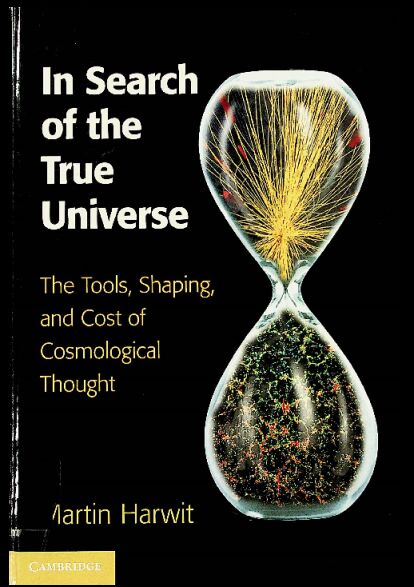
书名:In search of the true universe
ISBN\ISSN:9781107044067,1107044065,9781107620254,1107620252
出版时间:2013
出版社:Cambridge University Press,
前言
Astrophysicist and scholar Martin Harwit examines how our understanding of the Cosmos advanced rapidly during the twentieth century and identifies the factors contributing to this progress. Astronomy, whose tools were largely imported from physics and engineering, benefited mid-century from the U.S. policy of coupling basic research with practical national priorities. This strategy, initially developed for military and industrial purposes, provided astronomy with powerful tools yielding access – at virtually no cost – to radio, infrared, X-ray, and gamma-ray observations. Today, astronomers are investigating the new frontiers of dark matter and dark energy, critical to understanding the Cosmos but of indeterminate socio-economic promise. Harwit addresses these current challenges in view of competing national priorities and proposes alternative new approaches in search of the true Universe. This is an engaging read for astrophysicists, policy makers, historians, and sociologists of science looking to learn and apply lessons from the past in gaining deeper cosmological insight.
查看更多
目录
Preface page vii
Notes on Usage xv
1 The Nineteenth Century’s Last Five Years 1
Part I The Import of Theoretical Tools
2 An Overview 9
3 Conclusions Based on Principles 25
4 Conclusions Based on a Premise 55
5 Conclusions Based on Calculations 76
6 Ask the Right Questions, Accept Limited Answers 97
Part II A National Plan Shaping the Universe We Perceive
7 A New Order and the New Universe It Produced 121
8 Where Did the Chemical Elements Arise? 157
9 Landscapes 178
10 The Evolution of Astrophysical Theory after 1960 200
11 Turmoils of Leadership 230
12 Cascades and Shocks that Shape Astrophysics 256
13 Astrophysical Discourse and Persuasion 290
Part III The Cost of Discerning the True Universe
14 Organization and Functioning of the Astronomical Community 309
15 Language and Astrophysical Stability 329
16 An Economically Viable Astronomical Program 350
Epilogue 367
Appendix: Symbols, Glossary, Units and Their Ranges 369
Index 385
查看更多
作者简介
Martin Harwit is Professor Emeritus of Astronomy at Cornell University. For many years he also served as Director of the National Air and Space Museum in Washington, DC. For much of his astrophysical career he built instruments and made pioneering observations in infrared astronomy. His advanced textbook, Astrophysical Concepts, has taught several generations of astronomers through its four editions. Harwit has had an abiding interest in how science advances or is constrained by factors beyond the control of scientists. His book Cosmic Discovery first raised these questions. The present volume explores how philosophical outlook, historical precedents, industrial progress, economic factors, and national priorities have affected our understanding of the cosmos. Harwit is a recipient of the Astronomical Society of the Pacific's highest honor, the Bruce Medal, which commends 'his original ideas, scholarship, and thoughtful advocacy'.
查看更多
馆藏单位
中科院文献情报中心