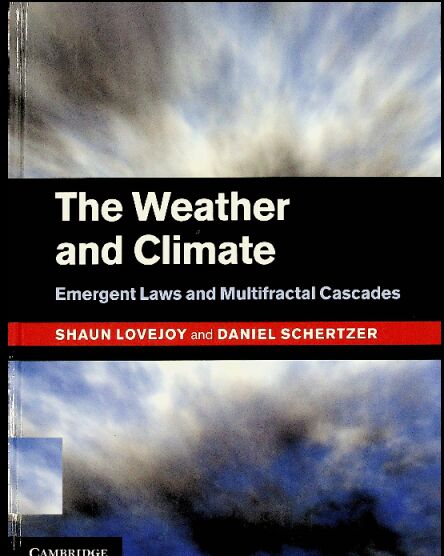
书名:The weather and climate
责任者:Shaun Lovejoy | Daniel Schertzer.
出版时间:2013
出版社:Cambridge University Press,
前言
Advances in nonlinear dynamics, especially modern multifractal cascade models, allow us to investigate the weather and climate at unprecedented levels of accuracy. Using new stochastic modelling and data analysis techniques, this book provides an overview of the nonclassical, multifractal statistics. By generalizing the classical turbulence laws, emergent higher-level laws of atmospheric dynamics are obtained and are empirically validated over time-scales of seconds to decades and length-scales of millimetres to the size of the planet. In generalizing the notion of scale, atmospheric complexity is reduced to a manageable scale-invariant hierarchy of processes, thus providing a new perspective for modelling and understanding the atmosphere. This new synthesis of state-of-the-art data and nonlinear dynamics is systematically compared with other analyses and global circulation model outputs. This is an important resource for atmospheric science researchers new to multifractal theory and is also valuable for graduate students in atmospheric dynamics and physics, meteorology and oceanography.
查看更多
目录
Preface ix
Acknowledgments xiii
Acronyms and abbreviations xiv
1 Introduction 1
1.1 A new synthesis 1
1.2 The Golden Age, revolution resolution and paradox: an up-to-date empirical tour of atmospheric variability 4
1.3 The phenomenological fallacy 19
2 Classical turbulence, modern evidence 21
2.1 Complexity or simplicity? Richardson’s dreams and the emergence of the laws of turbulence 21
2.2 The equations of the atmosphere and their scale symmetries 25
2.3 Extensions to passive scalars, to the atmospheric primitive equations 28
2.4 Classical isotropic 3D turbulence phenomenology: Kolmogorov turbulence and energy cascades 31
2.5 The special case of 2D turbulence 36
2.6 Atmospheric extensions 37
2.7 Summary of emergent laws in Chapter 2 51
Appendix 2A: Spectral analysis in arbitrary dimensions 53
Appendix 2B: Cascade phenomenology and spectral analysis 55
Appendix 2C: Spectral transfers 58
3 Scale-by-scale simplicity: an introduction to multiplicative cascades 59
3.1 Cascades as conceptual models 59
3.2 Discrete-in-scale multiplicative cascades 61
3.3 Universal multifractal processes 76
3.4 Summary of emergent laws in Chapter 3 81
Appendix 3A: The convexity of K(q) 82
4 Empirical analysis of cascades in the horizontal 83
4.1 The empirical estimation of turbulent fluxes in both dissipation and scaling ranges 83
4.2 The scaling properties of reanalyses 86
4.3 The cascade structure of in-situ aircraft measurements: wind, temperature and humidity fields 96
4.4 The cascade structure of precipitation 100
4.5 The scaling of atmospheric forcings and boundary conditions 106
4.6 Summary of emergent laws in Chapter 4 109
Appendix 4A: Trace moments of quasi-Gaussian processes 111
5 Cascades, dimensions and codimensions 113
5.1 Multifractals and the codimension function 113
5.2 The codimension multifractal formalism 115
5.3 Divergence of statistical moments and extremes 125
5.4 Continuous-in-scale multifractal modelling 141
5.5 Wavelets and fluctuations: structure functions and other data analysis techniques 150
5.6 Summary of emergent laws in Chapter 5 162
Appendix 5A: Divergence of high-order statistical moments 165
Appendix 5B: Continuous-in-scale cascades: the autocorrelation and finite size effects 167
Appendix 5C: A Mathematica code for causal and acausal multifractal simulations 172
Appendix 5D: Multifractal simulations on a sphere 174
Appendix 5E: Tendency, poor man’s and Haar structure functions and the MFDFA technique 175
6 Vertical stratification and anisotropic scaling 183
6.1 Models of vertical stratification: local, trivial and scaling anisotropy 183
6.2 The Brunt–Väisälä frequency and the classical stable layer approach to stratification 197
6.3 The implications of anisotropic scaling for aircraft turbulence measurements 201
6.4 Horizontal and vertical analyses of dynamic and thermodynamic variables 204
6.5 Direct verification of anisotropic cascades using lidar backscatter of aerosols and CloudSat radar reflectivities 211
6.6 Zonal/meridional anisotropy in reanalyses 217
6.7 Summary of emergent laws in Chapter 6 223
Appendix 6A: Revisiting the revised EOLE experiment: the effect of temporal averaging 225
Appendix 6B: Cross-spectral analysis between wind, altitude and pressure 227
7 Generalized scale invariance and cloud morphology 229
7.1 Beyond self-similarity and selfaffinity 229
7.2 GSI data analysis 255
7.3 Spatially varying anisotropies, morphologies: some elements of nonlinear GSI 262
7.4 Summary of emergent laws in Chapter 7 269
Appendix 7A: The normalization constant in anisotropic continuous-in-scale multifractal simulations 271
8 Space-time cascades and the emergent laws of the weather 274
8.1 Basic considerations and empirical evidence 274
8.2 Anisotropic space-time turbulence 300
8.3 Global space-time scaling in Fourier space 304
8.4 Space-time relations 308
8.5 Summary of emergent laws in Chapter 8 312
Appendix 8A: The effect of the vertical wind on the temporal statistics 313
9 Causal space-time cascades: the emergent laws of waves, and predictability and forecasting 314
9.1 Causality 314
9.2 The emergent laws of turbulencegenerated waves 318
9.3 Predictability/forecasting 329
9.4 Summary of emergent laws in Chapter 9 335
10 The emergent laws of macroweather and the transition to the climate 337
10.1 What is the climate? 337
10.2 Macroweather: its temporal variability, and outer-limit tc 350
10.3 Spatial variability in macroweather and climatic zones 356
10.4 Summary of emergent laws in Chapter 10 363
Appendix 10A: The dimensional transition asymptotic scaling of cascades in the macroweather regime 366
Appendix 10B: Stochastic linear forcing paradigm versus the fractionally integrated flux model 371
Appendix 10C: A comparison of monthly surface temperature series 374
Appendix 10D: Coupled ocean–atmosphere modelling 378
11 The climate 383
11.1 Multidecadal to multimillennial scaling: instruments and multiproxies 383
11.2 Scaling up to 100 kyr: a composite overall scaling picture of atmospheric variability 396
11.3 Climate forcings and global climate models 411
11.4 The atmosphere in a nutshell: a summary of emergent laws in Chapter 11 424
References 427
Index 454
Colour plate section appears between pages 336 and 337.
查看更多
作者简介
Daniel Schertzer is a professor at École des Ponts ParisTech, Université de Paris-Est, and Scientific Director of the Chair 'Hydrology for Resilient Cities', sponsored by VEOLIA Water. His research introduced multifractals and related techniques in hydrology, after having contributed to their theoretical developments in turbulence, in particular with the definition of a co-dimension formalism, the concepts of generalized scale invariance and universal multifractals. His work has covered many domains of geophysics and the environment, with a particular emphasis on atmospheric dynamics, precipitation extremes and remote sensing. His publications include two books and 115 ISI-indexed publications, which have received more than 4000 citations, and he is executive editor of the journal Nonlinear Processes in Geophysics, which he co-founded as well as the nonlinear geophysics divisions of European Geophysical Union (EGU) and American Geophysical Union (AGU). Professor Schertzer has been a union officer of the EGU and an officer of AGU committees and the International Association for Hydrological Sciences bureau. He is also vice-president of the French National Committee of Geodesy and Geophysics, and a member of the Higher Council of Meteorology (France).
查看更多
馆藏单位
中科院文献情报中心