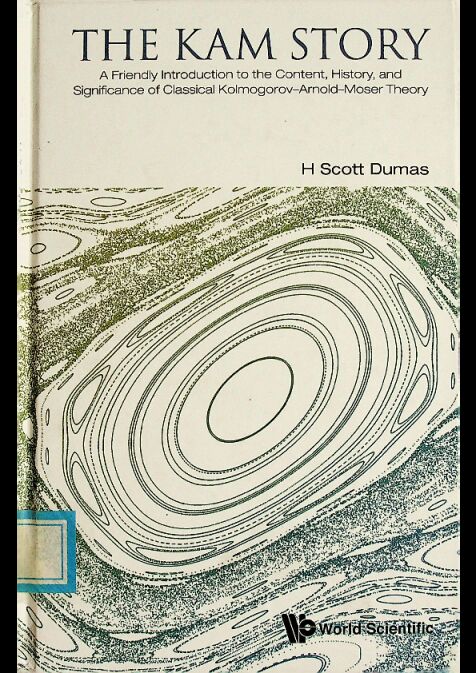
书名:The KAM story
责任者:H. Scott Dumas (University of Cincinnati | USA).
ISBN\ISSN:9789814556583,9814556580
出版时间:2014
出版社:World Scientific,
前言
In many ways classical mechanics serves as the bedrock of physical science, yet surprisingly, it has crucial features that are not widely known. Many people know something about 'chaos theory' - how mathematical models of certain deterministic classical systems fail to predict the evolution of those systems in a practical sense. If they're interested in history, they also know that much of chaos theory was understood by mathematicians almost a century before it was popularized by way of computer models in the last third of the 20th century. But there is a deeper, more interesting story that is not well known outside a circle of experts, and the aim of this book is to tell this story to a wider audience.
The story in a nutshell is this: Right from the start, after enunciating his laws of mechanics and gravitation, Isaac Newton ran into difficulties using those laws to describe the motion of three bodies moving under mutual gravitational attraction (the so-called 'three body problem'). For the next two centuries, these difficulties resisted solution, as the best minds in mathematics and physics concentrated on solving other, increasingly complex model systems in classical mechanics (in the abstract mathematical setting, to 'solve' a system means showing that its trajectories move linearly on so-called 'invariant tori'). But toward the end of the 19th century, using his own new methods, Henri Poincaré confronted Newton's difficulties head-on and discovered an astonishing form of 'unsolvability,' or chaos, at the heart of the three body problem. This in turn led to a paradox. According to Poincaré and his followers, most classical systems should be chaotic; yet observers and experimentalists did not see this in nature, and mathematicians working with model systems could not (quite) prove it to be true either. The paradox persisted for more than a half-century, until Andrey Kolmogorov unraveled it by announcing that, against all expectation, many of the invariant tori from solvable systems remain intact in chaotic systems. These tori make most systems into hybrids - they are a strange, fractal mixture of regularity and chaos. This stunning announcement was later affirmed with rigorous mathematical proofs by Vladimir Arnold and Jürgen Moser, and the names Kolmogorov, Arnold, and Moser were combined in the acronym KAM, by which the theory has since been known. Thus the true picture of classical mechanics - often thought to have been essentially sketched in the 17th century - was not complete until the latter part of the 20th century. And although the mathematical theory is indeed mostly complete, certain applications to problems in physics (especially in celestial and statistical mechanics) have been developed only with great difficulty, and some remain controversial and uncertain even today.
To compare the practical impact of KAM theory to that of relativity or quantum theory is not realistic (to be frank, the practical impact of KAM theory has been limited). Yet in the history of ideas and the philosophy of science, it is not a stretch to rank KAM theory alongside the revolutions in modern physics. But KAM theory - and the paradox that precipitated it - also had the misfortune of playing out over roughly the same interval during which the revolutions of modern physics took place. Not surprisingly, in that period, physicists abandoned classical mechanics to the few hardy mathematicians who remained interested in it. The physicists returned with wondrous stories of their exploits in quantum mechanics, relativity, and nuclear physics. The time has come for mathematicians to tell their tales from this period in a broad setting, too.
When I asked specialists why none of them had yet written a broad overview of KAM theory, they invariably answered that, with several different 'schools' having descended from the original founders of the theory, it would be awkward for any one individual to take up that task. In other words, KAM theory is still slightly controversial, and the experts are understandably touchy about each other's contributions. Since I don't belong to any particular school, I am prepared to step into the breach, or break the ice. I hope the experts will follow me, not with pitchforks, but with first-hand accounts, corrections, and further detail.
查看更多
目录
Preface vii
Acknowledgments ix
1. Introduction 1
1.1 What this book is, and how it came about 2
1.2 Representative quotations and commentary 4
1.3 Remarks on the style and organization of this book 7
2. Minimum Mathematical Background 9
2.1 Dynamical systems 9
2.2 Hamiltonian systems 13
2.2.1 Two pictures for Hamiltonian systems 15
2.2.2 What does it mean to 'solve' a Hamiltonian system? 19
2.2.3 Completely integrable Hamiltonian systems 20
2.2.4 Resonant and nonresonant tori 25
2.2.5 A first introduction to the idea of nondegeneracy 26
3. Leading Up to KAM: A Sketch of the History 29
3.1 The planets lead the way 29
3.2 Newton, Poincaré, and the most romantic view of KAM 30
3.3 A more sober view 31
3.4 The n body problem 32
3.5 The stability problem 33
3.6 Toward the modern era - integrability and its vulnerabilities 35
3.7 Weierstrass, Poincaré, and the King Oscar prize 38
3.8 Aftermath of the prize: the seeds of change are sown 40
3.9 A quick sketch of Poincaré and his work 40
3.10 HPT: 'The fundamental problem of dynamics' 45
3.11 From small divisors to nonintegrability and chaos 46
3.12 The post-Poincaré era 52
3.12.1 Poincaré's legacy in dynamics 52
3.12.2 The chaos debate 56
3.12.3 Ergodic theory 57
3.12.4 Over-indulgence in chaos 58
3.12.5 Paradox and a long crisis in mechanics 60
4. KAM Theory 63
4.1 C.L. Siegel and A.N. Kolmogorov: Small divisors overcome 63
4.2 Kolmogorov's discovery of persistent invariant tori 67
4.3 A closer look at the convergence scheme 69
4.3.1 An overview of the scheme 70
4.3.2 Technical issues 72
4.4 Chronology of Arnold's and Moser's work 76
4.4.1 Arnold's chronology 76
4.4.2 Moser's chronology 78
4.5 A prototype KAM theorem 79
4.6 Early versions of the KAM theorem 80
4.7 More recent results that are optimal (or nearly so) 84
4.8 Further approaches and results 87
5. KAM in Context: Questions, Consequences, Significance 93
5.1 A quick overview of KAM theory in prose and pictures 93
5.1.1 A cartoon summary of KAM theory 93
5.1.2 Hegel's last laugh 95
5.1.3 The big historical picture 96
5.2 Pros and cons, the myths of detractors and enthusiasts 99
5.2.1 A list of pros and cons 99
5.2.2 Discussion 100
5.3 'Sociological' issues 105
5.3.1 Why did it take so long? 105
5.3.2 Why so few Americans? 106
5.3.3 Did Kolmogorov prove KAM? 107
5.3.4 How hard is the proof? 108
5.4 How much celebration is called for? 110
5.4.1 Quick summary of the usual arguments 110
5.4.2 A plea for KAM theory in classical mechanics 111
6 Other Results in Hamiltonian Perturbation Theory (HPT) 115
6.1 Geometric HPT: KAM, cantori, & Aubry-Mather theory 116
6.2 Classical HPT: Nekhoroshev theory 119
6.2.1 Nekhoroshev's theorem 119
6.2.2 Brief history of Nekhoroshev theory & applications 121
6.2.3 Remarks on the proofs in Nekhoroshev theory 125
6.3 Instability in HPT 126
6.3.1 The Chirikov regime and standard map 127
6.3.2 The Nekhoroshev regime and Arnold diffusion 131
7. Physical Applications 147
7.1 Stability of the solar system (or not?) 147
7.1.1 KAM theory applied to the n body problem 148
7.1.2 Specialized results for subsystems 155
7.1.3 The physical solar system 156
7.2 Ramifications in statistical mechanics 159
7.2.1 About Boltzmann 160
7.2.2 The ergodic hypothesis 162
7.2.3 Equipartition, FPU, & the ultraviolet catastrophe 172
7.3 Other applications of KAM in physics 177
7.3.1 The generic application: elliptic equilibria 177
7.3.2 Stability of charged particle motions 178
7.3.3 More exotic applications 179
Appendix A Kolmogorov's 1954 paper 181
Appendix B Overview of Low-dimensional Small Divisor Problems 187
B.1 The linearization problem 187
B.1.1 From Schröder's equation to Siegel's problem 187
B.1.2 Refinements and optimality for Siegel's problem 189
B.2 Mappings of the circle 190
Appendix C East Meets West - Russians, Europeans, Americans 193
C.1 Cultural stereotypes in mathematics 194
C.2 Cultural and stylistic tensions 195
C.3 Cultural cross-currents in KAM theory 196
Appendix D Guide to Further Reading 199
D.1 General references on KAM 199
D.1.1 Original KAM articles, and priority 199
D.1.2 Accessible proofs of KAM theorems 200
D.1.3 Books on KAM theory (what books?) 201
D.1.4 Reviews, monographs, & book chapters on KAM 202
D.1.5 Expository, historical, & other sources on KAM 204
D.2 Mathematical background 205
D.2.1 Dynamical systems and ODEs 205
D.2.2 Classical mechanics and Hamiltonian dynamics 206
D.2.3 Ergodic theory 208
D.3 Chaos theory 208
D.3.1 The popular side of chaos 208
D.3.2 A chaos debate 209
D.3.3 The aftermath of popular chaos theory 212
D.4 History 213
D.4.1 The special nature of history of math & physics 213
D.4.2 Early history of mathematics and astronomy 213
D.4.3 Between Newton and Poincaré 214
D.4.4 Weierstrass and Poincaré's time 214
D.4.5 The Painlevé conjecture & the n body problem 215
D.4.6 The Soviet & Russian schools of dynamical systems 216
D.4.7 History of dynamical systems in general 216
D.5 Biography 216
D.5.1 General biographical sources 217
D.5.2 The principals 217
D.6 Applications of KAM (and Nekhoroshev) theory 219
D.6.1 Applications to celestial mechanics; stability 219
D.6.2 Applications to statistical mechanics, ergodic theory 220
D.6.3 Other applications 222
D.7 Mathematical topics related to classical KAM theory 222
D.7.1 Low-dimensional small divisor problems 223
D.7.2 Aubry-Mather & weak KAM theory, KAM for PDE 223
D.7.3 Nekhoroshev theory 224
D.7.4 Arnold diffusion 225
D.8 Culture, philosophy, Bourbaki, etc. 225
Appendix E Selected Quotations 229
Appendix F Glossary 235
Bibliography 315
Index 351
查看更多
馆藏单位
中科院文献情报中心