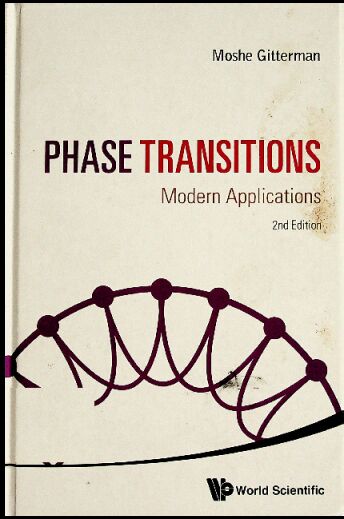
书名:Phase transitions
责任者:Moshe Gitterman | Bar IIan University | Israel.
出版时间:2014
出版社:World Scientific,
前言
This book provides a comprehensive review of the theory of phase transitions and its modern applications, based on the five pillars of the modern theory of phase transitions: the Ising model, mean field, scaling, renormalization group and universality. This expanded second edition includes, along with a description of vortices and high temperature superconductivity, a discussion of phase transitions in chemical reactions and moving systems. The book covers the close connection between phase transitions and small world phenomena as well as scale-free systems such as the stock market and the Internet.
查看更多
目录
Preface to the Second Edition v
Preface to the First Edition vii
1. Phases and Phase Transitions 1
2. Thermodynamics of Phase Transitions 7
2.1 Classification of Phase Transitions 7
2.2 Appearance of a Second Order Phase Transition 9
2.3 Critical Phenomena 11
2.4 Correlations 15
2.5 Speed of Equilibration Near the Gas–Liquid Critical Point 17
2.6 The Mechanism of Slowing Down Near the Critical Points 19
2.7 Conclusion 20
3. The Ising Model 23
3.1 Phase TransitionsinIsing Model 26
3.2 1DIsingModel 27
3.3 2DIsingModel 29
3.4 3DIsingModel 33
3.5 Conclusion 3
4. Mean Field Theory 37
4.1 Landau Mean Field Theory 38
4.2 First Order Phase Transitions in Landau Theory 41
4.3 Landau Theory Supplemented with Fluctuations 42
4.4 Correlation Radius and Penetration Length 44
4.5 CriticalIndices 47
4.6 GinzburgCriterion 47
4.7 Wilson’s -Expansion 48
4.8 Conclusion 51
5. Scaling 53
5.1 Relations Between Thermodynamic Critical Indices 55
5.2 Scaling Relations 57
5.3 Dynamic Scaling 61
5.4 Conclusion 63
6. The Renormalization Group 65
6.1 Fixed Points of a Map 65
6.2 Basic Idea of the Renormalization Group 67
6.3 RG:1DIsingModel 69
6.4 RG: 2D Ising Model for the Square Lattice (1) 70
6.5 RG: 2D Ising Model for the Square Lattice (2) 73
6.6 Conclusion 77
7. Phase Transitions in Quantum Systems 79
7.1 Symmetry of the Wave Function 79
7.2 Exchange Interactions of Fermions 81
7.3 Quantum Statistical Physics 83
7.4 Superfluidity 87
7.5 Bose–Einstein Condensation of Atoms 88
7.6 Superconductivity 89
7.7 Tunneling Supercurrent: Josephson Effect 94
7.7.1 dc Josephson effect 95
7.7.2 ac Josephson effect 96
7.8 High Temperature Superconductors 97
7.9 Conclusion 99
8. Universality 101
8.1 Heisenberg Ferromagnet and Related Models 101
8.2 Many-SpinInteractions 105
8.3 Gaussian and Spherical Models 109
8.4 The x–y Model 112
8.5 Vortices 115
8.6 Interactions Between Vortices 117
8.7 Vortices in Superfluids and Superconductors 119
8.8 Conclusion 119
9. Phase Transitions in Reactive Systems 121
9.1 Multiple Solutions of the Law of Mass Action 121
9.2 Phase Separation in Reactive Binary Mixtures 123
9.3 Thermodynamic Analysis of Reactive Ternary Mixtures 127
9.4 KineticsofPhaseSeparation 131
9.5 Change of Critical Parameters Due to a Chemical Reaction 138
9.6 ModificationoftheCriticalIndices 140
9.7 Conclusion 146
10. Phase Transitions in Moving Systems 149
10.1 Solution of the Linearized Equation with Constant Velocity 151
10.2 Stability Conditions for Spatially Dependent Periodic Damping 152
10.3 Stability Conditions for Space-Dependent Random Velocity 153
10.4 Stability Conditions for Time-Dependent Random Velocity 155
10.5 Stability Conditions for Time-Periodic Damping 156
10.6 Stability Conditions for a Sample of Finite Size 156
10.7 Stability of Nonlinear Convective Ginzburg–Landau Equation 157
10.8Conclusion 158
11. Random and Small World Systems 161
11.1Percolation .161
11.2 Ising Model with Random Interactions 163
11.3SpinGlasses 165
11.4SmallWorldSystems .167
11.5EvolvingGraphs 171
11.6 Phase Transitions in Small World Systems 172
11.7Conclusion 174
12. Self-Organized Criticality 175
12.1Power-LawDistributions 177
12.2SandPiles 179
12.3DistributionofLinksinNetworks .180
12.4DynamicsofNetworks 182
12.5MeanFieldAnalysisofNetworks .186
12.6HubsinScale-FreeNetworks 188
12.7Conclusion 190
Bibliography 191
Index 197
查看更多
馆藏单位
中科院文献情报中心