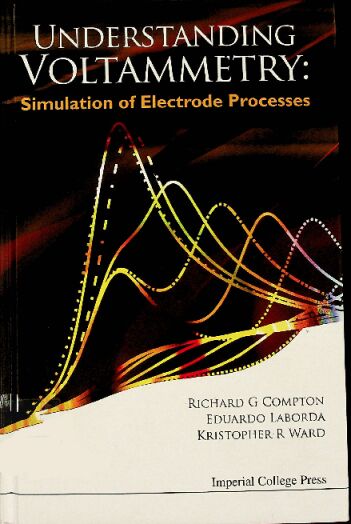
书名:Understanding voltammetry
责任者:Richard G. Compton | Oxford University | UK ; Eduardo Laborda | Oxford University | UK & University of Murcia | Spain ; Kristopher R. Ward | Oxford University | UK.
出版时间:2014
出版社:Imperial College Press,
前言
This book is aimed at students, researchers and professors in the broad area of electrochemistry who wish to simulate electrochemical processes in general,and voltammetry in particular. It has been written as a result of numerous requests over recent years for assistance in getting started on such activity and aims to lead the novice reader who has some prior experience of experimental electrochemistry at least, from a state of zero knowledge to being realistically able to embark on using simulation to explore non- standard experiments using cyclic voltammetry, microdisc electrodes and hydrodynamic electrodes such as rotating discs.
The book complements the texts Understanding Voltammetry(2nd edition,Imperial College Press,2011,written with C.E. Banks)and Understanding Voltammetry:Problems and Solutions(Imperial College Press,2012,with C.Batchelor-McAuley and E.J.F.Dickinson).
We wish the reader many happy hours of simulation and hope that this is fully repaid by the impact on their experimental research.RGC, EL,KRW, July 2013
查看更多
目录
Preface V
1.Introduction 1
1.1 Electrochemical Systems 2
1.2 Voltammetric Techniques 19
1.3 Finite Difference Methods 20
1.4 Voltammetry: A Selected Bibliography 22
References 23
2. Mathematical Model of an Electrochemical System 25
2.1 Cyclic Voltammetry 25
2.2 Diffusion: Fick's Second Law 28
2.3 Boundary Conditions 32
2.4 Current 34
2.5 Dimensionless Coordinates 35
2.6 Summary 44
References 43
3. Numerical Solution of the Model System 45
3.1 Finite Differences 45
3.2 Time Evolution: Discretising Fick's Second Law 50
3.3 The Thomas Algorithm 54
3.4 Simulation Procedure 57
3.5 Checking Results 61
3.6 Performance and Runtime Analysis 66
References 69
4. Diffusion-Only Electrochemical Problems in One-Dimensional Systems 71
4.1 Unequally Spaced Grids 71
4.2 Finite Electrode Kinetics 81
4.3 Unequal Diffusion Coefficients 87
4.4 Other One-Dimensional Electrode Geometries 90
References 96
5. First-Order Chemical Kinetic Mechanisms 99
5.1 First-Order ECireMechanism: Basic Concepts 99
5.2 First-Order Catalytic Mechanism: Coupled Equation Systems 107
5.3 LU Decomposition and Extended Thomas Algorithm 112
5.4 First-Order ECrey Mechanism: Including a Third Species 114
5.5 Multiple-Electron Transfer Processes 116
5.6 Heterogeneous Chemical Processes 119
References 121
6. Second-Order Chemical Kinetic Mechanisms 123
6.1 Second-Order Catalytic Mechanism:The Newton-Raphson Method 123
6.2 Multiple-Electron Transfers: Adaptive Spatial Grids 131
6.3 Adsorption 136
References 143
7.Electrochemical Simulation in Weakly Supported Media 145
7.1 The Nernst-Planck-Poisson Problem 146
7.2 Weakly Supported Cyclic Voltammetry and Chronoamperometry 153
References 158
8. Hydrodynamic Voltammetry 161
8.1 Rotating Disc Electrode 163
8.2 Channel Electrode169
References 174
9.Two-Dimensional Systems: Microdisc Electrodes 175
9.1Microdisc Electrodes: The Mode 175
9.2 Numerical Solution 181
9.3 Implementation 191
9.4 Microband Electrodes 194
References 198
10. Heterogeneous Surfaces 201
10.1 Arrays of Microdisc Electrodes 202
10.2 Microband Arrays 216
10.3 Porous Electrodes 222
10.4 Conclusion 225
References 225
Appendix A: Review of C++ 229
A.1 Hello World 229
A.2 Variables,Types and Operators 231
A.3 Logic and Program Control 234
A.4 Functions 236
References 238
Appendix B: Microdisc Program 239
References 246
Index 247
查看PDF
查看更多
馆藏单位
中科院文献情报中心