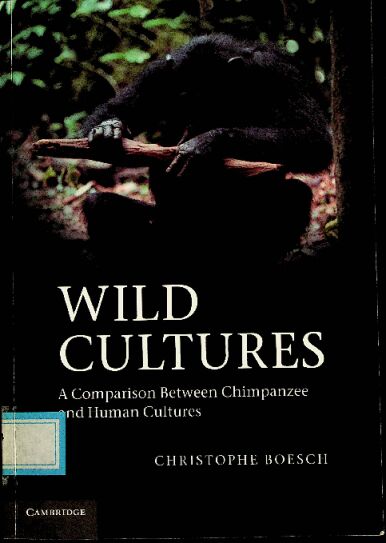
书名:Wild cultures
ISBN\ISSN:9781107689152,9781107025370,1107025370
出版时间:2012
出版社:Cambridge University Press,
摘要
How do chimpanzees say, 'I want to have sex with you?' By clipping a leaf or knocking on a tree trunk? How do they eat live aggressive ants? By using a short stick with one hand or long stick with both? Ivorian and Tanzanian chimpanzees answer these questions differently, as would humans from France and China if asked how they eat rice. Christophe Boesch takes readers into the lives of chimpanzees from different African regions, highlighting the debate about culture. His ethnography reveals how simple techniques have evolved into complex ones, how teaching styles differ, how material culture widens access to new food sources and how youngsters learn culture. This journey reveals many parallels between humans and chimpanzees and points to striking differences. Written in a vivid and accessible style, Wild Cultures places the reader in social and ecological contexts that shed light on our twin cultures.
查看更多
目录
Acknowledgments pagex
Introduction 1
And the culture war started ... 3
Chimpanzee ethnography to uncover culture 4
Cul tural biases and scientific progress 5
1. Studying culture in the wild 9
To study animals, all you need is love 12
First steps towards chimpanzee cul ture 14
About animals, ignorance, and anthropocentrism 16
Time to realize that Descartes got it wrong 19
Synopsis 21
2. From human culture to wild culture 22
Culture and ecology in humans 27
D ifferent approaches to culture 28
Animal ethnography to expose animal cultures 30
Imo, the cul tural innovator 32
Social transmission of cultural traits 33
The paradox of studying "culture outside of cul ture" 39
Animal cultures to learn about human cultures 45
Synopsis 46
3. Shaping nature into home: about material culture 47
Tool makers in evolution 52
Material culture shapes one's own world 53
Technology boosts chimpanzee cultural ethnography 56
Cumulative cultural evolution in chimpanzees 66
When culture and environment mix 72
Material culture in other species 74
History of material culture: chimpanzee Stone Age 76
Contribution to the cultural debate 78
Synopsis 80
4. One for all and all for one: about social culture 81
Hunting cultures in chimpanzees 86
Cooperation: acting at the same time or acting together? 91
Cooperation in high-risk situations 96
Cultural altruism in chimpanzees 100
Social niche construction in animals 102
Contribution to the cultural debate 104
Synopsis 107
5. I want to have sex with you: about symbolic culture 108
Arbitrary social conventions in chimpanzees 112
Innovation and transmission of inventions 118
Social transmission of symbolic cultural traits 122
Symbolic culture and social conventions in other animal species 123
Contribution to the culture debate 124
Synopsis 127
6. Leaming culture: from pupils to teachers 128
Cultural acquisition in the natural world 131
Mothers as the main culture vehicle 136
Teaching styles differ across chimpanzee and human cultures 142
Leaming one's own social culture 149
Contribution to the culture debate 153
Synopsis 154
7. Dead or alive? Towards a notion of death and empathy 155
Understanding of death in humans and other animals 160
Mourning and compassion around death in chimpanzees 162
About empathy and compassion 165
The origin of a notion of death 172
Contribution to the culture debate 174
Synopsis 175
8. Wiid culture - wild Intelligence: cognition and culture 176
Culture-driven cognition 183
Cognition and culture in humans 186
Cultural cognition in the laboratory versus in the real world 192
Cultural cognition in nature 200
Culture and cognition in chimpanzees 202
Contribution to the culture debate 212
Synopsis 214
9.Uniquely chimpanzee - uniquely human 215
Cultural diversity in humans and chimpanzees 219
Cultural transmission mechanisms in chimpanzees and humans 225
Uniquely chimpanzee culture 228
Uniquely human culture 232
Ethnography of culture 237
Synopsis 238
Epilogue: Will we have the time to study chimpanzee culture? 239
References 243
Index 267
查看PDF
查看更多
馆藏单位
中科院文献情报中心