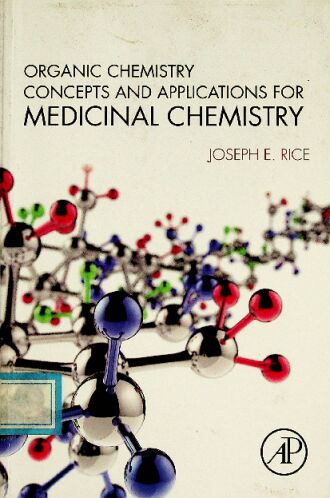
书名:Organic chemistry concepts and applications for medicinal chemistry
ISBN\ISSN:9780128007396,0128007397
出版时间:2014
出版社:Academic Press, an imprint of Elsevier,
摘要
Organic Chemistry Concepts and Applications for Medicinal Chemistry provides a valuable refresher for understanding the relationship between chemical bonding and those molecular properties that help to determine medicinal activity. This book explores the basic aspects of structural organic chemistry without going into the various classes of reactions. Two medicinal chemistry concepts are also introduced: partition coefficients and the nomenclature of cyclic and polycyclic ring systems that comprise a large number of drug molecules. Given the systematic name of a drug, the reader is guided through the process of drawing an accurate chemical structure. By emphasizing the relationship between structure and properties, this book gives readers the connections to more fully comprehend, retain, apply, and build upon their organic chemistry background in further chemistry study, practice, and exams.
查看更多
前言
Medicinal chemistry is a discipline that is focused on the relationship between chemical structure and biological activity. This relationship serves as the basis for the design and synthesis of new drug entities. Knowledge of medicinal chemistry is therefore of utmost importance to students in pharmacy programs, to medical and nursing students, and to chemists involved in the drug design process.
Pharmacy students at Rutgers take organic chemistry as sophomores but are not taught medicinal chemistry until their fourth year. Shortly after I started teaching medicinal chemistry I noticed that many students had difficulty recalling some of the important concepts from two years prior. To address that need I wrote an extended handout to serve as a review. Over the years that handout has been revised and amended numerous times. This book grew out of those efforts.
The first four chapters provide a review of important concepts first introduced in organic chemistry. Among the topics covered are chemical bonding, stereochemistry and conformation, functional groups and acid–base chemistry. It is essential that the students thoroughly understand these principles so as to be able to fully grasp the subtle relationship between chemical structure and pharmaceutical activity that is at the core of medicinal chemistry. Reaction mechanisms and chemical transformations, while certainly of great importance to those involved in the synthesis of new drug entities, are not discussed in this book.
Chapter five introduces the student to partition coefficients, a subject not likely covered in undergraduate organic chemistry courses. The ease with which a drug passes from one compartment of the body to another is related to its partition coefficient. Like every other property, partition coefficients depend on structure with each portion of a molecule contributing to its overall hydrophobicity or hydrophilicity.
An integral part of medicinal chemistry education at Rutgers is training students to draw the correct structure of a drug when presented with its systematic name. The sixth chapter of this book is therefore concerned with nomenclature. While the naming of simple compounds such as alkanes, alkenes, alkynes, alcohols, amines, and carbonyl derivatives is introduced in almost all organic chemistry courses, the systematic nomenclature of heterocyclic compounds and complex polycyclic ring systems is generally not covered. Chapter six begins with a discussion of relatively simple heterocyclic ring systems and then progresses to more complex compounds that involve fused, bridged, and spiro polycyclic compounds. Such ring systems form the basis of a majority of drug structures. A series of rules for numbering these ring systems is described. Methods are also described for specifying the attachment of highly complex substituents onto parent compounds. The last section of this chapter focuses on the special nomenclature and numbering of a few natural product classes of medicinal interest including steroids, prostaglandins, and morphinans.
The chemistry of drug metabolism is reviewed in the final chapter of this book. Most foreign chemicals become transformed once they enter the body. In this process, which is known as metabolism, some existing functional groups on compounds undergo chemical changes while in other instances new functionality is added. Most commonly this is done to aid in the removal of the foreign substance from the body. The reader will learn to associate a variety of structural features of drug molecules with likely metabolic pathways and will become familiar with the chemical processes that are involved in the formation of specific metabolites.
查看更多
目录
Preface ix
1. Bonding in Organic Compounds 1
Atomic Orbitals 1
Hybrid Orbitals 4
Resonance 16
Aromaticity 19
Reference 26
2. The Three-Dimensional Structure of Organic Compounds 27
Isomers 27
Stereoisomerism at Saturated Centers 28
Prochirality 38
Stereoisomerism at Unsaturated Centers 39
Conformations 43
Reference 49
3. Functional Groups 51
Common Functional Groups 51
The Electronic Effects of Functional Groups 55
References 65
4. Acids and Bases 67
Bronsted-Lowry Acids and Bases 67
Ionization 71
Estimating Acid/Base Strength 74
Lewis Acids and Bases 82
5. Partition Coefficients 85
What is a Partition Coefficient? 85
Effect of Structure on Partition Coefficients 87
Reference 92
6. The Nomenclature of Cyclic and Polycyclic Compounds 93
Common Heterocycles 93
Fused-Ring Systems 101
Substituents and Saturation 111
Bridged Rings 122
Spiro Rings 128
Special Classes of Compounds 132
Steroids 132
Prostaglandins 139
Morphinans 140
7. Drug Metabolism 145
Phase I: Oxidative Processes 146
Phase I: Reductions 174
Phase I: Hydrolysis 183
Phase II: Conjugation 187
Miscellaneous Phase II Processes 198
Reference 201
Index 203
查看更多
馆藏单位
中科院文献情报中心