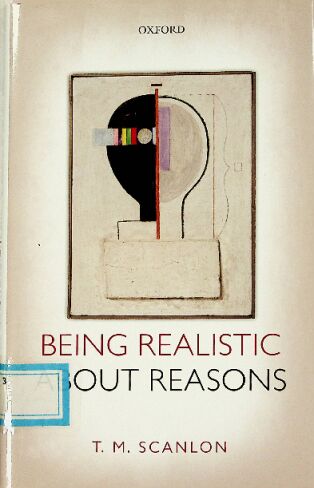
书名:Being realistic about reasons
责任者:T.M. Scanlon. | Scanlon, Thomas M.
ISBN\ISSN:9780199678488,0199678480
出版时间:2014
出版社:Oxford University Press,
前言
This book is a revised version of the John Locke Lectures that I presented in Oxford in the spring of 2oo9. I am very grateful to the Oxford Faculty of Philosophy for the invitation to give these lectures, which stimulated me to develop my ideas on the subject, and for many fruitful and enjoyable conversations with members of the Faculty while I was in Oxford. I benefitted particularly from conversations with Robert Adams, John Broome, Tom Hurka, Joseph Raz, Ralph Wedgwood, and Tim Williamson.
Since 2009, Lectures 2 and 4 have been heavily revised and extended, and Lecture 5 substantially rewritten. While I have been working on these lectures, a number of very substantial new books have appeared defending positions similar to mine (in particular, similar to, although in some cases subtly different from, the position I take on realism and ontology in Lecture 2.) These include David Enoch's Taking Morality Seriously, John Skorupski's The Domain of Reasons, Ronald Dworkin's Justice for Hedgehogs, and Derek Parfit's On What Matters. I have been encouraged by this convergence of opinions, and have tried to take these works into account as best I can. My connection with Parfit's work is particularly close. We have discussed our work in joint semi-nars on normative realism, and he has given me extensive comments on drafts of these lectures, resulting in significant improvement. As always, I am greatly in his debt.
As I have worked to refine and develop the views on ontology pre-sented in Lecture 2, I have been increasingly struck by similarities of my view to earlier writings by others, including Thomas Nagel, Crispin Wright, Hilary Putnam, and W.W.Tait. Although differences remain in each case, I have learned a great deal from their work and have been encouraged by the thought that, if not in complete agreement with them, I am at least heading in the right direction.
These lectures formed the basis of my Pufendorf Lectures at the University of Lund in 2010, and my Kant Lectures at Stanford in 2012. An early version of Lecture i was presented as the Royal Institute of Philosophy Lecture, and versions of other lectures have been presented as talks at a number of universities. I am grateful to members of these audiences for their comments and questions.
I am particularly grateful to my colleagues, Selim Berker, Peter Koellner, Charles Parsons, and Hilary Putnam for many very helpful and encouraging conversations, and for their extensive written com-ments on various drafts. Many others have generously sent me written comments or made helpful suggestions, including at least Paul Boghos-sian, Anthony Brueckner, Tyler Burge, Roger Crisp, Matti Eklund, David Enoch, Solomon Feferman, Kit Fine, Richard Kraut, Thomas Nagel, Wlodek Rabinowicz, Michael Ridge, Simon Rippon, Michael Smith, and John Skorupski.
My thanks also to Adam Kern for research assistance, and to Lucy Scanlon for helping with the selection of cover art and in many other ways.
Some of the questions dealt with in these lectures have occupied me for a long time. I have been trying to decide what to think about Carnap's views on ontology ever since writing my senior thesis on mathematical platonism under Paul Benacerraf's supervision in 1962. It was that experience that drew me into philosophy, and I never would have taken it up as a profession were it not for Paul's encouragement and guidance.Without Paul neither this book nor anything else I have done in philosophy would have been written.
查看更多
目录
Lecture 1: Introduction: Reasons Fundamentalism 1
Lecture 2: Metaphysical Objections 16
Lecture 3: Motivation and the Appeal of Expressivism 53
Lecture 4: Epistemology and Determinateness 69
Lecture 5: Reasons and their Strength 105
Bibliography 124
Index 129
查看PDF
查看更多
作者简介
T. M. Scanlon received a BA from Princeton in 1962 and a PhD from Harvard in 1968, in between studying for a year at Brasenose College, Oxford. He taught at Princeton from 1966 until 1984, and at Harvard since that time. Scanlon is the author of many articles in moral and political philosophy, and of three books: What We Owe to Each Other (Harvard University Press, 1998), The Difficulty of Tolerance: Essays in Political Philosophy (CUP, 2003), and Moral Dimensions: Permissibility, Meaning, Blame (Harvard University Press, 2008).
查看更多
馆藏单位
中科院文献情报中心