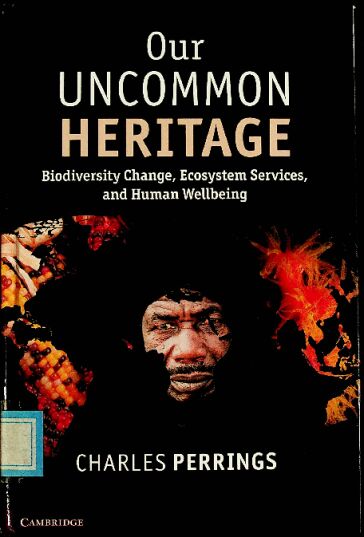
书名:Our uncommon heritage
ISBN\ISSN:9781107043732,1107043735
出版时间:2014
出版社:Cambridge University Press,
摘要
Biodiversity change is the biggest environmental problem of our time. It leads to much more than species extinctions, affecting the food we eat, the diseases we face, our vulnerability to fire and flood, and our ability to adapt to climate change. Our Uncommon Heritage explores the many dimensions of human-driven biodiversity change. It integrates ecology, economics and policy to examine the causes and consequences of changes in ecosystems, species and genes, and to identify better ways to manage those changes. It explores the place of biodiversity in the wealth of nations, the rights and responsibilities people have for natural resources at local, regional, national and international levels, and the challenges faced in protecting the common good at the global level. This is an important book for students and researchers in the fields of conservation and sustainability science, ecology, natural resource economics and management. It also has much to say to those engaged in international conservation, health, agriculture, forestry and fisheries policy.
查看更多
目录
List of figures page xi
List of tables xiv
Foreword by Partha Dasgupta and Georgina Mace xvii
Preface xxvii
List of acronyms xxxvii
1 Biodiversity change 1
1.1 Biodiversity 1
1.2 The Holocene extinction 8
1.3 The challenge for biodiversity science 12
1.4 Science and policy at the crossroads 19
1.5 The challenge for conservation 22
1.6 A roadmap 23
Part I Diagnosing the biodiversity change problem 37
2 Biodiversity in the modern world 39
2.1 Widening horizons 39
2.2 Agriculture and biodiversity 40
2.3 Biodiversity and disease 52
2.4 Wildlife conservation 59
2.5 Finding the balance 68
3 Biodiversity and ecosystem services 78
3.1 Biodiversity, ecosystem services, and the market 78
3.2 Origins of ecosystem services 80
3.3 Ecosystem services in the Millennium Ecosystem Assessment 84
3.4 Ecosystem services and biodiversity 92
3.5 Changing environmental conditions: a digression on climate 95
3.6 The valuation of ecosystem services 98
3.7 Scratching the surface 109
4 Biodiversity loss, sustainability, and stability 119
4.1 Sustainability and stability 119
4.2 Measures and models of biodiversity 122
4.3 The portfolio effect 126
4.4 The portfolio effect and sustainability 132
4.5 The biodiversity portfolio 139
5 Biodiversity externalities and public goods 148
5.1 Market failures and biodiversity externalities 148
5.2 Identifying the social cost of externalities and public goods 151
5.3 Biodiversity as a "layered" public good 157
5.4 Strategic behavior and the provision of international environmental public goods 163
5.5 Biodiversity-related international public goods 171
5.6 Externalities and public goods in context 177
6 Poverty alleviation and biodiversity change 184
6.1 Stating the problem 184
6.2 Poverty and environmental change 186
6.3 Modeling the relation between income growth and biodiversity change 191
6.4 Biodiversity and poverty alleviation 198
6.5 Conclusions 206
7 Globalization: trade, aid, and the dispersal of species 214
7.1 Globalization and biodiversity 214
7.2 Globalization and the cost of biological invasions 218
7.3 The invasive species risks of trade 227
7.4 The regulation of trade-related biological invasions 231
7.5 System-level effects of species dispersal 234
7.6 Conclusions 238
PartⅡ The search for solutions 249
8 Getting the prognosis right 251
8.1 Understanding the "anthropogenic" in anthropogenic biodiversity change 251
8.2 Biodiversity scenarios 254
8.3 Current prognoses 262
8.4 The International Science-Policy Platform on Biodiversity and Ecosystem Services 264
8.5 Social indicators of biodiversity change 269
8.6 Biodiversity change and social wellbeing 273
9 Understanding what is lost 280
9.1 Indicators of the importance of biodiversity change for human wellbeing 280
9.2 The value of environmental assets 282
9.3 Adjusted net savings and wealth estimates 287
9.4 Assets in the system of national accounts 294
9.5 Satellite accounts and the capital accounts in the system of national accounts 296
9.6 Towards the construction of inclusive wealth accounts 301
10 Managing risk, uncertainty, and irreversibility in biodiversity change 309
10.1 The unknowns in the problem of biodiversity change 309
10.2 Decision-making under risk 313
10.3 Decision-making under uncertainty 316
10.4 The precautionary principle and decision-making under uncertainty 321
10.5 Learning 325
10.6 Decision-making under uncertainty and biodiversity change 328
11 Conservation incentives and payments for ecosystem services 337
11.1 Externalities and public goods revisited 337
11.2 Internalizing biodiversity externalities 340
11.3 Markets for habitat conservation 344
11.4 Designing payments for ecosystem services 357
11.5 The incentive effects of international payments for ecosystem services 362
12 Paying for international environmental public goods 370
12.1 International environmental public goods 370
12.2 The Global Environment Facility 373
12.3 The national provision of biodiversity-related international public goods 381
12.4 The private provision of international environmental public goods 386
12.5 Coordination 391
13 Strengthening the biodiversity-related multilateral agreements 398
13.1 Identifying the biodiversity-related multilateral agreements 398
13.2 The Convention on Biological Diversity's Aichi targets 402
13.3 Negotiating the relationship between trade and biodiversity change 408
13.4 The problem of resources beyond national jurisdiction 416
13.5 The problem of scale revisited 428
14 Genetic resources and the poor 436
14.1 Biodiversity loss and poverty revisited 436
14.2 Rights to the genetic resources of wild-living species 442
14.3 Rights to the genetic resources in domesticated species 446
14.4 Rights, and the conservation of genetic resources in poor regions 452
14.5 Private affluence, public poverty 457
15 Redirecting biodiversity change 464
15.1 Assembling the pieces of the problem 464
15.2 Refocusing conservation 466
15.3 Knowing what is happening 468
15.4 Enhancing the efficiency of biodiversity markets 471
15.5 Reducing the biodiversity costs of poverty alleviation 475
15.6 The abrogation of common heritage rights 479
15.7 The uncommon heritage of humankind 481
Index 491
查看更多
馆藏单位
中科院文献情报中心