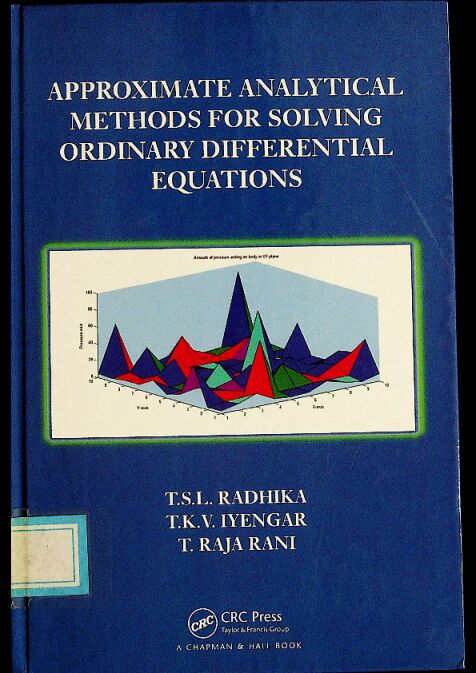
书名:Approximate analytical mathods for solving ordinary differential equations
责任者:T.S.L. Radhika | T.K.V. Iyengar | and T. Raja Rani. | Rani, T. Raja,
出版时间:2015
出版社:C RC Press/Taylor & Francis,
前言
It is needless to say that differential equations play an important role in modeling many physical, engineering, technological, and biological processes. The differential equations in these diverse contexts may not be directly solvable by the usual elementary methods and hence in general do not have exact or closed-form solutions. In all such cases, researchers have tried to obtain either analytical approximate solutions or numerical approximate solutions. With the available high-speed computers and excellent computational algorithms, considerable advancement has been made in obtaining good numerical solutions. However, there have been trials to obtain approximate analytical solutions, and several approximate analytical methods have been developed to cater to the needs that have arisen and with a view to obtain "better-and-better" solutions. The methods range from the classical series solution method to the diverse perturbation methods and from the pioneering asymptotic methods to the recent ingenious homotopy methods.
This book aims to present some important approximate methods for solving ordinary differential equations and provides a number of illustrations. While teaching some related courses, we felt the need for a book of this type because there is no single book with all the available approximate methods for solving ordinary differential equations. At present, a student or a researcher interested in understanding the state of the art has to wade through several books and research articles to grasp the diverse methods. This book covers both the well-established techniques and the recently developed procedures along with detailed examples elucidating the applications of these methods to solve related real-world problems. It aims to give a complete description of the methods considered and discusses them through illustrative examples without going into several of the rigorous mathematical aspects.
Chapter 1 is introductory. We explain briefly the methods chosen for discussion in the present work.
Chapter 2 introduces the classical method of solving differential equations through the power series method. In fact, this method has been the basis for the introduction and the development of various special functions found in the literature. We explain and illustrate the method with a number of examples and proceed to describe the Taylor series method.
Chapter 3 deals with the asymptotic methods, which can be used to find asymptotic solutions to the differential equations that are valid for large values of the independent variable and in other cases as well.
The introduction of perturbation methods, which constitutes one of the top ten progresses of theoretical and applied mechanics of the 20th century, is the focus of Chapter 4. Attention is drawn to some research articles in which the perturbation methods are used successfully in understanding some physical phenomena whose mathematical formulation involves a so-called perturbation parameter.
Chapter 5 focuses on a special asymptotic technique called the multiple-scale technique for solving the problems whose solution cannot be completely described on a single timescale.
Chapter 6 describes an important asymptotic method called the WKB (for its developers, Wentzel, Kramers, and Brillown) method that helps construct solutions to problems that oscillate rapidly and problems for which there is a sudden change in the behavior of the solution function at a point in the interval of interest.
Chapter 7 deals with some nonperturbation methods, such as the Adomian decomposition method, delta expansion method, and others, that were developed during the last two decades and can provide solutions to a much wider class of problems.
Chapter 8 presents the most recent analytical methods developed, which are based on the concept of homotopy of topology and were initiated by Liao. The methods are the homotopy analysis method, homotopy perturbation method, and optimal homotopy asymptotic method.
Our principal aim is to present and explain the methods with emphasis on problem solving. Many illustrations are presented in each chapter.
The content of this book was drawn from diverse sources, which are cited in each chapter. Further, attention is drawn to some research articles that discuss use of the methods. We are grateful to the authors of all the works cited.
We believe this book will serve as a handbook not only for mathematicians and engineers but also for biologists, physicists, and economists. The book presupposes knowledge of advanced calculus and an elementary course on differential equations.
Acknowledgments The authors wish to convey their sincere gratitude to their respective institutions, BITS PILANI-Hyderabad campus, India; NIT, Warangal, India; and Military Technological College, Muscat, Oman for providing resources and support while developing this book. They are indebted to their colleagues for their interest and constant encouragement.
The authors are grateful to their family members for their unflinching support and endurance without which this book would not have been possible.
T Raja Rani wishes to place on record her sincere thanks to Prof CNB Rao for his mentorship and guidance while writing this book.
查看更多
目录
PREFACE ix
CHAPTER 1 INTRODUCTION 1
CHAPTER 2 POWER SERIES METHOD 7
Introduction 7
Algebraic Method (Method of Undetermined Coefficients) 10
Introduction and Some Important Definitions 10
Solution at Ordinary Point of an Ordinary Differential Equation 13
Method for First-Order Equations 13
Solution at a Singular Point (Regular) of an Ordinary Differential Equation 23
Frobenius Series Method 25
Remarks on the Frobenius Solution at Irregular Singular Points 35
Taylor Series Method 36
Exercise Problems 44
Applications 46
Bibliography 47
CHAPTER 3 ASYMPTOTIC METHOD 49
Introduction 49
Asymptotic Solutions at Irregular Singular Points at Infinity 50
Method of Finding Solutions at Irregular Points 51
Asymptotic Method for Constructing Solutions that Are Valid for Large Values of the Independent Variable 54 C2\Asymptotic Solutions of Perturbed Problems 56
Solutions to ODEs Containing a Large Parameter 60
Exercise Problems 62
Applications 63
Bibliography 63
CHAPTER 4 PERTURBATION TECHNIQUES
Introduction 65
Basic Idea behind the Perturbation Method 65
Regular Perturbation Theory 67
Singular Perturbation Theory 72
Boundary-Layer Method 74
Exercise Problems 85
Applications 86
Bibliography 87
CHAPTER 5 METHOD OF MULTIPLE SCALES 89
Introduction 89
Method of Multiple Scales 90
Exercise Problems 98
Applications 98
Bibliography 99
CHAPTER 6 WKB THEORY 101
Introduction 101
WKB Approximation for Unperturbed Problems 102
WKB Approximation for Perturbed Problems 105
Some Special Features of Solutions Near the Boundary Layer 105
Formal WKB Expansion 106
Exercise Problems 125
Applications 126
Bibliography 126
CHAPTER 7 NONPERTURBATION METHODS 127
Introduction 127
Lyapunov's Artificial Small-Parameter Method 128
Delta(δ) Expansion Method 135
Adomian Decomposition Method 137
Introduction 137
Adomian Decomposition Method 137
Solving Riccati's Equation Using the Adomian Decomposition Method 142
Generalization of the Adomian Decomposition Method for Higher-Order Equations 145
Modified Adomian Decomposition Method for Singular IVP Problems for ODEs 148
Exercise Problems 151
Applications 153
Bibliography 153
CHAPTER 8 HOMOTOPY METHODS 155
Introduction 155
Homotopy Analysis Method 155
Method 156
Rules for the Selection of the Different Functions and the Parameters Described in the Definition Given by Equation (8.3) 158
Homotopy Perturbation Method 166
Optimal Homotopy Analysis Method 169
Optimal Homotopy Asymptotic Method 170
Exercise Problems 176
Applications 176
Bibliography 178
INDEX 181
查看更多
馆藏单位
中科院文献情报中心