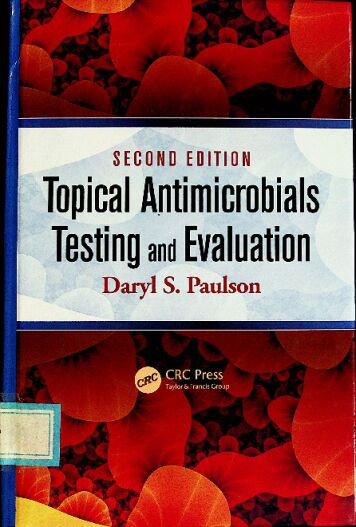
书名:Topical antimicrobials testing and evaluation
责任者:Daryl S. Paulson | Biosciences Laboratories | Inc. | Bozeman | Montana | USA.
分类号:医药、卫生
版次:second edition.
摘要
A range of factors must be considered when developing a topical antimicrobial for use in a healthcare personnel handwash, surgical scrub, or preoperative skin preparation. Antimicrobial effectiveness, low skin irritation, ease of use, and pleasing aesthetics are all essential if the product is to succeed. In addition, all facets of the product must comply with stringent regulatory requirements. With updated protocols and research, Topical Antimicrobials Testing and Evaluation, Second Edition comprehensively presents and reviews the latest techniques for testing antimicrobial compounds for effectiveness and regulatory compliance.
查看更多
目录
Preface xi
Acknowledgment s xiii
About the Author xv
Chapter 1 General Approach to Developing Topical A ntimicrobials l
I. Business 1
II. Quality Assurance 4
A. Inspection of the Laboratory/Per sonnel Performing the Work 5
III. Moving Quality Control Outward 5
A. During the Study: Control 8
B. The Fishbone Checklist (Cause and Effect) 8
C. Quality Improvement: After the Study Has Been Completed 9
IV. A Tighter Approach to Delivering a Useful Product 9
V. The Quadrant Model 9
A. Social Requirements 9
B. Cultural Requirements 11
C. Science 11
D. Psychology 12
VI. A Recurring Problem: Reductionism 12
A. Product Categories 13
1. Preoperative Skin-Prepping Formulations 13
2. Surgical Scrub Formul ations and Hand Antiseptics 15
3. Healthcare Personnel Handwash Formulations and Hand Antiseptics 17
4. Food-Handler Handwash Formulations and Hand Sanitizers 18
5. Antimicrobial Handwash and Bodywash Formulations 21
VII Conclusion 22
Chapter 2 Skin Properties 23
I. Structure 23
Il. Epidermis 25
III. Dermis 27
IV. Dermal Vascularization 28
A. Subcutaneous Tissue 29
B. Hairs 29
C. Sebaceous Glands 29
D. Sweat Glands 30
V. The Tissue Fluids 30
Chapter 3 Skin Microbiology 31
I. Etiology of Infectious Diseases 31
A. Encounter and Entry 31
B. Spread 32
C. Multiplication 33
D. Immune System 33
1. Microbial Nutrition 34
2. Physical Factors 35
3. Endogenous Microorgani sms of the Body 35
II. Bacterial Cell 36
A. Bacterial Cell Structures 37
1. Bacterial Size and Form 37
B. Cell Envelope 38
1.Capsules and Slime Layers 38
2. Constitution of Capsular Substances 39
3. Membrane Components 45
4. Bacterial Endospores 47
C. Biofilms 49
1. Biofilm Genesis 49
2. Perioperative Implications 53
3. Vascular Catheterization 53
4. Orthopedics 54
5. Endotracheal Tubes 54
D. Are Topical Antimicrobials Effective? 54
III. Mycology (Fungi) 55
A. Yeasts 55
B. Molds 55
C. Dimorphism 56
1. Cell Structure 56
2. Capsule 56
3. Cell Wall 57
Chapter 4 Specific M icroorganisms 59
I. Staphylococc us 59
ll. Streptococcus 59
A. Antigenic Structure 60
III. Other Microorganisms 60
A. Mycobacteria 60
B. Enterobacteriaceae 60
C. Escherichia coli 60
1. Surface Antigens 61
2. Enterotoxins 61
D. Klebsiella 61
E. Serratia 61
F. Proteus Bacterium 62
G. Salmonella 62
H. Shigella 62
1. Toxins 63
IV. Fungi 63
A. Dimorphism 63
B. Candida 63
C. Aspergillus 63
D. Histopl asma 63
1. Cytoplasmic Membrane 64
2. Cytopl asmic Content 64
V. Viruses 64
A. Complex Vi ruses 66
Chapter 5 Measurement of Anti microbial Action of Topical A ntimicrobials 67
I. Genera l Performance Characteristics 67
A. Description of tbe Study's Purpose 68
1. Exploratory Data Analysis 69
2. Standard Deviation 69
3. Proper Randomization 69
4. Control Product(s) 69
B. Description of the Experi mental Strategy 69
1. Statistical Conclusion Validity 70
2. Internal Validity 71
3. Construct Validity 72
4. External Validity 73
5. Is the Study Biased? 75
6. Hawthorne Effect 76
7. John Henry Effect 77
8. Pygmalion Effect 78
C. Microbiological Methodology 78
D. Statistical Methods Used to Evaluate the Study 79
E. New Product Development Applications 79
1. Marketing Concerns 81
2. Olher Considerations 82
II. Conclusion 83
Chapter 6 Current Topical Antimicrobia ls 85
I. Iodine Complexes 85
A. Range of Action 86
II. Chlorhexidine Gluconate 87
A. Antimicrobial Action 88
III. Tinctures of CHG and Alcohol 89
IV. Parachlorometaxylenol 89
V. Alcohols 90
VI. Triclosan 91
VIl. Quaternary Ammonium Compounds 91
Chapter 7 General Statistics 93
I. Sample Size Determination 93
Il. What 1ype of Analysis Should I Use to Ensure the Study Has Been Done Correctly? 98
A. Exploratory Data Analysis (EDA) 98
B. Covariance or Analysis of Variance Statistics: Which Is the Correct Way? 100
1. Studies to Replace a Component (Toweling, Wraps, etc.) 101
2. 95% Responder Rate 102
3. Computation 103
4. Once the Data Are Examined, What Shall I Do with Them? 106
Chapter 8 Specific Statistical Designs for Clinical Trials 109
I. Preoperative Skin Preparation 109
A. Statistical Model. 110
B. Analysis of Means 111
Chapter 9 Epistemological Requirements in Evaluating the Effects of Specific Treatments 115
I. Experimental Strategy 115
Il. Choice of Qualitative or Quantitative Methods . I15
III. Statistical Models 116
IV. Statistical Model-Building and Analysis: Exploratory Phae 118
V. Statistical Model Selection 119
VI. Parametric Statistics 120
A. ANOVA 121
VII. Nonparametric Statistics 121
VllI. Qualitative Research Designs 122
IX. Phenomenological Designs 123
X. Heuristic Designs 124
XI Historical Research Design 124
XII. Evaluative Research Design 125
XIII.Conclusion 125
Chapter 10 Evaluation Strategies and Sample Working Protocols 127
I. Consumer Antimicrobial Products 127
A. Evaluating Consumer Antimicrobial Handwash Product 127
B. Evaluative Confusion 128
C. Antim icrobial Hand Soaps and Disease Prevention 128
D. Functional Parameters of Effective Antimicrobial Soaps 129
II. Antim icrobial Efficacy Studies 129
A. Healthcare Personnel Handwash Evaluations 129
B. Modified Cade Handwash Procedure 131
C. General-Use Handwash Evaluation 131
D. Proposed Anti microbia l Hand Soap Evaluation 132
1. Test Material 132
2. Test Methods 133
3. Comments 135
4. Conclusion 136
III. Sample Protocol: Hea lthcare Personnel Handwash Evaluations 136
A. Modified Cade Handwash Evaluation 137
1. Purpoe 137
2. Scope 137
3. Test Material 137
4. Test Methods 137
IV. General-Use Handwash Evaluation 141
A. Eva luati ng Anti m icrobial Body Soaps/Lotions 141
1. Axilla Cup Scrub Method l4l
2. Full Body Shower Wash Evaluation 142
B. Sample Protocol : Single Applications of Two Bar Soap Test Products 142
1. Purpose 142
2. Scope 142
3. Test Material 143
4. Test Methods 143
C. Sample Protocol: Food-Handler Antimicrobial Handwash Evaluation 145
1. Purpose 145
2. Scope 145
3. Test Material 146
4. Test Methods 146
V. Medical/Healthcare Industry Antimicrobial 149
A. Sample Protocol: Healthcare Personnel Handwash 149
1. Purpose 149
2. Scope 149
3. Test Material 149
4. Test Methods 149
B. Sample Protocol: Su rgical Scrubs 153
1. Purpose 153
2. Scope 153
3. Test Materials 153
4. Test Methods 153
C. Sample Protocol :Preoperative Skin-Prepping Solutions 156
1. Purpose 156
2. Scope 156
3. Test Material 156
D. Sample Protocol: Indwelling Catheter/Preinjection Preparation 159
1. Purpose 159
2. Scope 159
3. Test Material 160
4. Test Sites 160
5. Test Methods 160
E. Sample Protocol: Full Body Presurgical Wash 165
1. Purpose 165
References 169
Index 175
查看更多
作者简介
Daryl S. Paulson, Ph.D., a decorated Vietnam combat veteran, counselor in trauma-associated disorders, and President/CEO of BioScience Laboratories, Inc., has advanced degrees in microbiology, statistics, counseling, human science, and psychology. He has authored numerous articles and 14 books, including Biostatistics and Microbiology: A Survival Manual (Springer, 2009), Applied Statistical Designs for the Researcher (Marcel Dekker, 2003), Handbook of Topical Antimicrobial Testing and Evaluation, Competitive Business, Caring Business: An Integral Perspective for the 21st Century (Paraview Press, 2002), and Haunted by Combat: Understanding PSTD in War Veterans (Greenwood Publishing, 2007). Address correspondence to Daryl S. Paulson, 1765 South 19th Avenue, Bozeman, Montana 59718, or dpaulson@biosciencelabs.com.
查看更多
馆藏单位
中科院文献情报中心