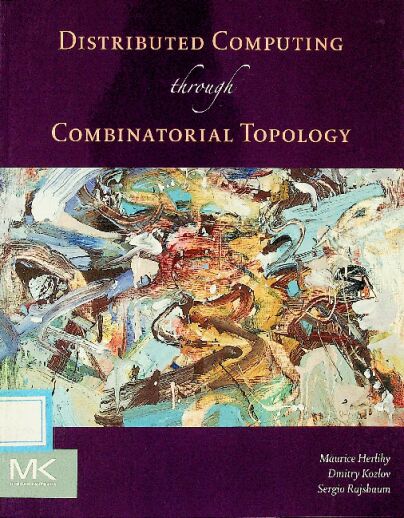
书名:Distributed computing through combinatorial topology
责任者:Maurice Herlihy | Dmitry Kozlov | Sergio Rajsbaum.
出版时间:2014
出版社:Morgan Kaufmann, is an imprint of Elsevier,
摘要
Distributed Computing Through Combinatorial Topology describes techniques for analyzing distributed algorithms based on award winning combinatorial topology research. The authors present a solid theoretical foundation relevant to many real systems reliant on parallelism with unpredictable delays, such as multicore microprocessors, wireless networks, distributed systems, and Internet protocols.
查看更多
前言
This book is intended to serve as a textbook for an undergraduate or graduate course in theoretical distributed computing or as a reference for researchers who are, or want to become, active in this area. Previously, the material covered here was scattered across a collection of conference and journal publications, often terse and using different notations and terminology. Here we have assembled a self-contained explanation of the mathematics for computer science readers and of the computer science for mathematics readers.
Each of these chapters includes exercises. We think it is essential for readers to spend time solv-ing these problems. Readers should have some familiarity with basic discrete mathematics, including induction, sets, graphs, and continuous maps. We have also included mathematical notes addressed to readers who want to explore the deeper mathematical structures behind this material.
The first three chapters cover the fundamentals of combinatorial topology and how it helps us under-stand distributed computing. Although the mathematical notions underlying our computational models are elementary, some notions of combinatorial topology, such as simplices, simplicial complexes, and levels of connectivity, may be unfamiliar to readers with a background in computer science. We explain these notions from first principles, starting in Chapter 1, where we provide an intuitive introduction to the new approach developed in the book. In Chapter 2 we describe the approach in more detail for the case of a system consisting of two processes only. Elementary graph theory, which is well-known to both computer scientists and mathematicians, is the only mathematics needed.
The graph theoretic notions of Chapter 2 are essentially one-dimensional simplicial complexes, and they provide a smooth introduction to Chapter 3, where most of the topological notions used in the book are presented. Though similar material can be found in many topology texts, our treatment here is different. In most texts, the notions needed to model computation are typically intermingled with a substantial body of other material, and it can be difficult for beginners to extract relevant notions from the rest. Readers with a background in combinatorial topology may want to skim this chapter to review concepts and notations.
The next four chapters are intended to form the core of an advanced undergraduate course in dis-tributed computing. The mathematical framework is self-contained in the sense that all concepts used in this section are defined in the first three chapters.
In this part of the book we concentrate on the so-called colorless tasks, a large class of coordination problems that have received a great deal of attention in the research literature. In Chapter 4, we describe our basic operational and combinatorial models of computation. We define tasks and asynchronous, fault-tolerant, wait-free shared-memory protocols. This chapter explains how the mathematical lan-guage of combinatorial topology (such as simplicial complexes and maps) can be used to describe con-current computation and to identify the colorless tasks that can be solved by these protocols. In Chapter 5, we apply these mathematical tools to study colorless task solvability by more powerful protocols. We first consider computational models in which processes fail by crashing (unexpectedly halting). We give necessary and sufficient conditions for solving colorless tasks in a range of different computa-tional models, encompassing different crash-failure models and different forms of communication. In Chapter 6, we show how the same mathematical notions can be extended to deal with Byzantine fail-ures, where faulty processes, instead of crashing, can display arbitrary behavior. In Chapter 7, we show how to use reductions to transform results about one model of computation to results about others.
Chapters 8–11 are intended to form the core of a graduate course. Here, too, the mathematical framework is self-contained, although we expect a slightly higher level of mathematical sophistication. In this part, we turn our attention to general tasks, a broader class of problems than the colorless tasks covered earlier. In Chapter 8, we describe how the mathematical framework previously used to model colorless tasks can be generalized, and in Chapter 9 we consider manifold tasks, a subclass of tasks with a particularly nice geometric structure. We state and prove Sperner's lemma for manifolds and use this to derive a separation result showing that some problems are inherently ''harder'' than others. In Chapter 10, we focus on how computation affects connectivity, informally described as the question of whether the combinatorial structures that model computations have ''holes.'' We treat connectivity in an axiomatic way, avoiding the need to make explicit mention of homology or homotopy groups. In Chapter 11, we put these pieces together to give necessary and sufficient conditions for solving general tasks in various models of computation. Here notions from elementary point-set topology, such as open covers and compactness are used.
The final part of the book provides an opportunity to delve into more advanced topics of distributed computing by using further notions from topology. These chapters can be read in any order, mostly after having studied Chapter 8. Chapter 12 examines the renaming task, and uses combinatorial theo-rems such as the Index Lemma to derive lower bounds on this task. Chapter 13 uses the notion of shel-lability to show that a number of models of computation that appear to be quite distinct can be analyzed with the same formal tools. Chapter 14 examines simulations and reductions for general tasks, show-ing that the shared-memory models used interchangeably in this book really are equivalent. Chapter 15 draws a connection between a certain class of tasks and the Word Problem for finitely-presented
查看更多
目录
Acknowledgments xi
Preface xiii
PART I FUNDAMENTALS
CHAPTER 1 Introduction 3
1.1 Concurrency Everywhere 3
1.2 Distributed Computing 9
1.3 Two Classic Distributed Computing Problems 12
1.4 Chapter Notes 18
1.5 Exercises 19
CHAPTER 2 Two-Process Systems 21
2.1 Elementary Graph Theory 22
2.2 Tasks 25
2.3 Models of Computation 28
2.4 Approximate Agreement 33
2.5 Two-Process Task Solvability 36
2.6 Chapter Notes 37
2.7 Exercises 38
CHAPTER 3 Elements of Combinatorial Topology 41
3.1 Basic Concepts 42
3.2 Simplicial Complexes 44
3.3 Standard Constructions 47
3.4 Carrier Maps 50
3.5 Connectivity 53
3.6 Subdivisions 55
3.7 Simplicial and Continuous Approximations 60
3.8 Chapter Notes 64
3.9 Exercises 64
PART II COLORLESS TASKS
CHAPTER 4Colorless Wait-Free Computation 69
4.1 Operational Model 70
4.2 Combinatorial Model 78
4.3 The Computational Power of Wait-Free Colorless Immediate Snapshots 88
4.4 Chapter Notes 92
4.5 Exercises 93
CHAPTER 5 Solvability of Colorless Tasks in Different Models 97
5.1 Overview of Models 98
5.2 t-Resilient Layered Snapshot Protocols 99
5.3 Layered Snapshots with k-Set Agreement 103
5.4 Adversaries 105
5.5 Message-Passing Protocols 108
5.6 Decidability 112
5.7 Chapter Notes 117
5.8 Exercises 118
CHAPTER 6 Byzantine-Resilient Colorless Computation 123
6.1 Byzantine Failures 123
6.2 Byzantine Communication Abstractions 125
6.3 Byzantine Set Agreement 128
6.4 Byzantine Barycentric Agreement 128
6.5 Byzantine Task Solvability 129
6.6 Byzantine Shared Memory 131
6.7 Chapter Notes 132
6.8 Exercises 132
CHAPTER 7 Simulations and Reductions 135
7.1 Motivation 135
7.2 Combinatorial Setting 137
7.3 Applications 139
7.4 BG Simulation 140
7.5 Conclusions 143
7.6 Chapter Notes 144
7.7 Exercises 145
PART III GENERAL TASKS
CHAPTER 8 Read-Write Protocols for General Tasks 149
8.1 Overview 149
8.2 Tasks 150
8.3 Examples of Tasks 152
8.4 Protocols 158
8.5 Chapter Notes 163
8.6 Exercises 164
CHAPTER 9 Manifold Protocols 167
9.1 Manifold Protocols 168
9.2 Layered Immediate Snapshot Protocols 173
9.3 No Set Agreement from Manifold Protocols 178
9.4 Set Agreement vs.Weak Symmetry Breaking 182
9.5 Chapter Notes 188
9.6 Exercises 189
CHAPTER 10 Connectivity 191
10.1 Consensus and Path Connectivity 191
10.2 Immediate Snapshot Model and Connectivity 193
10.3 k-Set Agreement and (k-1) Connectivity 199
10.4 Immediate Snapshot Model and k-Connectivity 199
10.5 Chapter Notes 203
10.6 Exercises 204
CHAPTER 11 Wait-Free Computability for General Tasks 205
11.1 Inherently Colored Tasks: The Hourglass Task 205
11.2 Solvability for Colored Tasks 208
11.3 Algorithm Implies Map 212
11.4 Map Implies Algorithm 212
11.5 A Sufficient Topological Condition 222
11.6 Chapter Notes 227
11.7 Exercises 227
PART IV ADVANCED TOPICS
CHAPTER 12 Renaming and Oriented Manifolds 231
12.1 An Upper Bound: Renaming with 2n + 1 Names 232
12.2 Weak Symmetry Breaking 236
12.3 The Index Lemma 237
12.4 Binary Colorings 240
12.5 A Lower Bound for 2n-Renaming 242
12.6 Chapter Notes 244
12.7 Exercises 244
CHAPTER 13 Task Solvability in Different Models 247
13.1 Shell ability 248
13.2 Examples 249
13.3 Pseudo spheres 251
13.4 Carrier Maps and Shell able Complexes 253
13.5 Applications 256
13.6 Chapter Notes 270
13.7 Exercises 271
CHAPTER 14 Simulations and Reductions for Colored Tasks 273
14.1 Model 273
14.2 Shared-Memory Models 275
14.3 Trivial Reductions 277
14.4 Layered Snapshot from Read-Write 277
14.5 Immediate Snapshot from Snapshot 279
14.6 Immediate Snapshot from Layered Immediate Snapshot 280
14.7 Snapshot from Layered Snapshot 284
14.8 Exercises 287
14.9 Chapter Notes 287
CHAPTER 15 Classifying Loop Agreement Tasks 289
15.1 The Fundamental Group 290
15.2 Algebraic Signatures 291
15.3 Main Theorem 293
15.4 Applications 296
15.5 Torsion Classes 297
15.6 Conclusions 297
15.7 Chapter Notes 297
15.8 Exercises 298
CHAPTER 16 Immediate Snapshot Subdivisions 299
16.1 A Glimpse of Discrete Geometry 299
16.2 Chapter Notes 304
16.3 Exercises 304
Bibliography 305
Index 313
查看更多
作者简介
Prof. Sergio Rajsbaum is a member of the Institute of Mathematics at UNAM, where he is now a Full Professor. He has spent postdoctoral and sabbatical stays at the Massachusetts Institute of Technology and HP Research Labs. His main research interests are in the theory of distributed computing, and has about 100 publications in prestigious conferences and journals, and has been Program Committee member, and Program Chair of main forums in the area, such as the ACM Principles of Distributed Computing.
查看更多
馆藏单位
中科院文献情报中心