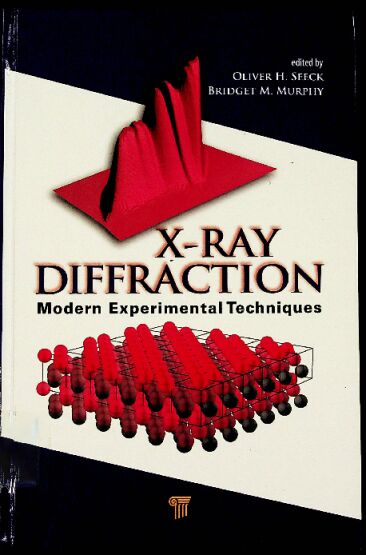
书名:X-ray diffraction
责任者:Oliver H. Seeck | Bridget M. Murphy.
ISBN\ISSN:9789814303590,9814303593
出版时间:2015
出版社:Pan Stanford Publishing,
前言
The development of human culture accompanies the progressive understanding of nature. In the last few centuries, the progress was tremendous, especially upon realization that nature is based on complex interplay between interactions on microscopic and macroscopic scale. Regarding the properties of matter, microscopic interactions,in particular between the atoms, are of eminent importance and they basically determine all characteristics. Even fully macroscopic properties such as melting point, viscosity, and stiffness are based on interatomic and intermolecular interaction parameters.Toaccomplishdetailedunderstandingofthemicroscopic aspects of nature,science fields such as atomic physics, materials science, chemistry, and theoretical biology have been established. During the past decade, the focus has been additionally put on engineering and technology applications, resulting in the so-called micro-and nanotechnology.In the 21st century, the miniaturization and use of nanomaterials is omnipresent, e.g, in computer and sensor technology and in optics, medicine,and cosmetics; the future potentials are huge.
For further advancements in micro- and nanotechnology, profound knowledge of the interatomic and intermolecular interaction parameters is essential. On the one hand, this is challenging for theoretical science groups that develop mathematical tools to understand nature. On the other hand, experimental tools have to be designed and utilized to actually probe the interactions on the atomic scale. Therefore, scientific instruments with methods based on electrons, ions, or photons have been designed. Some of them are available as (more or less)inexpensive laboratory equipment. However, for high-end applications, they can be very costly and complex with a need of well-trained personnel for operation.
Tremendous progress has been achieved in the development of tools based on X-radiation. During the past 50 years,the evolution went from laboratory sources, so-called X-ray tubes, which are still available today, to parasitic use of synchrotron radiation from particle physics experiments,dedicated storage rings for X-radiation,and finally to X-ray lasers. The latter two are large-scale facilities with construction costs of several hundred million US dollars up to USD 1 billion and significant manpower with hundreds of FTEs to run the experiments.All over the world, approximately 20 modern sources are available,of which four deliver high-energy photons and two X-ray lasers. Synchrotron radiation sources offer extraordinary high X-ray beam quality for high-precision measurements on the atomic or molecular scale with accessible time scales from seconds down to femtoseconds(in the case of X-ray lasers).At each of the sources,a large number of experimental stations have been accommodated,which are specialized on certain X-ray methods, such as micro-diffraction, small-angle scattering, X-ray photo emission,fluorescence spectroscopy, tomography, and many more.
Modern synchrotron radiation sources are available for the general scientific and industrial community. Users are mostly from fields in physics, chemistry, geoscience, materials science, biology, archeology, and related fields.Usually, beam time is distributed on a proposal-based system with external referees. For this,an applicant has to define the science case and to choose anexperimentalstation that fits his purpose best.At this point, a potential user should be able to evaluate the capabilities of the experimental stations at the synchrotron radiation sources and to identify the X-ray methods that he wants to apply. Aside from the experimental station, the X-ray photon flux and energy, the beam size and the divergence, the coherence and timing are properties of eminent importance.
In this book,the most important X-ray scattering and diffraction methods are introduced along with some aspects about the production of X-radiation at synchrotrons.In the first two chapters, the basics of X-ray diffraction and scattering methods and an overview of the characteristics of synchrotron radiation are presented. Also, the X-ray optics of a synchrotron radiation experiment are explained, which enables the reader to estimate the flux and the other beam parameters at the sample.In thelater chapters,experts explain the different scattering and diffraction techniques.
The chapters on micro-diffraction and small-angle scattering give insights into the research of macromolecular samples, crystalline or amorphous. For both methods, focusing of the beam is of eminent importance; therefore,in the micro-diffraction section, focusing techniques are introduced.The following two chapters focus on inelastic scattering and X-ray standing waves, which are widely used to investigate phonon- and electron-density distribution in hard condensed matter. The next two chapters are devoted to magnetism. Two fully different X-ray methods are applicable: Magneticscattering,whichis adiffraction method based on magnetic interaction with the X-rays, and nuclear scattering, which monitors changes in the hyperfine field of the nuclei induced by magnetism in the sample.
The three following chapters deal with special topics: scattering at liquid interfaces, extreme condition science with X-rays,and tomography. The firstis demanding as many chemical and biological reactions appear at liquid interfaces. Extreme condition science (high temperature and high pressure)relies on well-established X-rays powder diffraction methods; however, the experimental setup is very complex and the present status is explained in the book.Tomography is also introduced,though it is not a particular scattering or diffraction method.In many cases, such as metallic sintered powders, tomography and scattering methods are complementary.
The last two chapters describe applications of coherent X-rays. The so-called speckle pattern that arises from scattering ofcoherent beams at disordered samples contains more information than standard scattering data and can be used to do imaging or time- resolved studies. The experimental techniques and the rather complex theory are introduced in these chapters.
This book gives an insight into the up-to-date X-ray scattering methods that are available at modernsynchrotron radiation sources. It enables the reader to understand the basic concept behind the methods and therefore to plan an appropriate, synchrotron radiation-based experiment.
查看更多
目录
Preface xiii
1.Overview of X-Ray Scattering and Diffraction Theory and Techniques 1
Oliver H. Seeck
1.1Scattering at Single Electrons 2
1.2Scattering in Bulk Matter 5
1.2.1 Scattering in Disordered Matter 6
1.2.2 Scattering in Crystalline Matter 7
1.2.3 Scattering at Powders of Crystalline Matter 10
1.3 Scattering at Surfaces 12
1.3.1 Scattering at Crystal Surfaces 14
1.3.2 Scattering at Surfaces with Density Profile 16
1.3.3 Scattering at Rough Surfaces 19
1.4 Some Dynamical Scattering Theory 22
2. Scattering and Diffraction Beamlines at Synchrotron Radiation Sources 29
Oliver H. Seeck
2.1 Synchrotron Radiation Sources 31
2.1.1 Bending Magnets 32
2.1.2 Wigglers 37
2.1.3 Undulators 38
2.1.4 Undulators at X-Ray Free Electron Lasers 43
2.2Brilliance 45
2.3Beamline Optics 47
3. Micro- and Nanodiffraction 55
Christina Krywka and Martin Müller
3.1 Introduction 55
3.2 X-Ray Focusing Optics 56
3.2.1 Refractive Optics 58
3.2.1.1 Metal compound refractive lenses 58
3.2.1.2 Silicon nanofocusing refracttive lenses 60
3.2.1.3 Diamond lenses 61
3.2.1.4 Polymerlenses 62
3.2.2 Diffractive Optics 62
3.2.2.1 Fresnelzone plates 62
3.2.3 Reflective Optics 65
3.2.3.1 Kirkpatrick-Baez mirror 65
3.2.3.2 Multilayer KB mirror 67
3.2.4 Beam Concentrating and Collimating Elements 67
3.2.4.1 Capillaries 67
3.2.4.2 Waveguides 69
3.3Experiments 71
3.3.1 X-Ray Micro-and Nanodiffraction Instrumentation 72
3.3.2 Examples of Micro-and Nanodiffraction Experiments 74
3.3.2.1 Small beams and crystallographic parameters 75
3.3.2.2 μSAXS on single-cellulose fibers 77
3.3.2.3 2D microdiffraction scanning of the wood cell wall 78
3.3.2.4 In situ deformation of single wood cells 81
3.3.3 Beam Damage in Microdiffraction Experiments 82
3.4 Summary 83
4. Small-Angle X-Ray Scattering 89
Ulla Vainio
4.1Introduction 90
4.2Experimental Setup 91
4.2.1 Sample Cells and OptimalSample Thickness 93
4.2.2 Corrections to Experimental Data 94
4.2.3 Absolute Intensity Scale 96
4.3 Theory 97
4.3.1 Scattering Length Density 99
4.3.2 Power Laws 100
4.3.3 Porod Constant 102
4.3.4 Scattering from Particles 103
4.3.4.1 Guinier approximation 105
4.3.4.2 Form factor 106
4.3.4.3 Structure factor 107
4.3.4.4 Polydispersity 109
4.3.4.5 Distance distribution function 110
4.3.4.6 Kratky plotand Porod invariant 111
4.3.5 Scattering from Fluctuations 113
4.3.6 Generalized Scattering Functions 113
4.4 Radiation Damage 114
4.5 BioSAXS 115
4.6 GISAXS 115
4.7 ASAXS 118
5. TheX-Ray Standing Wave Technique: Fourier Analysis with Chemical Sensitivity 129
Jörg Zegenhagen
5.1 Introduction 129
5.2Formation of an XSW 132
5.3 XSW Analysis 133
5.4XSW Structure Factor versus XRD Structure Factor 136
5.5XSW Fourier Analysis: Imaging of Mn In GaAs 137
5.6 Summary 141
6.InelasticX-Ray Scattering from Phonons 145
Alexei Bosak and Michael Krisch
6.1 Introduction 145
6.2General Formalism 148
6.3Experimental Technique 150
6.4Mapping of Phonon Dispersion Surfaces 152
6.5Combining IXS and TDS 154
6.5.1 Visualization of the Fermi Surface of Zinc 155
6.5.2 Giant Kohn Anomaly in ZrTe3 158
6.5.3 Diffuse Scattering and Correlated Disorderin Manganese Analogue of Prussian Blue 162
6.5.4 Powder Wide-Angle IXS 164
6.5.5 Conclusions and Outlook 168
7. Magnetic X-Ray Scattering 175
S. P Collins
7.1Introduction 175
7.2 Is MagneticX-Ray Scattering the Right Technique? 177
7.3 Strength of the Magnetic Resonance180
7.3.1 Strong Magnetic Resonances(3d/4d/5d L2,3;4f/5f M4.5) 180
7.3.2 Weak Magnetic Resonances(3d K;4f L2,3) 181
7.3.3 Nonresonant Magnetic Scattering 182
7.4 Sample Material 182
7.5 FeBO3: Introduction 184
7.6 Nonresonant MagneticX-Ray Calculation: FeBO3 185
7.7Magnetic X-Ray Scattering Measurements:FeBO3 189
7.8 Discussion: FeBO3 193
7.9 Magnetic Scattering and Polarization 195
7.10 Resonant Scattering and Atomic Multipoles 197
7.11 Future Directions 198
8. Nuclear Resonant Scattering of Synchrotron Radiation:Applications in Magnetism 205
Ralf Röhlsberger
8.1Introduction 205
8.2 Basic Principles of Nuclear Resonant Scattering 207
8.3 Imaging the Magnetic Spin Structure of Exchange-Spring Magnetic Layers 215
8.4 Antiferromagnetic Coupling in Fe/Cr Multilayers 218
8.5 Spatially Resolved Magnetic Reversal in an Exchange Bias Layer System 220
8.6 Conclusion and Outlook 225
9. Reflectivity at Liquid Interfaces 229
Bridget M. Murphy
9.1Introduction 230
9.2 X-Ray Reflectivity 231
9.3 Fresnel Reflectiviy 231
9.4 Roughness at Liquid Surfaces 234
9.5 Kinematic Scattering Theory for Liquid Surfaces 237
9.5.1 Experimental Considerations 239
9.5.2 Bulk Scattering 240
9.6 Instrumentation 241
9.6.1 Single-Crystal Liquid Diffractometer 241
9.6.2 High-Energy Liquid Diffractometer 241
9.6.3 Double-Crystal Liquid Diffractometer 243
9.7 Examples 245
9.7.1 Reflectivity from Water 245
9.7.2 Reflectivity from Liquid Mercury 247
9.8 Summary 248
10.X-Ray Diffraction at Extreme Conditions: Today and Tomorrow 255
Hanns-Peter Liermann
10.1 Introduction 255
10.1.1 Why X-Ray Diffraction at Extreme Conditions 257
10.1.1.1 Precise high-Pand high-T equation of state studies 258
10.1.1.2 Studies on crystallographic properties 260
10.1.1.3 Phase stabilities studies 262
10.1.1.4 Elastic-plasticbehavior of mantle minerals 263
10.1.2 LVPvs.DAC:Advantages and Disadvantages 266
10.1.3 The Future ofX-Ray Diffraction at Extreme Conditions in the DAC at Synchrotron Facilities 267
10.2 Standard X-Ray Diffraction Techniques and Sample Environments Used at Extreme Conditions 268
10.2.1 Powder Diffraction at Simultaneous High Pressure and Temperature in the DAC 269
10.2.1.1 Laser-heated DAC 269
10.2.1.2 Resistive-heated DAC 274
10.2.2 Single Crystal Diffraction in the DAC at Simultaneous High Pressure and Temperature 279
10.2.3 Determination of Pressure at High Temperatures 281
10.2.4 Diffraction on Nano-Crystalline Powders,Amorphous Solid and Liquids: Use of the Total Scattering Function in the DAC 285
10.3 New Directions in Extreme Conditions Research at the Third-and Fourth-Generation Light Sources 287
10.3.1 Types of Dynamic Experiments to Be Conducted at the Third-and Fourth-Generation Sources 291
10.3.2 Possible Single-Exposure and Pump and Probe Experiments Using the Time Structure of PETRA III (ECB) and the European XFEL(HED)for Dynamic Experiments at Extreme Conditions 293
10.3.2.1 Single exposure experiments at third generation synchrotron 293
10.3.2.2 Pump and probe experiments at third generation synchrotron 294
10.3.2.3 Single exposure experiments at fourth generation XFEL 296
10.3.2.4 Pump and probe experiments at the fourth-generation XFEL 296
10.4 Summary 298
11. Synchrotron Tomography 315
Astrid Haibel
1.1 Measurement Principle of Synchrotron Tomography 316
11.1.1 Monochromatization 317
11.2 Absorption Tomography 318
11.3 Phase-Contrast Tomography 320
11.3.1 Direct Phase-Contrast Methods 321
11.3.2 Indirect Phase-Contrast Methods 322
11.4 Tomography with Magnifying X-Ray Optics 325
11.5 Tomographic Reconstruction 326
11.5.1 Fourier Slice Theorem 327
11.6 Image Artifacts 329
11.7 Applications and Quantitative 3D Image Analysis 332
12. Coherent X-Ray Diffraction Imaging of Nanostructures 341
Ivan A.Vartanyants and Oleksandr M.Yefanov
12.1 Introduction 341
12.2 Coherent and Partially Coherent Scattering on Crystals 345
12.2.1 Coherent Scattering from a Finite Size Crystal 346
12.2.2 Coherent Scattering from a Finite-Size Crystal with a Strain 355
12.2.3 Partially Coherent Scattering from a Finite-Size Crystal 358
12.3 Experimental Examples 366
12.3.1 CoherentX-Ray Imaging of Defects in Colloidal Crystals 366
12.3.2 Coherent Diffraction Tomography of Nanoislands from Grazing Incidence Small-Angle X-Ray Scattering 370
12.3.3 Coherent-Pulse 2D Crystallography at Free-Electron Lasers 374
12.4 Summary 377
13.X-Ray Photon Correlation Spectroscopy 385
Christian Guttand Michael Sprung
13.1 Introduction 385
13.2 Theory 387
13.2.1 Equilibrium Fluctuations 387
13.2.2 Two-Time Correlation Functions 387
13.3 XPCS via Split and Delay Techniques at XFEL Sources 391
13.4 X-Ray Cross-Correlation Analysis—Local Bond Order in Liquids and Glasses 392
13.5 Designing XPCS Experiments 393
13.6 Experimental XPCS Setup 396
13.7 Examples 398
13.7.1 Surface Dynamics of Thin Polymer Films 398
13.7.2 Measuring Atomic Diffusion with Coherent X-Rays 403
13.7.3 Antiferromagnetic Domain Wall Fluctuations 406
13.7.4 Reentrant Glassy Behavior 409
13.7.5 Dynamical Heterogeneity in an Aging Colloidal Gel 410
13.7.6 Local Bond Orderin Colloidal Glasses 412
13.7.7 Summary 415
Index 421
查看PDF
查看更多
馆藏单位
中科院文献情报中心