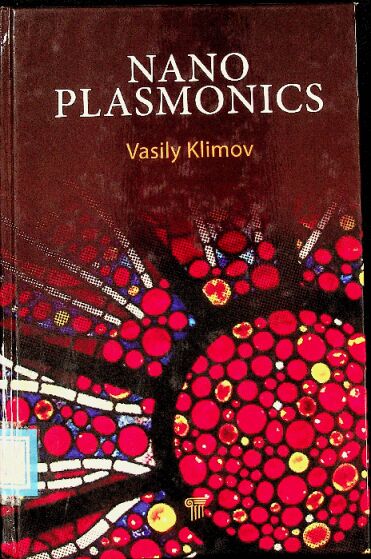
书名:Nano plasmonics
ISBN\ISSN:9789814267168,9814267163
出版时间:2014
出版社:Pan Stanford Pub,
前言
Nanoplasmonics is a component of nano-optics, which is optics at the nanometer scale. The subject of nanoplasmonics is optical properties of metal nanoparticles and nanostructures determined by electron oscillations around a crystal lattice. Primarily, the importance of nanoplasmonics is based on two factors. First, localization and enhancement of optical fields can occur owing to the presence of a spatial nanoscale substance (the lightning rod effect), Second, frequencies of metal nanoparticle eigenoscillations are located in optical spectrum in ranges from ultraviolet to infrared. Coexistence of these two properties of metal nanoparticles causes an interesting and complex physics, which forms the basis for numerous applications.
More specifically, the properties of metal nanoparticles and related physics are determined, first of all, by their shape: any variation from a trivial spherical form leads to the origin of new properties and peculiarities. Almost full control over shapes of nanoparticles allows one to talk about full control over their optical properties. The adjustability of plasmonic nanoparticles allows for their effective interaction between themselves and with light, atoms, and molecules. In other words, this book deals with the investigation ofthe influence ofthe geometly and shapes ofnanoparticles on their properties. This aspect is extremely important because until now for simplicity many researchers have considered wave propagations in infinite systems which have no peculiarities related to real nanoparticles of finite volume. Moreover, sometimes such infinite systems have pathological properties.
Despite the rapid growth of nanoplasmonics, its main achieve— ments are scattered over many journal publications, and one of the main goals of this project is to make a first-time systematic presentation of results obtained over the world. Though many results in this area were obtained by me personally, this book is based, of course, not just on my results. I have tried to make the book as self-sufficient as possible from the theoretical point of view, and I expect that many formulas can be used immediately by both theorists and experimentalists in nanoplasmonics and related areas. Theoretical methods and approaches presented in the book can be also applied in further original investigations. As to the experimental aspects of nanoplasmonics, this work contains, first of all, an overview of fundamental experiments and applications having reputable substantiation and interpretation.
Although I have tried to make the book comprehensible to a wide audience, some parts of it are rather complicated and need special grounding. That is why for better perception the hook is supplied with a lot of photographs, pictures, plots, and diagrams. These illustrations will be especially useful for those readers who have just entered into this domain ofscience. From this point ofview, the electronic edition will be most useful because the majority of illustrations in it are in full color.
Although currently nanoplasmonics is of great importance, I decided to issue this book in English only after i felt assured that its tone is correct and the book is demanded by the audience More than 1500 copies oftwo Russian editions have already been sold, and this circulation an be regarded as a success for a scientific book. I believe that the English version ofthe book will be even in greater demand because it is extended and updated to include further development of nanoplasmonics.
查看更多
目录
Preface xiii
Acknowledgments xv
1 Introduction 1
2 The World of Nanoparticles 9
2.1 Role ofMicro- and Nanoparticles in the History of Our Civilization 9
2.2 Modern Methods ofNanoparticle Synthesis 15
2.2.1 Methods Based on Chemical Reactions in a Solid Body 15
2.2.2 Nanochemistry Methods 16
2.2.2.1 Precipitation from colloid solutions 16
2.2.2.2 The reverse micelle synthesis 19
2.2.3 Gas-Phase Synthesis of Nanoparticles 22
2.2.4 Nanolithography Methods of Metal Nanoparticle and Nanostructure Synthesis 24
2.2.4.1 Electron beam and ion beam lithography 25
2.2.4.2 Nanosphere lithography 26
2.2.4.3 Atom nanolithography with the help of optical fields 27
2.2.5 Forming ofArbitrary Three-Dimensional Metal Nanostructures with the Help of Focused Ion Beams 29
2.3 Nanoparticles and Nanostructures Gallery 29
2.4 Conclusion 38
3 Introduction to Electrodynamics of Metals 45
3.1 Maxwell's Equations and the Propagation of Electromagnetic Waves 45
3.2 The Drude—Sommerfeld Theory of Optical Properties of Metals 52
3.3 Optical Properties ofReal Metals 55
3.4 Electric Permittivity omeall Particles 57
3.5 Dispersion in Free-Electron Gas and Bulk Plasmons 58
4 Surface Plasmons 53
4.1 Two-Dimensional Surface Plasmons 63
4.1.1 Surface Plasmons on a Plane Metal—Dielectric interface 64
4.1.2 Surface Plasmons in Planar Layered Media 70
4.2 One-Dimensional Surface Plasmons 75
4.2.1 Plasmons in Metal Wires ofa Circular Cross Section 76
4.2.2 Plasmons in Nanowires of Other Cross Sections 79
4.3 Excitation ofSurface Plasmons 81
4.3.1 Attenuated Total lnternal Reflection 83
4.3.2 The Surface Diffraction Grating Method 84
4.3.3 The Method ofNanolocalized Light Sources 85
4.4 Observation ofSurface Plasmons 85
5 The Theory of Plasmon Oscillations in Nanoparticles 91
5.1 The "ε-Method" of Maxwell's Equations Solutions for Particles of an Arbitrary Size 92
5.2 Application ofthe "ε-Method" to a Solution of Maxwell's Equations for Nanoparticles 99
5.3 Implementations ofthe "ε-Method" of the Maxwell's Equations' Solution 104
5.3.1 Analytical Solutions 104
5.3.2 Integral Form ofthe "ε-Method" and Its Numerical Solutions 105
5.4 The Analogy between Localized Plasmons and Atoms and Molecules 109
6 Optical Properties of Spherical Particles 115
6.1 Excitation ofa Spherical Particle by a Dipole Source of Light 116
6.2 Optical Resonances in Spherical Particles ofan Arbitrary Size 121
6.3 Optical Properties ofa Spherical Particle of an Arbitrary Size 126
6.4 The Quasi-Static Theory ofOptical Properties of Spherical Nanoparticles 133
6.5 The Influence of Nonlocal Effects on Optical Properties of Spherical Particles 140
6.6 Optical Properties of Layered Spherical Particles 148
6.6.1 Optical Properties ofLayered Nanoparticles in a Homogeneous Field 148
6.6.2 Spontaneous Emission ofan Atom in the Presence of Layered Spherical Particles 151
7 Plasmonic Properties of Nanospheroids 157
7.1 Plasmon Resonances in Spheroidal Nanoparticles (Quasi-Static Approximation) 159
7.1.1 Prolate Spheroids 159
7.1.2 Oblate Spheroids 164
7.2 Optical Properties ofSpheroids 169
7.2.1 Spheroids‘ Polarizability 169
7.2.2 Spheroids' Scattering and Absorption Cross Sections 172
7.2.3 Rates of Spontaneous Emission of Molecules in the Vicinity ofa Spheroid 174
7.2.3.1 Prolate spheroids 175
7.2.3.2 Oblate spheroids 179
7.3 Plasmon Oscillations in Spheroidal Shells 180
7.4 The Effect ofRetardation in Nanoparticles of Spheroidal and Related Shapes 185
8 Optical Properties of a Three-Axial Nanoellipsoid 193
8.1 The General Solution of the Quasi-Static Problem of Plasmon Oscillations in a Three-Axial Nanoellipsoid in the Context of the "ε-Method" 194
8.2 Explicit Expressions for Plasmon Modes of a Nanoellipsoid in the Cartesian Coordinates 197
8.3 Plasmon Resonances in an Ellipsoid ofa Finite Size (Taking the Effect of Retardation into Account) 206
8.4 Optical Properties ofa Nanoellipsoid in a Homogeneous External Field 209
8.5 The Influence ofa Metal Nanoellipsoid on the Spontaneous Emission ofan Atom 214
9 Localized Plasmons in Polyhedral Nanoparticles 221
9.1 Optical Properties of Dielectric Particles in the Form of Regular Polyhedra (Platonic Solids) 222
9.2 Properties of Localized Plasmons in Nanoparticles of a Complex Form 227
9.2.1 A Nanocube and Related Geometries 227
9.2.2 A Decahedron and Related Geometries 236
9.2.3 A Tetrahedron, a Trigonal Prism, and Related Geometries 238
9.3 Conclusions 247
10 Localized Plasmons in Nanoparticle Clusters 251
10.1 The Classification of Plasmon Oscillations in a Cluster on the Basis of Plasmon Oscillations in the Particles Composing It 252
10.1.1 The System of Linear Integral Equations Describing Plasmon Oscillations in a Cluster ofNanoparticles 252
10.1.2 Plasmon Oscillation Properties in Clusters with Large Distances between
Nanoparticles: The Point Dipole Model 254
10.1.3 Weakly and Strongly Localized Plasmon Oscillations in Clusters of Strongly Interacting Nanoparticles 261
10.2 Two-Dimensional Plasmons in a Cluster of Two Nanowires 261
10.3 Plasmons in a Cluster of Two Nanospheres 265
10.4 Local Fields' Enhancement in a Cluster of Two Nanospheres 277
10.5 Plasmons in a Cluster of Two Different Nanospheres and in Nonsymmetric Nanoshells 278
10.6 Plasmons in a Cluster of Two Nonspherical Nanoparticles of Finite Volume 282
10.61 Plasmon Oscillations in a Cluster of Two Nanocubes 282
10.6.2 Experimental Study of Plasmon Oscillations in a Cluster ofTwo Gold Nanodiscs 283
10.6.3 Plasmon Oscillations in a Cluster of Two Nanospheroids 284
10.7 Plasmons in the Region of the Nanocontact of Two Plasmon Bodies oflnfinite Volume 301
10.8 Plasmons Oscillations in a Cluster of More Than Two Particles 306
10.8.1 Plasmon Properties of Linear Clusters: Quasi-Static Approximation 306
10.8.2 Plasmon Properties of Linear Clusters: Retardation Effects 318
10.8.3 Plasmon Properties of Self-Similar Clusters 324
10.8.4 Plasmon Properties of Starlike Clusters 325
10.9 Influence of Plasmon Resonances in a Cluster of Nanoparticles on the Radiation ofAtoms and Molecules 326
10.10 Plasmon Nanoparticles Influence on the van der Waals Forces between Nanoparticles 334
10.11 Plasmon Resonance Excitation in a Cluster of Nanoparticles 338
11 Optical Properties of Metamaterials and Nanoparticles Made from Them 351
11.1 Optics of Particles with a Negative Refractive Index 353
11.1.1 Main Properties ofMedia with a Negative Refractive Index 353
11.1.2 Experimental Realization of Media with a Negative Refractive Index 358
11.1.3 Focusing Properties ofa Slab Made ofa Metamaterial with a Negative Refractive Index 364
11.1.4 Plasmon Resonances in a Sphere ofa Material with a Negative Refractive Index and Their Influence on the Radiation of Atoms and Molecules 370
11.2 Optical Properties of Chiral Particles 377
11.2.1 Main Properties and Methods ofChiraI Media Implementation 377
11.2.2 Optical Properties ofa Spherical Chiral Particle 383
11.2.3 Waves in an Infinite Uniform Chiral Medium 383
11.2.4 Spherical Waves in Chiral Media 387
11.2.5 Optical Properties ofa Spherical Chiral Particle Placed in the Field ofa Plane Wave 388
11.2.6 Spontaneous Emission ofOptically Active Molecules Induced by the Presence of Nearby Chiral Nanoparticles 391
12 Optical Properties of Nanoholes in Metal Films 405
12.1 Optical Properties ofa Circular Hole in an Inflnitely Thin, Perfectly Conducting Screen (Bethe—Bouwkamp Theory) 406
12.2 A Circular Hole in a Screen of Finite Thickness 409
12.2.1 Localized Plasmons in a Nanohole 410
12.2.2 Localized Surface Plasmons and Light Transmission through a Hole 415
12.3 Extraordinary Light Transmission through Arrays of Nanoholes 418
12.4 A Pattern ofRadiation Outgoing from a Nanoaperture 425
12.5 Fluorescence ofAtoms and Molecules Near a Nanoaperture 428
12.5.1 Influence ofa Circular Nanoaperture in a Perfectly Conducting Screen on
Spontaneous Emission ofan Atom or a Molecule 428
12.5.2 Experimental Investigations of Molecules' Emission Near Nanoapertures 434
12.6 Conclusion 438
13 Applications of Nanoplasmonics 445
13.1 Tumor Therapy and Visualization with the Help of Nanoparticles 445
13.2 Biosensors on Surface Plasmons 449
13.3 Biosensors Based on Localized Plasmons in Nanopaticles 451
13.3.1 The Method of Nanoparticle Agglomeration 451
13.3.2 The Method ofChange ofLocal Dielectric Permittivity 454
13.4 Spectroscopy ofSingle Plasmon Nanoparticles 457
13.5 Element Base for Plasmonic integrated Circuit 459
13.5.1 Passive Elements 460
13.5.2 Active (Dynamic) Elements 468
13.6 Applications Based on the Nanoparticles' influence on the Radiation and Fluorescence ofAtoms and Molecules 472
13.7 Super- and l-lyperlenses Based on Surface Plasmons and Metamaterials 488
13.8 invisibility Cloaks Based on Metamaterials 498
14 Conclusion 521
Appendix A1: Short Theory ofSpontaneous Emission and Fluorescence of Atoms and Molecules in the Presence ofNanobodies 523
A1.1 The Nanobodies' Influence on the Rate ofan Atom's or a Molecule's Spontaneous Emission 523
A1.2 Nano-Objects' lnfluence on Fluorescence of Molecules 527
Appendix A2: Popular Numerical Methods in Nana-Optics and Nanaplasmonics 533
A2.1 Discrete Dipole Approximation 534
A2.2 The T-Matrix Method 537
A2.3 The Multiple Multipole Method 539
A2.4 The Finite-Difference Time Domain Method 542
A2.5 Numerical Methods Based on the Integral Form of Maxwell's Equations 548
A2.6 Other Numerical Methods 550
A2.7 Commercial Simulators for Nana-Optics and Nanoplasmonics 551
A2.8 Conclusion 551
Appendix A3: Acronyms and Terms Used Frequently in Nanoplasmonics, Nano-Optics, and Related Sciences 557
Index 567
查看更多
馆藏单位
中科院文献情报中心