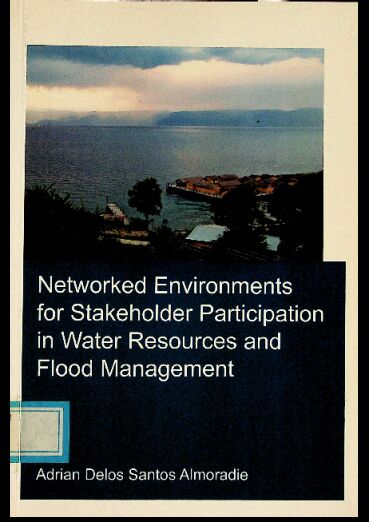
书名:Networked environments for stakeholder participation in water resources and flood management
责任者: Adrian Delos Santos Almoradie.
出版时间:2014
出版社:CRC Press /Balkema,
摘要
Stakeholders’ lack of awareness, involvement and participation in the planning and management of water resources and flood risk often creates problems in the acceptance and implementation of proposed measures. Interactions among stakeholders and decision makers build awareness, trust, enhance cooperation and negotiation for best possible measures.
The main challenge in stakeholder participation is maintaining the participatory process. Stakeholders’ spatial distribution, limitation of financial resources and diverse stakeholders’ interest (even opposed) are some of the hindrances in maintaining the participatory process.
Addressing these challenges and hindrances, this research developed and implemented three frameworks for developing "Networked Environments for Stakeholder Participation" (NESPs). Networked environments are web-based computer-aided or mobile environments for remote virtual interaction between participating entities such as stakeholders. NESPs are envisioned to enable stakeholder participation by providing sharing of information, planning, negotiating and decision support. NESPs were implemented in five real case studies (1) Lakes of Noord-Brabant, The Netherlands, (2) Danube river (Braila-Isaccea section), Romania, (3) Somes Mare catchment, Romania, (4) Cranbrook catchment, London and (5) Alster catchment, Hamburg, Germany.
The overall results of the research show that networked environments can address the challenges and hindrances in stakeholder participation and enhance participation in water resources and flood management.
查看更多
目录
Table of Contents
SUMMARY VII
CHAPTER 1 GENERAL INTRODUCTION 1
1.1 Background 1
1.2 Water resources and nood management i n EU and non-EU countries 3
1.3 Importance of stakeholder participation 4
1.4 Towards a Networked Environment for Stakeholder Participation (NESP) 4
1.5 Objective of this research 6
1.6 Outline of the thesis 7
CHAPTER 2 STAKEHOLDER PARTICIPATION AND ITS RELEVANCE TO WATER RESOURCES AND FLOOD MANAGEMENT 9
2.1 Introduction 9
2.2 Objectives, benefits and potential pitfalls i n stakeholder participation 10
2.3 Types of participation 11
2.3.1 Information and knowl edge sharing 12
2.3.2 Consultati ve participation 12
2.3.3 Collaborative decision making 13
2.4 Participatory process 13
2.5 Lessons learned i n stakeholder participation 14
2.6 In formation dissemination and participation in a Network ed Environment (NE) 16
2.6.1 Information dissemination i n a NE 16
2.6.2 Participation i n a NE 17
2.7 Concludi ng remarks 20
CHAPTER 3 CASE STUDIES DESCRIPTION 23
3.1 Noord-Brabant lakes, the Netherlands 24
3.2 Dan ube river (Braila-Isaccea section), Romania 27
3.3 Somes Mare catchment, Romania 29
3.4 Cranbrook catchment, London, United Kingdom 31
3.5 Alster catchment, Hamburg, Germany 33
3.6 Concluding remarks 34
CHAPTER 4 NESP CONCEPTUAL FRAMEWORKS 37
4.1 Introduction 37
4.2 Conceptual frameworks 38
4.2.1 NESP-IKS (Information and Knowledge Sharing) 3
4.2.2 NESP-CP (Consultative Participation) 40
4.2.3 NESP-CDM (Collaborati ve Decision Maki ng) 41
4.3 Adaptation of the framework 10 different cases 44
4.4 Concluding remarks 46
CHAPTER 5 NESP INFORMATION TECHNOLOGIES 47
5.1 Introduction 47
5.2 Review of technologies for NESP 4
5.2.1 Web based technologies 4
5.2.2 Mobile technologies 49
5.2.3 Spatial Data Infrastructure and Water Mark-up Language (WaterML) 2.0 52
5.2.4 Other technologies 53
5.3 Criteria for selection of technology 54
5.4 Concluding remarks 54
CHAPTER 6 DESIGN OF NESP AND SOFTWARE IMPLEMENTATION 57
6.1 Introduction 57
6.2 NESP-IKS: Noord Brabant lakes 5
6.2.1 Generic conceptual and final design 5
6.2.2 Implemented design of the Noord -Brabant Water Quality platform 63
6.3 NESP-CP: Danube river and Somes Mare catchment 65
6.3.1 Generic conceptual and final design 65
6.3.2 Implemented design of the Somes Mare NESP flood platform 72
6.3.3 Implemented design of the Danube NESP nood plat form 74
6.4 NESP-CDM: Cranbrook and Alster catchment 76
6.4.1 Generic conceptual and final design 76
6.4.2 Implemented deign 80
6.5 Conc luding remarks 82
CHAPTER 7 DEPLOYMENT AND EVALUATION OF NESPS 85
7.1 Deployment methods 85
7.2 Evaluation methods 85
7.3 NESP-IKS: Noord Brabant lakes 86
7.3.1 Deployment 87
7.3.2 Stakeholders evaluation 95
7.4 NESP-CP I:Somes Mare catchment. 97
7.4.1 Deployment 97
7.4.2 Stakeholder evaluation 105
7.5 NESP-CP 2: Danube river (Braila-1 accea ection) 106
7.5.1 Deployment I06
7.5.2 Stakeholder evaluation (Danube and Somes Mare) 112
7.6 NESP-CDM I: Cranbrook catchment 115
7.6.1 Deployment 116
7.6.2 Stakeho lder evaluation 127
7.7 NESP- COM 2: Alster catchment 127
7.7.1 Deployment 128
7.7.2 Stakeholder evaluation (Alster and Cranbrook catchment) 136
7.8 Concluding remarks 138
7.8.1 NESP-IKS 138
7.8.2 NESP-CP 139
7.8.3 NESP-CDM 140
CHAPTER 8 CONCLUSIONS AND RECOMMENDATIONS 143
8.1 Conclu ions 143
8.1.1 General conclusion 143
8.1.2 NESP-IKS 145
8.1.3 NESP-CP 145
8.1.4 NESP-CDM 146
8.1.5 Judgement engine: TOPSIS method 146
8.1.6 Model uncertainty 147
8.1.7 NESP information technologies 147
8.2 Recommendations and future work 148
8.2.1 Methods 148
Multi criteria decision methods 148
Uncenainty analysis 148
Game theory 149
8.2.2 Web-based implementation of water related applications 149
Semi-distributed Conceptual Models 149
Flood Forecasting System 149
Data Driven Models 149
8.2.3 Group Visualisation Techniques 150
ABBREVIATIONS 151
REFERENCES 153
SAMENVATTING 161
ACKNOWLEDGEMENT 165
ABOUT THE AUTHOR 167
查看更多
作者简介
Adrian Delos Santos Almoradie (1981, Masbate, Philippines). BSc. Civil Engineering (2003), University of San Carlos - Technological Center (Cebu City),. he worked as a Hydrological engineer in the Water Resources Center (WRC) of University of San Carlos for 2 years. In 2006 he enrolled in the MSc programme at UNESCO-IHE, Delft the Netherlands. In 2008 he obtained a MSc degree in Water Science and Engineering -Hydroinformatics specialization. PA\He worked for a year in a special program of the Hydroinformatics chair group at UNESCO-IHE, before starting his PhD in 2009. His PhD task included co-supervision of MSc students during their thesis and some lecturing or seminars. During his MSc and PhD studies, he expanded his research interest on flood risk and water resources management, stakeholder participation, multi-criteria analysis, decision support systems, hydrology-hydrometry, hydrological (surface and groundwater) and flood modelling, uncertainty analysis, GIS, web-based GIS, Spatial and Temporal Data Infrastructure (STDI), database management system and development of web-based computer and mobile applications for water resources management. PA\Currently he is working as a Post-Doc with the Water Profile- Water resources management and Eco-Hydrology group of Prof. Mariele Evers in the Department of Geography, University of Bonn, Germany.
查看更多
馆藏单位
中科院文献情报中心