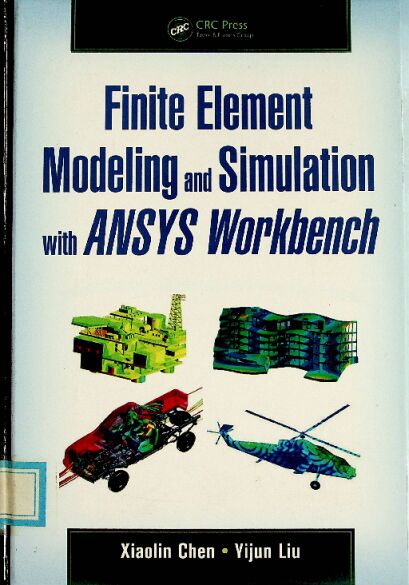
书名:Finite element modeling and simulation with ANSYS Workbench
责任者:Xiaolin Chen | Yijun Liu.
出版时间:2015
出版社:CRC Press, Taylor & Franics Group,
摘要
Finite Element Modeling and Simulation with ANSYS Workbench combines finite element theory with real-world practice. Providing an introduction to finite element modeling and analysis for those with no prior experience, and written by authors with a combined experience of 30 years teaching the subject, this text presents FEM formulations integrated with relevant hands-on applications using ANSYS Workbench for finite element analysis (FEA). Incorporating the basic theories of FEA and the use of ANSYS Workbench in the modeling and simulation of engineering problems, the book also establishes the FEM method as a powerful numerical tool in engineering design and analysis.
查看更多
目录
Preface xi
Authors xiii
1. Introduction 1
1.1 Some Basic Concepts 1
1.1.1 Why FEA? 1
1.1.2 Finite Element Applications in Engineering 1
1.1.3 FEA with A NSYS Workbench 3
1.1.4 A Brief History of FEA 3
1.1.5 A General Procedu re for FEA 4
1.2 An Example in FEA: Spring System 4
1.2.1 One Spring Element. 5
1.2.2 A Spring System 6
1.2.2.1 Assembly of Element Equations: Direct Approach 6
1.2.2.2 Assembly of Element Equa tions: Energy Approach 8
1.2.3 Boundary and Load Conditions 9
1.2.4 Solution Verification 10
1.2.5 Exa mple Problems 10
1.3 Overview of AN SYS Workbench 13
1.3.1 The User Interface 13
1.3.2 The Toolbox 14
1.3.3 The Project Schematic 14
1.3.4 Working with Cells 16
1.3.5 The Menu Ba r 16
1.4 Summary 17
Problems 18
2. Bars and Trusses 21
2.1 Introduction 21
2.2 Review of the 1-D Elasticity Theory 21
2.3 Modeling of Trusses 22
2.4 Formulation of the Bar Element. 23
2.4.1 Stiffness Matr ix: Direct Method 23
2.4.2 Stiffness Mat rix: Energy Approach 25
2.4.3 Treatment of Distributed Load 27
2.4.4 Bar Element in 2-D and 3-D 28
2.4.4.1 2-D Case 28
2.4.4.2 3-D Case 31
2.4.5 Element Stress 31
2.5 Exa mples with Bar Elements 32
2.6 Case Study with ANSYS Workbench 40
2.7 Summary 52
2.8 Review of Learning Objectives 52
Problems 52
3. Beams and Frames 57
3.1 Introduction 57
3.2 Review of the Beam Theory 57
3.2.1 Euler-Bernoulli Beam and Timoshenko Beam 57
3.2.2 Stress, Strain, Deflection, and Their Relations 59
3.3 Modeling of Beams and Frames 60
3.3.1 Cross Sections and Strong/Weak Axis 60
3.3.2 Support Conditions 61
3.3.3 Conversion of a Physical Model into a Line Model 62
3.4 Formulation of the Beam Element 62
3.4.1 Element Stiffness Equation:The Direct Approach 63
3.4.2 Element Stiffness Equation:The Energy Approach 64
3.4.3 Treatment of Distributed Loads 66
3.4.4 Stiffness Matrix for a General Beam Element. 67
3.5 Examples with Beam Elements 68
3.6 Case Study with ANSYS Workbench 77
3.7 Summary 96
3.8 Review of Learning Objectives 96
Problems 96
4. Two-Dimensional Elasticity 101
4.1 Introduction , 101
4.2 Review of 2-D Elasticity Theory 101
4.2.1 Plane Stress 101
4.2.2 Plane Strain 102
4.2.3 Stress-Strain (Constitutive) Equations 103
4.2.4 Strain and Displacement Relations 104
4.2.5 Equilibrium Equations 105
4.2.6 Boundary Conditions 105
4.2.7 Exact Elasticity Solution 105
4.3 Modeling of 2-D Elasticity Problems 106
4.4 Formulation of the Plane Stress/Strain Element 107
4.4.1 A General Formula for the Stiffness Matrix 108
4.4.2 Constant Strain Triangle (CST or T3) 108
4.4.3 Quadratic Triangular Element (LST or T6) 113
4.4.4 Linear Quadrilateral Element (Q4) 114
4.4.5 Quadratic Quadrilateral Element (Q8) 115
4.4.6 Transformation of Loads 116
4.4.7 Stress Calculation 118
4.4.7.1 The von Mises Stress 118
4.4.7.2 Averaged Stresses 119
4.4.8 General Comments on the 2-D Elements 120
4.5 Case Study with ANSYS Workbench 121
4.6 Summary 138
4.7 Review of Learning Objectives 138
Problems 138
5. Modeling and Solution Techniques 143
5.1 Introduction 143
5.2 Symmetry 143
5.2.1 An Example 144
5.3 Substructures (Superelements) 145
5.4 Equation Solving 146
5.4.1 Direct Methods (Gauss Elimination) 146
5.4.2 Iterative Methods 146
5.4.3 An Example: Gauss Elimination 146
5.4.4 An Example: Iterative Method 147
5.5 Nature of Finite Element Solutions 148
5.6 Convergence of FEA Solutions 149
5.7 Adaptivity (h-, p-, and hp-Methods) 149
5.8 Case Study with ANSYS Workbench 150
5.9 Summary 161
5.10 Review of Learning Objectives 162
Problems 162
6. Plate and Shell Analyses 165
6.1 Introduction 165
6.2 Review of Plate Theory 165
6.2.1 Force and Stress Relations in Plates 165
6.2.2 Thin Plate Theory (Kirchhoff Plate Theory) 167
6.2.2.1 Example: A Thin Plate 169
6.2.3 Thick Plate Theory (Mindlin Plate Theory) 170
6.2.4 Shell Theory 171
6.2.4.1 Shell Example: A Cylindrical Container. 171
6.3 Modeling of Plates and Shells 172
6.4 Formulation of the Plate and Shell Elements 173
6.4.1 Kirchhoff Plate Elements 173
6.4.2 Mindlin Plate Elements 174
6.4.3 Discrete Kirchhoff Elements 175
6.4.4 Flat Shell Elements 175
6.4.5 Curved Shell Elements 176
6.5 Case Studies with ANSYS Workbench 177
6.6 Summary 185
6.7 Review of Learning Objectives 185
Problems 185
7. Three-Dimensional Elasticity 189
7.1 Introduction 189
7.2 Review of Theory of Elasticity 189
7.2.1 Stress-Strain Relation 190
7.2.2 Displacement 191
7.2.3 Strain-Displacement Relation 191
7.2.4 Equilibrium Equations 191
7.2.5 Bounda ry Conditions 192
7.2.6 Stress Analysis 192
7.3 Modeling of 3-D Elastic Structures 192
7.3.1 Mesh Discretization 193
7.3.2 Boundary Conditions:Supports 193
7.3.3 Boundary Conditions: Loads 194
7.3.4 Assembly Analysis: Contacts 194
7.4 Formulation of Solid Elements 195
7.4.1 General Formulation . ]95
7.4.2 Typical Solid Element Types 196
7.4.3 Formulation of a Linear Hexahedral Element Type 197
7.4.4 Treatment of Distributed Loads 200
7.5 Case Studies with ANSYS Workbench 200
7.6 Summary 220
7.7 Review of Learning Objectives 220
Problems 220
8. Structural Vibration and Dynamics 225
8.1 Introduction 225
8.2 Review of Basic Equations 225
8.2.1 A Single DOF System 226
8.2.2 A Multi-DOF System 228
8.2.2.1 Mass Matrices 228
8.2.2.2 Damping 230
8.3 Formulation for Modal Analysis 231
8.3.1 Modal Equations 233
8.4 Formulation for Frequency Response Analysis 235
8.4.1 Modal Method 235
8.4.2 Direct Method 236
8.5 Formulation for Transient Response Analysis 236
8.5.1 Direct Methods (Direct Integration Methods) 237
8.5.2 Modal Method 238
8.6 Modeling Examples 239
8.6.1 Modal Analysis 239
8.6.2 Frequency Response Analysis 240
8.6.3 Transient Response Analysis 240
8.6.4 Cautions in Dynamic Analysis 240
8.7 Case Studies with ANSYS Workbench 241
8.8 Summary 260
8.9 Review of Learning Objectives 260
Problems 260
9. Thermal Analysis 267
9.1 Introduction 267
9.2 Review of Basic Equations 267
9.2.1 Thermal Analysis 267
9.2.1.1 Finite Element Formulation for Heat Conduction 269
9.2.2 Thermal Stress Analysis 269
9.2.2.1 1-D Case 270
9.2.2.2 2-D Cases 271
9.2.2.3 3-D Case 271
9.2.2.4 Notes on FEA for Thermal Stress Analysis 271
9.3 Modeling of Thermal Problems 272
9.3.1 Thermal Analysis 272
9.3.2 Thermal Stress Analysis 272
9.4 Case Studies with ANSYS Workbench 274
9.5 Summary 292
9.6 Review of Learning Objectives 292
Problems 293
10. Introduction to Fluid Analysis 299
10.1 Introduction 299
10.2 Review of Basic Equations 299
10.2.1 Describi ng Fluid Motion 299
10.2.2 Types of Fluid Flow 299
10.2.3 Navier-Stokes Equations 300
10.3 Modeling of Fluid Flow 301
10.3.1 Fluid Domain 301
10.3.2 Meshing 301
10.3.3 Bounda ry Conditions 301
10.3.4 Solution Visualiza tion 302
10.4 Case Studies with ANSYS Workbench 303
10.5 Summary 325
10.6 Review of Learning Objectives 325
Problems 326
11. Design Optimization 331
11.1 lntroduction 331
11.2 Topology Optimization 331
11.3 Parametric Optimization 332
11.4 Design Space Exploration for Parametric Optimization 332
11.4.1 Design of Experiments 333
11.4.2 Response Surface Optimiza tion 335
11.5 Case Studies with ANSYS Workbench 335
11.6 Summary 355
11.7 Review of Learning Objectives 355
Problems 356
12. Failure Analysis 361
12.1 Introduction 361
12.2 Static Failure 361
12.2.1 Ductile Failure 361
12.2.1.1 Maximum Shear Stress Theory (Tresca Criterion) 361
12.2.1.2 Distortion Energy Theory (von Mises Criterion) 362
12.2.2 Brittle Failu re 362
12.2.2.1 Maximum Normal Stress Theory 362
12.2.2.2 Mohr-Coulomb Theory 362
12.3 Fatigue Failure 363
12.3.1 Soderberg Failure Criterion 364
12.3.2 Goodman Failure Criterion 364
12.3.3 Gerber Failure Criterion 365
12.4 Buckling Failure 366
12.5 Case Studies with ANSYS Workbench 367
12.6 Summary 376
12.7 Review of Leaming Objectives 377
Problems 377
Appendix 1:Review of Matrix Algebra 381
Appendix 2: Photo Credits 387
References 389
Index 391
查看更多
作者简介
Dr. Yijun Liu is a professor of mechanical engineering at the University of Cincinnati. He obtained his BS and MS in aerospace engineering from Northwestern Polytechnical University (China), and his PhD in theoretical and applied mechanics from the University of Illinois at Urbana-Champaign. Prior to joining the faculty, he conducted postdoctoral research at the Center of Nondestructive Evaluation of Iowa State University and worked at Ford Motor Company as a CAE analyst. Dr. Liu’s interests are in computational mechanics, finite element method, boundary element method, and fast multipole method in modeling composite materials, fracture, fatigue, structural dynamics, and acoustics problems.
查看更多
馆藏单位
中科院文献情报中心