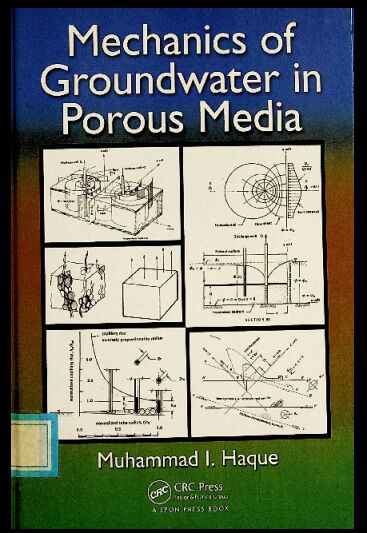
书名:Mechanics of groundwater in porous media
出版时间:2015
出版社:CRC Press, Taylor & Francis Group,
前言
Written for engineering and science students, Mechanics of Groundwater in Porous Media explains groundwater from both a mathematical and qualitative standpoint. The book builds up the theory of groundwater flow starting from basic physics and geometric intuition, and on to applied practice through real-world engineering problems. It includes graphical illustrations as well as solved illustrative problems throughout the text.
The book starts off by introducing the overall picture of groundwater, its relationship with the hydrological cycle, and other terminology used in the mechanics of groundwater flow though porous means. It presents a synopsis of basic definitions, concepts, and the fundamental principles of fluid mechanics and soil mechanics, which are necessary prerequisites for an adequate understanding of the book’s core material. The engineering applications are deducted from geometric and physical reasoning, with a minimum use of mathematical abstraction.
Mechanics of Groundwater in Porous Media is written primarily to serve as a textbook for senior undergraduate and upper-level graduate students in civil and environmental engineering, environmental science, hydrogeology, and geology, as well as a resource for practicing engineers.
查看更多
目录
Preface xi
Author xiii
1 Introduction 1
1.1 Hydrological cycle 2
1.1.1 Noncyclic water 5
1.2 Vertical moisture profle 5
1.2.1 Soil water zone 6
1.2.2 Intermediate zone 6
1.2.3 Capillary zone 7
1.3 Classifcation of aquifers 10
1.3.1 Confned aquifer 11
1.3.2 Unconfned aquifer 11
1.3.3 Perched aquifer 11
1.4 River–aquifer interaction 11
1.5 Homogeneity and isotropy of aquifers 13
1.6 Illustrative problems 14
Suggested readings 17
2 Preliminaries 19
2.1 Preliminaries from fuid mechanics 19
2.1.1 Stress vector and its vector resolution into normal and shearing components 19
2.1.2 Static pressure at a point 21
2.1.2.1 The invariance of static pressure with direction 23
2.1.2.2 Static pressure at a point not directly under the free surface 24
2.1.3 Bernoulli’s theorem 26
2.1.3.1 Kinetic energy 26
2.1.3.2 Potentials and the potential energy 29
2.1.3.3 Energy equation for steady motion of an incompressible ideal fuid 34
2.2 Preliminaries from soil mechanics 37
2.2.1 Porosity of soil or porous medium 37
2.2.2 Void ratio, water content, and degree of saturation 39
2.2.3 Total pressure, porewater pressure, and effective pressure 40
2.3 Continuum concept of a porous medium 41
2.3.1 Notion of porosity in a porous medium 42
2.3.2 Notion of rectilinear fow in a porous medium 44
2.3.3 Specifc discharge and seepage velocity 45
2.4 Stagnant groundwater and zero-gradient of piezometric head 47
2.5 Piezometric head in the feld 50
2.6 Illustrative problems 51
2.7 Exercises 54
Suggested readings 57
3 Field equations of fow through a porous medium 59
3.1 Darcy’s law 59
3.1.1 Generalization of Darcy’s law 63
3.1.2 Laboratory determination of coeffcient of permeability 66
3.2 Conservation of mass, or continuity, equation 69
3.3 Laplace equation 72
3.4 Two-dimensional anisotropic medium and permeability matrix (or tensor) 72
3.4.1 Mohr’s circle 78
3.4.2 Physical signifcance of cross permeability terms 82
3.5 Exercises 85
Suggested readings 86
4 Discharge potentials for two-dimensional fows in horizontal, shallow aquifers 87
4.1 Horizontal, shallow, confned (artesian) aquifer 87
4.2 Horizontal, shallow, unconfned (phreatic) aquifer 90
4.3 Horizontal, shallow, partly confned aquifer 96
4.4 Applications 99
4.4.1 Flow through horizontal, shallow, confned (artesian) aquifer 99
4.4.1.1 Case I: Rectilinear fow through a confned aquifer 99
4.4.1.2 Case II: Radial fow toward a well in a confned (artesian) aquifer 102
4.4.2 Flow through horizontal, shallow, unconfned (phreatic) aquifer 105
4.4.2.1 Case I: One-dimensional fow through an unconfned (phreatic) aquifer 105
4.4.2.2 Case II: Radial fow toward a well in an unconfned (phreatic) aquifer 109
4.4.3 Flow through horizontal, shallow, partly unconfned aquifer 110
4.4.3.1 Case I: One-dimensional fow through partly unconfned aquifer 110
4.4.3.2 Case II: Radial fow toward a well in partly unconfned aquifer 112
4.5 Illustrative problems 115
4.6 Exercises 118
Suggested readings 120
5 Laplace equation, superposition of harmonic functions, and method of images 121
5.1 Some important properties of harmonic functions 121
5.2 Method of images 122
5.2.1 Well at a fnite distance from an infnitely long stream 123
5.2.2 Well at a fnite distance from an infnitely long impervious boundary 132
5.2.3 Well operating in the vicinity of combined impervious and constant-head boundaries 135
5.2.4 Well between two parallel impervious boundaries 140
5.2.4.1 Location of image wells on the positive x-axis 142
5.2.4.2 Location of image wells on the negative x-axis 142
5.3 Method of images for circular boundary 143
5.4 Illustrative problems 145
5.5 Exercises 154
Suggested readings 155
6 Flow net 157
6.1 Isotropic case 157
6.1.1 Example of fow-net construction and analysis 163
6.2 Anisotropic case 165
6.2.1 Equivalent permeability in transformed regions 168
6.2.2 Example of fow-net construction in a homogeneous, anisotropic aquifer 171
6.2.3 Illustrative problem 6.1 174
6.3 Layered heterogeneity 177
6.3.1 Refraction of streamline 182
6.4 Concluding remarks 184
6.5 Exercises 185
Suggested readings 186
7 Determination of aquifer characteristics 187
7.1 Determination of transmissivity or coeffcient of permeability 188
7.1.1 Thiem equation: Confned aquifer 188
7.1.2 Dupuit equation: Unconfned aquifer 189
7.1.3 Illustrative problem 7.1 190
7.2 Theis equation: Transient radial fow to a well in a confned aquifer 191
7.2.1 Illustrative problem 7.2 194
7.3 Theis method 195
7.3.1 Illustrative problem 7.3 197
7.3.2 Optimization problem 199
7.4 Jacob straight-line method 200
7.4.1 Illustrative problem 7.4 201
7.5 Modifcation of the Jacob method: Distance–drawdown method 202
7.5.1 Illustrative problem 7.5 204
7.6 Remarks on the use of the Thiem equation in the case of unsteady fow condition 204
7.7 Exercises 206
Suggested readings 207
8 Coastal aquifers 209
8.1 Ghyben–Herzberg principle 209
8.2 Strack’s analysis: Instability caused by a fully penetrating well in a shallow coastal aquifer 210
8.2.1 Shallow confned interface fow region 213
8.2.2 Shallow confned fow region and continuity of discharge potential 215
8.2.3 Flow prior to pumping of well 216
8.2.4 Discharge potential for combined fow 217
8.2.5 Shape of the tip of the saltwater tongue 218
8.2.6 Relationship between the location of the tip on the x-axis and the well discharge 219
8.2.7 Relationship between the location of the stagnation point and the well discharge 222
8.2.8 Mechanics of instability 222
Suggested readings 225
9 Finite element method 227
9.1 Steady-state groundwater fow in a known two-dimensional region 227
9.1.1 Formulation of boundary-value problem 227
9.1.2 Corresponding calculus of variations problem 228
9.2 Finite element formulation for the Laplace equation 231
9.2.1 Compatibility matrix, continuity of piezometric head, and related issues 243
9.2.2 Treatment of known values of ϕ at the nodes 249
Suggested readings 250
Appendix A: Identical similarity between Figures 1.5 and 1.6 251
Appendix B: Transformation of components of a vector under rotation of reference frame 253
Appendix C: Table of well function W(u) 255
Appendix D: Proof of the assertion (dy/dx)=(d/dx)( δy) 257
Index 259
查看更多
馆藏单位
中科院文献情报中心