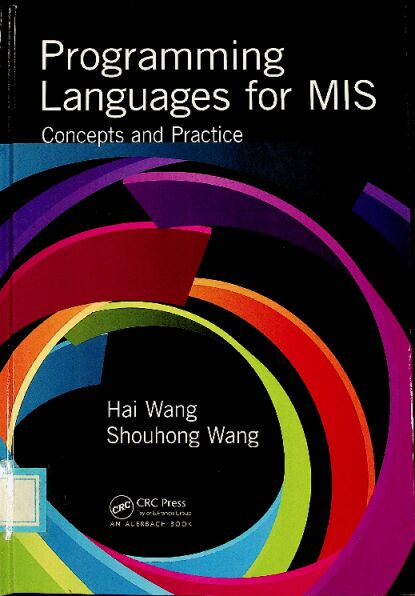
书名:Programming languages for MIS
责任者:Hai7 Wang | Shouhong Wang. | Wang, Hai,
摘要
Programming Languages for MIS: Concepts and Practice supplies a synopsis of the major computer programming languages, including C++, HTML, JavaScript, CSS, VB.NET, C#.NET, ASP.NET, PHP (with MySQL), XML (with XSLT, DTD, and XML Schema), and SQL. Ideal for undergraduate students in IS and IT programs, this textbook and its previous versions have been used in the authors' classes for the past 15 years.
Focused on web application development, the book considers client-side computing, server-side computing, and database applications. It emphasizes programming techniques, including structured programming, object-oriented programming, client-side programming, server-side programming, and graphical user interface.
Introduces the basics of computer languages along with the key characteristics of all procedural computer languages
Covers C++ and the fundamental concepts of the two programming paradigms: function-oriented and object-oriented
Considers HTML, JavaScript, and CSS for web page development
Presents VB.NET for graphical user interface development
Introduces PHP, a popular open source programming language, and explains the use of the MySQL database in PHP
Discusses XML and its companion languages, including XSTL, DTD, and XML Schema
With this book, students learn the concepts shared by all computer languages as well as the unique features of each language. This self-contained text includes exercise questions, project requirements, report formats, and operational manuals of programming environments. A test bank and answers to exercise questions are also available upon qualified course adoption.
This book supplies professors with the opportunity to structure a course consisting of two distinct modules: the teaching module and the project module. The teaching module supplies an overview of representative computer languages. The project module provides students with the opportunity to gain hands-on experience with the various computer languages through projects.
查看更多
目录
PREFACE xi
THE AUTHORS xv
ACKNOWLEDGMENTS xvii
CHAPTER 1 INTRODUCTION 1
1.1 Computers 1
1.2 Computer Programming Languages 1
1.2.1 Role of Computer Programming Language 1
1.2.2 Software Systems 2
1.2.3 Taxonomies of Computer Programming Languages 3
1.3 Computing Architecture in the Internet Environment 4
1.4 Key Characteristics Shared by All Procedural Programming Languages 5
1.4.1 Syntax, Sentence, and Word 5
1.4.2 Variable 5
1.4.3 Arithmetic Operation 6
1.4.4 Execution Sequence 6
1.4.5 If-Then-Else Logic 6
1.4.6 Loop 6
1.4.7 Module 7
CHAPTER 2 C++ 9
2.1 Introduction to Function-Oriented and Object-Oriented Programming 9
2.2 A Tour of C Language 9
2.2.1 C and C++ Keyword and User-Defined Word 14
2.2.2 Comment Statements 14
2.2.3 Preprocessor 14
2.2.4 Namespace 14
2.2.5 Structure of a C Program, Functions, and Arguments 15
2.2.6 Statements and Semicolon 16
2.2.7 Data Type 16
2.2.8 Arithmetic Operations 16
2.2.9 for-Loop 17
2.2.10 printf ( ) Statement with Conversion Specifier 18
2.2.11 if-Statement 18
2.2.12 String and String Processing 20
2.3 Functional Approach 20
2.3.1 Functional Decomposition 20
2.3.2 A Simple Example of User-Defined Function 21
2.3.3 Declaration of User-Defined Function 22
2.3.4 Calling-Function and Called-Function 22
2.3.5 Structure Diagram 23
2.3.6 An Example of Two Functions 23
2.3.7 An Example of Multiple Functions 25
2.4 Object-Oriented Approach 29
2.4.1 Object and Class 29
2.4.2 Descriptions of Class 31
2.4.3 public and private Statements 32
2.4.4 Constructor 32
2.4.5 Use of Class—Declare Object and Message Sending 32
2.5 Design of Objected-Oriented Program 35
2.6 Connection between Classes—An Example with Two Classes 39
2.7 An Example of Inheritance 43
2.8 Identify Class 48
2.9 Debugging 48
Appendix 2.1: Commonly Used C and C++ Keywords 52
C and C++ Keywords 52
C++ Only Keywords 52
CHAPTER 3 HTML, JAVASCRIPT, AND CSS 53
3.1 Introduction to the Internet 53
3.2 Creating Web Pages Using HTML 54
3.3 Simple Container Tags 55
3.3.1 55
3.3.2 and 55</h4><h4> 3.3.3 <BODY> 55</h4><h4> 3.3.4 Comments <!-- ... --> 55</h4><h4> 3.3.5 Headings <H1> <H2> ... <H6> 56</h4><h4> 3.3.6 <P> 56</h4><h4> 3.3.7 <I> 56</h4><h4> 3.3.8 <TABLE>, <TH>, <TR>, and <TD> 56</h4><h4> 3.3.9 <A> 56</h4><h4> 3.3.10 <CENTER> 56</h4><h4>3.4 Empty Tags 56</h4><h4> 3.4.1 <HR> 56</h4><h4> 3.4.2 <BR> 56</h4><h4> 3.4.3 <IMG> 57</h4><h4>3.5 Complex Container Tags 59</h4><h4> 3.5.1 <FORM> 59</h4><h4> 3.5.1.1 Attribute ACTION 59</h4><h4> 3.5.1.2 Attribute METHOD 60</h4><h4> 3.5.1.3 <INPUT> and Its Attributes TYPE, NAME, SIZE, and VALUE 60</h4><h4> 3.5.2 FRAME and FRAMESET 60</h4><h4>3.6 Publish Web Page 61</h4><h4>3.7 Introduction to JavaScript 61</h4><h4>3.8 Image Manipulation 62</h4><h4> 3.8.1 Object Classes and Their Methods and Attributes 63</h4><h4> 3.8.2 Event Handler 64</h4><h4>3.9 FORM Input Data Verification 64</h4><h4> 3.9.1 Comparison of JavaScript with C and C++ 66</h4><h4> 3.9.2 Function and Calling a Function 67</h4><h4> 3.9.3 String Processing 68</h4><h4> 3.9.4 if-Statement 68</h4><h4> 3.9.5 alert-Statement 69</h4><h4>3.10 FORM Data Calculation 69</h4><h4>3.11 Cookies 71</h4><h4>3.12 Miscellaneous JavaScript Statements 74</h4><h4> 3.12.1 new Statement 74</h4><h4> 3.12.2 Miscellaneous Functions and Methods 74</h4><h4>3.13 Cascading Style Sheet 74</h4><h4> 3.13.1 Inline CSS 75</h4><h4> 3.13.2 Internal CSS 76</h4><h4> 3.13.3 External CSS 79</h4><h4>3.14 Debugging Source Code of Web Pages 80</h4><h4>Appendix 3.1: List of HTML Commonly Used Tags 85</h4><h4>Appendix 3.2: JavaScript Reserved Words and Other Keywords 86</h4><h4>JavaScript Reserved Words 86</h4><h4 style="font-weight: bold;" >CHAPTER 4 VB.NET 87</h4><h4>4.1 Graphical User Interface 87</h4><h4>4.2 Microsoft Visual Studio and VB.NET Environment 87</h4><h4>4.3 Event Driven 90</h4><h4>4.4 Example of a Single Form 93</h4><h4>4.5 Multiple Forms 96</h4><h4> 4.5.1 Design Forms 96</h4><h4> 4.5.2 Module 98</h4><h4> 4.5.3 Class 99</h4><h4> 4.5.4 Coding 100</h4><h4>4.6 Programming with VB.NET 106</h4><h4> 4.6.1 General Format of Code, Comments, and Keywords 106</h4><h4> 4.6.2 Class and Object 108</h4><h4> 4.6.3 Methods 108</h4><h4> 4.6.4 Constant Variables 109</h4><h4> 4.6.5 Data Types 109</h4><h4> 4.6.6 Arithmetic Operations 109</h4><h4> 4.6.7 If-Then-Else Statement 110</h4><h4> 4.6.8 For-loop 110</h4><h4> 4.6.9 String Processing and Format Statement 110</h4><h4> 4.6.10 Print Document 110</h4><h4> 4.6.11 Message Box 111</h4><h4>4.7 Debugging 111</h4><h4 style="font-weight: bold;" >CHAPTER 5 C#.NET 115</h4><h4>5.1 Microsoft Visual Studio and C# Programming Environment 115</h4><h4>5.2 C# Program Structure 117</h4><h4>5.3 Run a C# Console Application Program 117</h4><h4>5.4 C# Syntax 118</h4><h4> 5.4.1 Arrays and foreach loop 119</h4><h4> 5.4.2 Command Line Arguments 120</h4><h4> 5.4.3 Functions 121</h4><h4>5.5 Examples of Console Application 123</h4><h4>5.6 Windows Forms Application 127</h4><h4>5.7 Examples of Windows Forms Application 130</h4><h4>5.8 Debugging 138</h4><h4 style="font-weight: bold;" >CHAPTER 6 ASP.NET 145</h4><h4>6.1 Introduction to ASP.NET 145</h4><h4>6.2 ASP.NET with VB.NET 146</h4><h4> 6.2.1 Structure of ASP.NET Program 147</h4><h4> 6.2.2 HTML Controls Versus ASP.NET Web Controls 149</h4><h4> 6.2.3 HTML Controls 149</h4><h4> 6.2.3.1 Submit Button 150</h4><h4> 6.2.3.2 Textbox 150</h4><h4> 6.2.3.3 Checkbox 151</h4><h4> 6.2.3.4 Radio Button 152</h4><h4> 6.2.3.5 Select 153</h4><h4> 6.2.4 Web Controls 154</h4><h4> 6.2.5 Validation Controls 156</h4><h4> 6.2.6 The Code-Behind Programming Framework 157</h4><h4> 6.2.7 Server-Side File Processing 159</h4><h4> 6.2.8 Accessory Features 162</h4><h4> 6.2.8.1 Sending E-mail Message 162</h4><h4> 6.2.8.2 Calendar 163</h4><h4> 6.2.8.3 Redirect Method 164</h4><h4> 6.2.8.4 Security 166</h4><h4> 6.2.9 Web Application Design 168</h4><h4> 6.2.10 ADO.NET—Server-Side Database Processing 172</h4><h4> 6.2.10.1 Database Connection and SQL in ASP.NET 173</h4><h4> 6.2.10.2 Search Database 175</h4><h4> 6.2.10.3 Update Database 177</h4><h4> 6.2.10.4 Use Data of Database for Decision 177</h4><h4>6.3 ASP.NET with C#.NET 179</h4><h4> 6.3.1 C# Programming with ASP.NET Web Controls 179</h4><h4> 6.3.2 Code-Behind Programming 184</h4><h4> 6.3.3 Server-Side File Processing 185</h4><h4> 6.3.4 <asp:SqlDataSource> Control for Database Processing 192</h4><h4>6.4 Debugging 195</h4><h4 style="font-weight: bold;" >CHAPTER 7 PHP 201</h4><h4>7.1 Introduction to PHP and PHP Development Environment 201</h4><h4>7.2 Format of PHP Program 202</h4><h4>7.3 Structure of PHP Program 205</h4><h4>7.4 Activate PHP in Web Page and Process Form Data on Server 206</h4><h4>7.5 Programming in PHP 207</h4><h4> 7.5.1 PHP Functions 207</h4><h4> 7.5.2 if-Statement 209</h4><h4> 7.5.3 Read Data File from Server 209</h4><h4> 7.5.4 fopen() and fclose() 210</h4><h4> 7.5.5 feof() and fgets() 211</h4><h4> 7.5.6 while-loop 211</h4><h4> 7.5.7 Write Data File to Server and fputs () 211</h4><h4>7.6 Relay Data through Multiple Dynamic Web Pages Using Hidden Fields 212</h4><h4>7.7 Example of Web Application Design 215</h4><h4>7.8 PHP and MySQL Database 219</h4><h4> 7.8.1 Set MySQL Database 219</h4><h4> 7.8.2 Create and Delete Table in PHP Using SQL 221</h4><h4> 7.8.3 Insert Data to Table 222</h4><h4> 7.8.4 Access Database 222</h4><h4> 7.8.5 Search Database 224</h4><h4> 7.8.6 Use ODBC Connection 225</h4><h4>7.9 Debugging 225</h4><h4 style="font-weight: bold;" >CHAPTER 8 XML 229</h4><h4>8.1 Introduction to XML 229</h4><h4> 8.1.1 HTML Documents Are Difficult to Process 229</h4><h4> 8.1.2 Databases Need Common Data Format to Exchange Data 230</h4><h4>8.2 XML Documents Are Data Sheets 231</h4><h4> 8.2.1 XML Instance Documents 231</h4><h4> 8.2.2 Declaration 232</h4><h4> 8.2.3 Tags and Element 232</h4><h4> 8.2.4 Attribute 232</h4><h4> 8.2.5 Comment Line and Editorial Style 233</h4><h4>8.3 Cascading Style Sheets 233</h4><h4>8.4 Extensible Style Language 234</h4><h4> 8.4.1 <xsl: stylesheet> 235</h4><h4> 8.4.2 <xsl :template> 235</h4><h4> 8.4.3 HTML Presentation 235</h4><h4> 8.4.4 <xsl:value-of> 235</h4><h4> 8.4.5 Empty Tag 236</h4><h4> 8.4.6 <xsl: for-each> 236</h4><h4>8.5 XML Data Tree 236</h4><h4>8.6 CSS Versus XSLT 237</h4><h4>8.7 Document Type Definition and Validation 239</h4><h4> 8.7.1 Simple Example of Internal DTD 240</h4><h4> 8.7.2 Simple Example of External DTD 240</h4><h4> 8.7.3 < !DOCTYPE> 241</h4><h4> 8.7.4 <!ELEMENT> 241</h4><h4> 8.7.5 <!ATTLIST> 242</h4><h4> 8.7.6 <!ENTITY> 242</h4><h4>8.8 XML Schema 242</h4><h4> 8.8.1 Schema Element 243</h4><h4> 8.8.2 Data Element, Attribute, and Data Type 244</h4><h4> 8.8.3 complexType 244</h4><h4> 8.8.4 sequence 244</h4><h4> 8.8.5 Cardinality 244</h4><h4> 8.8.6 Attribute 244</h4><h4> 8.8.7 XML Validation 244</h4><h4>8.9 Summary of Application of XML 245</h4><h4>8.10 An Example of XML Application 246</h4><h4>8.11 Advanced Subjects of XML 251</h4><h4> 8.11.1 Conversion of Relational Database into XML Tree 251</h4><h4> 8.11.2 xlink and xsl : if 254</h4><h4> 8.11.2.1 xlink 259</h4><h4> 8.11.2.2 <xsl : if > 260</h4><h4>8.12 XHTML 260</h4><h4>8.13 XBRL 262</h4><h4> 8.13.1 Comparison of XBRL with XML 262</h4><h4> 8.13.2 Taxonomy 263</h4><h4> 8.13.3 Prepare XBRL-Based Reports 263</h4><h4 style="font-weight: bold;" >CHAPTER 9 SQL 267</h4><h4>9.1 Introduction to SQL 267</h4><h4>9.2 CREATE and DROP 267</h4><h4>9.3 INSERT, UPDATE, DELETE 268</h4><h4>9.4 Query—SELECT 269</h4><h4>9.5 WHERE Clause and Comparison 271</h4><h4>9.6 ORDER BY Clause 272</h4><h4>9.7 Aggregate Functions 273</h4><h4>9.8 GROUP BY Clause and HAVING Clause 273</h4><h4>9.9 Joining Tables 274</h4><h4>9.10 Subquery 275</h4><h4> 9.10.1 Subquery—Reducing Computational Workload of Join Operation 275</h4><h4> 9.10.2 Subquery as an Alternative to GROUP BY 277</h4><h4> 9.10.3 Subquery—Determining an Uncertain Criterion 277</h4><h4>9.11 Tactics for Writing Queries 278</h4><h4>9.12 SQL Embedded in Host Computer Programming Languages 278</h4><h4>INDEX 281</h4></div>
<span id="tocShowPDF" data-src="https://bookreviews.nstl.gov.cn/data_import/toc/20220721150823157667-N2015072300098637-contents.pdf" class="expand-toggle">查看PDF</span><br />
<span id="tocShowMore" class="expand-toggle">查看更多</span>
<hr>
<h3>作者简介</h3>
<div id="bio" class="content-box">
<h4 class="content-line-height">Hai Wang is an associate professor at the Sobey School of Business at Saint Mary's University, Halifax, Nova Scotia, Canada. He received his BSc in computer science from the University of New Brunswick, and his MSc and PhD in computer science from the University of Toronto. He has published more than 50 research articles in the areas of MIS, big data, data mining, database management, knowledge management, and e-business. His research has continuously been funded by the Natural Sciences and Engineering Research Council of Canada in the past years. PA\Shouhong Wang is a professor at University of Massachusetts, Dartmouth. He received his PhD in information systems from McMaster University. He has over 30 years' experience of higher education in the MIS field. He has published more than 100 research papers in academic journals and several books on the subject of MIS.</h4>
</div>
<span id="bioShowMore" class="expand-toggle">查看更多</span>
<hr>
<h3>馆藏单位</h3>
<div id="libraryName" class="content-box">
<h4 class="content-line-height">
中科院文献情报中心 </h4>
</div>
</div>
</div>
<footer>
<div class="banquan">
<div class="jvzhong">
<img src="img/blue.png" alt="" />
<div class="bqtxt">
<p>© Copyright(C)2008 NSTL.All Rights Reserved 版权所有</p>
<p>国家科技图书文献中心咨询热线:800-990-8900 010-58882057 Email:service@nstl.gov.cn </p>
<p>地址:北京市复兴路15号 100038 京ICP备10027328号</p>
</div>
</div>
</div>
</footer>
</body>
</html>