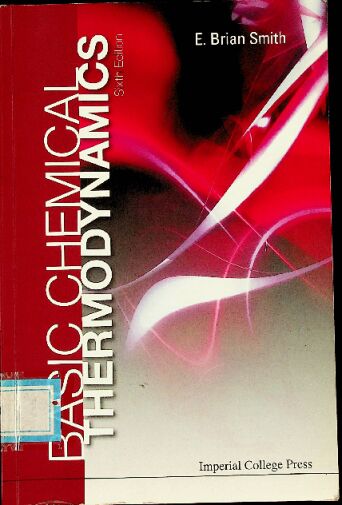
书名:Basic chemical thermodynamics
ISBN\ISSN:9781783263363,9781783263356
出版时间:2014
出版社:Imperial College Press,
摘要
This widely acclaimed text, now in its sixth edition and translated into many languages, continues to present a clear, simple and concise introduction to chemical thermodynamics. An examination of equilibrium in the everyday world of mechanical objects provides a starting point for an accessible account of the factors that determine equilibrium in chemical systems. This straightforward approach leads students to a thorough understanding of the basic principles of thermodynamics, which are then applied to a wide range of physical chemical systems. The book also discusses the problems of non-ideal solutions and the concept of activity, and provides an introduction to the molecular basis of thermodynamics. Over six editions, the views of teachers of the subject and their students have been incorporated. Reference to the phase rule has been included in this edition and the notation has been revised to conform to current IUPAC recommendations. Students taking courses in thermodynamics will continue to find this popular book an excellent introductory text.
查看更多
目录
Preface to the sixth edition v
Preface to the first edition vu
Notation xv
1 Introduction 1
1.1 The scope and nature of chemical thermodynamics 1
1.2 Equilibrium in mechanical systems 2
1.3 Reversibility and equilibrium 4
I.4 Why we need thermodynamics 6
I 5 The mole 9
1.6 The perfect gas 10
2 Energy 13
2.1 Work 13
2.2 Heat and temperature 15
2.3 Measurement of temperature 16
2.4 Heat and molecular motion 16
2.5 Conservation of energy 17
2.6 State functions a digression 19
2.7 Enthalpy 22
2.8 Heat capacity 24
Problems 25
3 Entropy and equilibrium 27
3.1 Reversibility and equilibrium a recapitulation 27
3.2 Condition of equilibrium 29
3.3 Entropy 29
3.4 Entropy as state function 32
3.5 Entropy of expansion of a gas 33
3.6 Entropy changes accompanying heat flow 34
3.7 Entropy and equilibrium 34
3.8 A cosmological aside 35
3.9 Entropy as a function of pressure and temperature 37
3.10 Molecular basis of entropy 39
3.11 Statistical basis of the Second Law 40
3.12 Magnitudes of entropy changes 41
3.13 Heat engines 43
Problems 43
4 Equilibrium in chemical systems 45
4.1 Free energy 45
4.2 Gibbs energy 47
4.3 Pressure-ctependence of Gibbs energy 50
4.4 Temperature va1iation of Gibbs energy 51
4.5 Phase equilibria 52
4.6 Clapeyron equation 55
4.7 Clausius-Cl apeyron equation 56
4.8 The vapour pressure of liquids 57
4.9 Chemical potential 60
4.10 Chemical potential and Gibbs energy 61
4.11 Equilibrium between gaseous reactants 64
4.12 Temperature-depend ence of equilibrium constants 67
4.13 Effect of pressure on equilibrium constants 70
4.14 Basic results of chemical thermodynamics 74
4.15 Le Chatelier's Principle 74
Problems 75
5 Determination of thermodynamic quantities 77
5.1 Hess’s Law 77
5.2 Standard enthalpies of formation 79
5.3 Average bond energies 80
5.4 Temperature-dependence of enthalpy changes 81
5.5 Standard Gibbs energies of formation 82
5.6 Determination of Gibbs energy changes 83
5.7 Determination of entropies of substances 84
5.8 Example of the determination of thermodyn amic quant1t1es 86
5.9 Calculation of thermodynamic quantities at temperatures other than 298K 92
5.10 Ellingham diagrams 94
5.11 Free-energy functions 96
Problems 97
6 Ideal solutions 99
6.1 The ideal solution 99
6.2 Properties of truly ideal solutions 102
6.3 Mixtu res of liquids 103
6.4 Tdeal solutions of solids in liquids 105
6.5 Ideal dilute solutions 109
6.6 Colligati ve properties 110
6.7 Freezing-point depression 110
6.8 Elevation of boiling point 114
6.9 Osmotic pressure 118
6.10 Properties of the solute in dilute solutions 120
6.11 SolubiLity of solids 122
Problems 123
7 Non-ideal solutions 125
7.1 The concept of activity 125
7.2 Activity of solids in liquids 127
7.3 Activity in aqueous solutions 128
7.4 Chemical equilibria in solution 132
7.5 Electrochemical cells 134
7.6 Standard electrode potentials 138
Problems 143
8 Thermodynamics of gases 145
8.1 Expansion of a perfect gas 145
8.2 Irreversible expansion 146
8.3 Equation of state of gases 149
8.4 The Joule-Thomson experiment 150
8.5 Imperfect gases fugacity 152
8.6 Calculation of fugacities 154
Problems 155
9 The molecular basis of thermodynamics 157
9.1 Energy levels 157
9.2 Microstates 160
9.3 The Boltzmann factor 162
9.4 The behaviour of heat capacity 165
9.5 Partition functions 168
9.6 Entropy and the partition function 170
9.7 Calculation of the translational partition function 175
9.8 The rotational partition function 177
9.9 The vibrational partition function 178
9.10 Evaluation of the thermodynamic properties of gaseous nitrogen 179
9.11 Chemical equilibrium 181
Problems 185
Answers to problems 187
Further reading 189
Appendix 1 Thermochemical data at 298.15 K 191
Appendix 2 Thermodynamic data for ions in aqueous solution at 298.15 K 195
Appendix 3 Units and fundamental constants 197
Periodic table of elements 201
Index 203
查看更多
馆藏单位
中科院文献情报中心