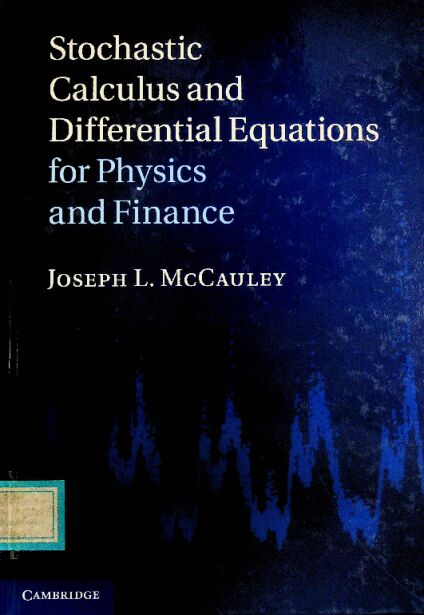
书名:Stochastic calculus and differential equations for physics and finance
ISBN\ISSN:9780521763400,0521763401
出版时间:2013
出版社:Cambridge University Press
摘要
Stochastic calculus provides a powerful description of a specific class of stochastic processes in physics and finance. However, many econophysicists struggle to understand it. This book presents the subject simply and systematically, giving graduate students and practitioners a better understanding and enabling them to apply the methods in practice. The book develops Ito calculus and Fokker–Planck equations as parallel approaches to stochastic processes, using those methods in a unified way. The focus is on nonstationary processes, and statistical ensembles are emphasized in time series analysis. Stochastic calculus is developed using general martingales. Scaling and fat tails are presented via diffusive models. Fractional Brownian motion is thoroughly analyzed and contrasted with Ito processes. The Chapman–Kolmogorov and Fokker–Planck equations are shown in theory and by example to be more general than a Markov process. The book also presents new ideas in financial economics and a critical survey of econometrics.
查看更多
目录
Abbreviations page xi
Introduction 1
1 Random variables and probability distributions 5
1.1 Particle descriptions of partial differential equations 5
1.2 Random variables and stochastic processes 7
1.3 The n-point probability distributions 9
1.4 Simple averages and scaling 10
1.5 Pair correlations and 2-point densities 11
1.6 Conditional probability densities 12
1.7 Statistical ensembles and time series 13
1.8 When are pair correlations enough to identify a stochastic process? 16
Exercises 17
2 Martingales, Markov, and nonstationarity 18
2.1 Statistically independent increments 18
2.2 Stationary increments 19
2.3 Martingales 20
2.4 Nonstationary increment processes 21
2.5 Markov processes 22
2.6 Drift plus noise 22
2.7 Gaussian processes 23
2.8 Stationary vs. nonstationary processes 24
Exercises 26
3 Stochastic calculus 28
3.1 The Wiener process 28
3.2 Ito's theorem 29
3.3 Ito's lemma 30
3.4 Martingales for greenhorns 31
3.5 First-passage times 33
Exercises 35
4 Ito processes and Fokker-Planck equations 37
4.1 Stochastic differential equations 37
4.2 Ito's lemma 39
4.3 The Fokker-Planck pde 39
4.4 The Chapman-Kolmogorov equation 41
4.5 Calculating averages 42
4.6 Statistical equilibrium 43
4.7 An ergodic stationary process 45
4.8 Early models in statistical physics and finance 45
4.9 Nonstationary increments revisited 48
Exercises 48
5 Selfsimilar Ito processes 50
5.1 Selfsimilar stochastic processes 50
5.2 Scaling in diffusion 51
5.3 Superficially nonlinear diffusion 53
5.4 Is there an approach to scaling? 54
5.5 Multiaffine scaling 55
Exercises 56
6 Fractional Brownian motion 57
6.1 Introduction 57
6.2 Fractional Brownian motion 57
6.3 The distribution of fractional Brownian motion 60
6.4 Infinite memory processes 61
6.5 The minimal description of dynamics 62
6.6 Pair correlations cannot scale 63
6.7 Semimartingales 64
Exercises 65
7 Kolmogorov's pdes and Chapman-Kolmogorov 66
7.1 The meaning of Kolmogorov's first pde 66
7.2 An example of backward-time diffusion 68
7.3 Deriving the Chapman-Kolmogorov equation for an Ito process 68
Exercise 70
8 Non-Markov Ito processes 71
8.1 Finite memory Ito processes? 71
8.2 A Gaussian Ito process with 1-state memory 72
8.3 McKean's examples 74
8.4 The Chapman-Kolmogorov equation 78
8.5 Interacting system with a phase transition 79
8.6 The meaning of the Chapman-Kolmogorov equation 81
Exercise 82
9 Black-Scholes, martingales, and Feynman-Kac 83
9.1 Local approximation to sdes 83
9.2 Transition densities via functional integrals 83
9.3 Black-Scholes-type pdes 84
Exercise 85
10 Stochastic calculus with martingales 86
10.1 Introduction 86
10.2 Integration by parts 87
10.3 An exponential martingale 88
10.4 Girsanov's theorem 89
10.5 An application of Girsanov's theorem 91
10.6 Topological inequivalence of martingales with Wiener processes 93
10.7 Solving diffusive pdes by running an Ito process 96
10.8 First-passage times 97
10.9 Martingales generally seen 102
Exercises 105
11 Statistical physics and finance: A brief history of each 106
11.1 Statistical physics 106
11.2 Finance theory 110
Exercise 115
12 Introduction to new financial economics 117
12.1 Excess demand dynamics 117
12.2 Adam Smith's unreliable hand 118
12.3 Efficient markets and martingales 120
12.4 Equilibrium markets are inefficient 123
12.5 Hypothetical FX stability under a gold standard 126
12.6 Value 131
12.7 Liquidity, reversible trading, and fat tails vs. crashes 132
12.8 Spurious stylized facts 143
12.9 An sde for increments 146
Exercises 147
13 Statistical ensembles and time-series analysis 148
13.1 Detrending economic variables 148
13.2 Ensemble averages and time series 149
13.3 Time-series analysis 152
13.4 Deducing dynamics from time series 162
13.5 Volatility measures 167
Exercises 168
14 Econometrics 169
14.1 Introduction 169
14.2 Socially constructed statistical equilibrium 172
14.3 Rational expectations 175
14.4 Monetary policy models 177
14.5 The monetarist argument against government intervention 179
14.6 Rational expectations in a real, nonstationary market 180
14.7 Volatility, ARCH, and GARCH 192
Exercises 195
15 Semimartingales 196
15.1 Introduction 196
15.2 Filtrations 197
15.3 Adapted processes 197
15.4 Martingales 198
15.5 Semimartingales 198
Exercise 199
References 200
Index 204
查看PDF
查看更多
作者简介
Joseph L. McCauley is Professor of Physics at the University of Houston. During his career he has contributed to several fields, including statistical physics, superfluids, nonlinear dynamics, cosmology, econophysics, economics and finance theory.
查看更多
馆藏单位
中科院文献情报中心