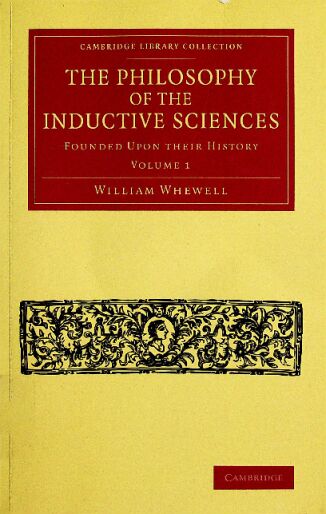
书名:The philosophy of the inductive sciences
出版时间:2014
出版社:Cambridge University Press,
前言
THE Work now before the Reader is intended as an application of the Plan of Bacon'sNovum Organum to the present condition of Physical Science. The progress of such Science during the last three centuries has given us the means of inquiring, with advantages which former generations did not possess, what that Organ,or intellec- tual method, is,by which solid truth is to be extracted from the observation of Nature;and though the attempt to discover this cannot but be an arduous undertaking, it is so plainly required of the present generation, that any one engaging in it with sobriety and industry, may claim to have his labours soberly and tolerantly estimated. I shall,therefore,make no apology for what might otherwise appear the presumption of such a design. My scheme is, however, narrower than Bacon's in this respect, that I have in the present work confined myself to those branches of human knowledge which have external nature for their object, and are often exclusively termed Sciences. The reason given for this limitation in the following pages,(namely, that it seemed proper to collect our philosophy of knowledge from the most certain and distinct portions of knowledge alone,)will,I trust, be considered as an adequate justification of the course pursued.
Many writers,both before and since Bacon, have employed themselves upon the subjects with which we are here concerned;—the philosophy of knowledge, and the methods of arriving at science: and I have availed myself of theirconclusiong,where they appeared to be real additions to sound philosophy. I must add,that I have not scrupled to subjeet their speculations to a critical examination, and to reject all that was thus found to be erroneous or worthless. A system which professes to give a view of the nature of knowledge, supplies canons of criticism by which all other philosophical doctrines must be tried, in order to determine their import and reality. It is an office essentially connected with the exposition of such a system, to pronounce on the value of previous essays of the same kind. Hence I have not hesitated, on some occasions, to dissent from the great masters of the philosophy of science,from Bacon, from Cuvier, and even from Newton himself; believing that they, upon maturer consideration,would have been led to those doc- trines and precepts which I have preferred to theirs. In like manner, although I have adopted Kant's reasoning respecting the nature of Space and Time,it will be found by any one acquainted with the system of that acute metaphysician, that my views difer widely from his. I have also ventured to condemn some of the opinions respecting physical philosophy,published by another emi- nent German writer(Schelling) to whose works I have in other subjects great obligations.
The present work was announced in the outset of a History of the Indwctive Sciences which was published three years ago.That History was,indeed, the result of labours undertaken with a view to the formation of a Philosophy of Science, and was intended from the first as an intro- duction to a work on that subject. I may therefore take the liberty of saying that I have as yet seen no reason to wish to make any material change in the History,as it is now before the world. I will not omit this opportunity of expressing my obligations to the German translator of the History*. It is a testimony which may well give an author some confidence in the value of his work, that one of the most eminent men of science in Europe should spontaneously postpone other tasks in order to give it, with the most flattering expressions, to the public of his own country. I may add that a Review of my History which has appeared in our own language has tended in no small degree to convince me that the work contains few material errors,and none which are of any importance with regard to its general scope. The Reviewer, ob- viously an enemy eager to find faults, was able to detect but very few passages which are really mistakest. Other critics lave made objections of various kinds to* The History of the Inductive Sciences has been translated into German by M.Von Littrow,Director of theImperial Observatory at Vienna, and author of many well-known mathematical works.十 See Edinburgh Review,No.cxxxi.p.129; also No.cxxxvi,p. 274. ButI am compelled by justice to acknowledge that the value of this testimony is materilly weakened by the Reviewer's extremelaxity and obscurity of view with regard to the nature of science;—defects which makehis judgment on such subjects nearly worthless.
that part of the History which relates to Physiology; but none which it is necessary to notice here. I regret that my plan should again lead me, in the present work, to trespass upon the domain of the physiologists.Those who have well studied that subject, feel a persuasion,a very natural and just one, that nothing less than a life profes- sionally devoted to the science, can entitle a person to decide the sill controverted questions which it involves; and hence they look, with a reasonable jealousy, upon attempts to discuss such questions, made by a lay specu- lator. I trust it will be found that I have not,in the present work,asserted any opinions on such subjects, with- out alleging sufficient reasons. Such discussions as I have introduced, appeared to me to be requisite to com- plete the philosophy of science: the value of the opinions thus delivered, it must be left to physiologists, present and future, to decide.
In writing the History,I was led,on several occasions, topass on from the facts to thelessons of philosophy which they suggest. I have now,in three or four instances, taken the liberty of restoring reflections so made to their proper place,by incorporating a few phrases, or here and there a sentence, from the History,in the present work. I think it right to mention this, that those who read both works may not deem me guilty of careless repetition.
Perhaps I shall be charged with having employed the term Idewin an unusual manner in these pages. Almost every writer who has introduced that term into his speculations,has been accused,by succeeding critics,of some degree of vagueness and vacillation in its use. The mode in which I have applied it appears to me very defi- nite. The grounds of the universal and necessary truths which we are able to assert in various departments of knowledge, reside in certain general forms of apprehen- sion,or relations of our conceptions; as Space,Time, Cause;and these I term Ideas;or,when ambiguity is to be guarded against, Fwndamental Ideas. If I could have found any other word or phrase which,in common usage, came nearer to this meaning,I should have been glad to adopt it. I have employed the word Conception to ex- press that which is,I think, its common signification;— our Conceptions are that,in the mind,which we denote by our General Terms, as a Triangle, a Squwre Number, a Force. But still,this term,in the present work,implies principles which have not been employed, at least not commonly, by previous writers.For in the course of my speculations, I am further led to speak of such Concep- tions as Modifications of our Fundamental Ideas; and as deriving from the Ideas their power of leading touni- versal and necessary truths. In instances in which no obscurity appeared likely to arise,I may, perhaps,occa- sionally have employed the terms Idea, Concepion, Notion,and others, with less discrimination.
Bacon's purpose and promise was,that his New Organ should produce material as well as intellectual profit;— works, as well as knowledge. That the study of the order of nature does add to man's power, the history of the sciences since Bacon hag abundantly shown. But though this hope ofderivative advantages may stimulate our exertions, it cannot govern our methods of seeking knowledge,without leading us away from the most general and genuine forms of knowledge. The nature of knowledgemust be studied in itself and for its own sake, before we attempt to lesr what external rewards it will bringus.Ihave,therefore, not aimed at imitating Bacon in those parts of his work, in which he contemplates the increase of man's dominion over nature, as the main object of natural philosophy;being fully persuaded that if Bacon himself had lad unfolded before him the great theories which have been established since his time, he would have acquiesced in the contemplation of them; and would have readily proclaimed the real reason for aiming at the knowledge of such truths to be, that they are true. Thus I have ventured to separate his frst Aphorism*into two;to consider the Interpretation as our primary object, not the minisration; the hnowing,not the doing; the Intelligence, not the Power.
查看更多
目录
PREFACE ix
Aphorisms respecting Ideas xvii
Aphorisms respecting Knowledge xxxvii
Aphorisms respecting the Language of Science xlviii
Aphorism I.relative to the Ancient Period xlix
1. Common Words xlix
2.Descriptive Terms lii
3. Theoretical Terms liv
Aphorism II.relative to the Modern Period lix
1.Systematic Nomenclature lx
2.Systematic Terminology lxi
3. Systematic Modification lxiv
Aphorisms(III.,IV.,V.,VI.,VII.)relative to the Appropriation of Common Words lxvii
Aphorisms(VIII.,IX,X.,XI.,XII,XII.,XIV.) relative to the Construction of New Terms lxxiii
Aphorism XV.,relative to the Form of Terms xcvi
1. Terms derived from Latin and Greek xxcvi
3.German Terms xcvii
3. Descriptive Terms c
4. Nomenclature. Zoology c
5.Mineralogy cii
6.Botany cii
7.Chemistry cii
8. Crystallography ciii
Aphorism XVI., relative to the composition and inflexion of Terms cv
1.Hybrids cvi
2. Terminations of Adjectives cvii
3. Formation of Substantives (names of things) cviii
4. Abstract Substantives cxiii
5. Rules of derivation from Greek and Latin cxiv
6. Modifications of Terminations cxv
Aphorism XVII.,relative to the mode of introducing Changes cxvi
PART L-DF IDEAS
BooK I-Of Ideas in General.
CHAP.1. Introductron 3
2.Of Faots and Theories 18
3. Of Sensations and Ideas 25
4. Of theDifferenceand Opposition of Sensation and Ideas 28
5. Of Ideal Conceptions 36
6. Of Induction 41
7.Of Successive Generalizations 45
8. Of Technical Terms 50
9.Of Necessary and Contingent Truths 53
10. Of Experience 59
11. Of the Grounds of Necessary Truths 63
12. The FundamentalIdeas are not derived from Experience 71
13. Of the Philosophy of the Sciences 75
BooK II.—TEr PhπosoPRY OF THE PuRE ScIENCES
CHAP1. Of the Pure Sciences 79
2. Of the Idea of Space 81
3. Of some Peculiarities of the Idea of Space 85
4. Of the Definitions and Axioms which relate to Space 88
5. Of some Objections to the Previous Doctrines 98
6. Of the Perception of Space 108
*6. Of the Idea of Time 121
7.Of some Peculiarities of the Idea of Time 124
8.Of the Axioms which relate to Number 128
9.Of the Perception of Time and Number 131
10. Of Mathematical Beasoning 135
11. Of the Foundations of the Higher Mathematics 139
12. Of the Doctrine of Motion 144
13. Of the Application of Mathematics to the Inductive Sciences 147
BooK III—Tee PHILo8oPHY oF THE MECHANICAL ScrENCES.
CHAP1.Of the Mechanical Sciences 157
2. Of the Idea of Cause 159
3. Modern Opinions respecting the Idea of Cause 163
4.Of the Axioms which relate to the Idea of Cause 169
5. Of the Origin of our Conceptions of Force and Matter 177
6.Of the Establishment of the Principles of Statics 184
7.Of the Establishment of the Principles of Dynamics 207
8. Of the Paradox of Universal Propositions established by Experience 237
9.Of the Establishment of the Law of Universal Gravitation 246
10.Of the General Diffusion of Clear Mechanical Ideas 253
Bo0K IV.—THn PHILosoPny oF THE SEcoNDARY MECHANICAL SCcIENCES
CHAP.1.Of the Idea of a Medium as commonly employed 267
2. Of Peculiarities in the Perceptions of the Diferent Senses 275
3. Successive Attempts at the Application of the Idea of a Medium 295
4.Of the Measure of Secondary Qualities 306
BooK V.—THE PHLosoPHY oF THE MFCHANTco-CxEMICAL ScIENCE8.
CHAP.1.Attempts at the Scientifc Application of the Idea of Polarity 331
2. Of the Connexion of Polarities 343
BooK VI.—THE PHILosoPHY oF CHEMISTRY.
CHAP. 1.Attempts to conceive Elementary Composition 361
2. Establishment and Development of the Idea of Chemical Affinity 373
3. Of the Idea of Substance 388
4. Application of the Idea of Substance in Chemistry 396
5. The Atomic Theory 405
BooK VII.—THE PHILosOPHY oF MoRPHoLoGY, INCLUDING CRYsTALLoGRAPHY.
CHAP.1. Explication of the Idea of Symmetry 423
2.Application of the Idea of Symmetry to Crystals 431
3. Speculations founded upon the Symmetry of Crystals 436
Bo0K VII.—Pxo8oPEY oF TEE CLA88IPICATORY SoIENCES.
CHAP.l.Of the Idea of Likene8s as governing the use of Common Names 449
2,Of the Methods of NaturalHistory as regulated by the Idea of Likeness 462
3.Application of the Natural History Method to Mineralogy 494
4.Of the Idea of Natural Afinity 510
查看PDF
查看更多
馆藏单位
中科院文献情报中心