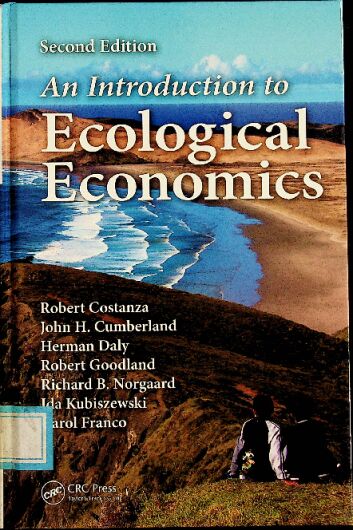
书名:An introduction to ecological economics
责任者:Robert Costanza ... [et al.].
前言
This book is not intended to be a stand-alone economics textbook, nor is it a comprehensive treatment of the wide range of activities currently going on in the transdisciplinary field of ecological economics. Rather; it is an introduction to the field from a particular perspective. It is intended to be used in introductory undergraduate or graduate courses, either alone or in combination with other texts. It is also intended for the interested independent reader.
The book is structured in four chapters. We begin with a description of some of the current problems of society and their underlying causes. We trace the causes to problems in the conventional way in which the world and humans' role in it are viewed. Ecological economics is essentially a rethinking of this fundamental relationship and a working out of the implications of a new way of thinking for how we manage our lives and our planet. In Chapter 2, we present a historical narrative of how world�views have evolved. This emphasizes how much worldviews do evolve and change. We outline what we think the next step in this evolution will be (or should be). We present various ideas and models in their proper historical context and as a living narrative, rather than as a list of sterile abstractions. The third chapter is a distillation of what we view as the fun�damental principles of ecological economics that are the result of this evo�lutionary process. The fourth chapter is a set of policies that follow from the principles and a set of instruments that could be used to implement the policies. It lays out the process of shared envisioning as an essential element to achieving sustainability. A brief conclusions section at the end of Chapter 4 summarizes and gives prospects for the future.
The second edition includes several new pieces in each section and a series of independently authored boxes.
查看更多
目录
Preface xi
Acknowledgments xiii
Authors xv
Remembering Robert Goodland xvii
1. Humanity% Current Dilemma 1
1.1 The Global Ecosystem and the Economic Subsystem 6
1.2 From Localized Limits to Global Limits 7
1.2.1 First Evidence of Limits: Human Biomass Appropriation 8
1.2.2 Second Evidence of Limits: Climate Change 8
1.2.3 Third Evidence of Limits: Ozone Shield Rupture 10
1.2.4 Fourth Evidence of Limits: Land Degradation (Land-System Change) 11
1.2.5 Fifth Evidence of Limits: Biodiversity Loss 13
1.2.6 Latest Evidence of Planetary Boundaries 17
1.2.6.1 Ocean Acidification 17
1.2.6.2 Freshwater Use 17
1.2.6.3 Nitrogen and Phosphorus Cycles 18
1.2.6.4 Atmospheric Aerosol Loading 18
1.2.6.5 Chemical Pollution 21
1.3 Population and Poverty 21
1.4 Beyond Brundtland 22
1.5 Toward Sustainability 23
1.6 The Fragmentation of Economics and the Natural Sciences 24
2. The Historical Development of Economics and Ecology 25
2.1 Early Codevelopment of Economics and Natural Science 28
2.1.1 Adam Smith and the Invisible Hand 30
2.1.2 Thomas Malthus and Population Growth 31
2.1.3 David Ricardo and the Geographic Pattern of Economic Activity 32
2.1.4 Sadi Carnot, Rodolf Clausius, and Thermodynamics 34
2.1.5 Charles Darwin and the Evolutionary Paradigm 40
2.1.6 John Stuart Mill and the Steady State 42
2.1.7 Karl Marx and the Ownership of Resources 43
2.1.8 W. Stanley Jevons and the Scarcity of Stock Resources 45
2.1.9 Ernst Haeckel and the Beginnings of Ecology 46
2.1.10 Alfred J. Lotka and Systems Thinking 47
2.1.11 Alfred C. Pigou and Market Failure 48
2.1.12 Harold Hotelling and the Efficient Use of Resources over Time 51
2.2 Economics and Ecology Specialize and Separate 54
2.3 Reintegration of Ecology and Economics 56
2.3.1 Ludwig von Bertalanffy and General System Theory 59
2.3.2 Elinor Ostrom and Garret Hardin: Open-Access Resource Management and Commons Institutions 62
2.3.3 Howard T. Odum and Nicholas Economics Georgescu-Roegen: Energetics and Systems 65
2.3.4 Kenneth Boulding and Spaceship Earth and Herman Daly and Steady-State Economics 69
2.3.5 C.S. Holling and Adaptive Environmental Management 71
2.3.6 Coeccolution of Ecological and Economic Systems 72
2.3.7 Role of Neoclassical Economics in Ecological Economics 77
2.3.7.1 Critical Connections 79
2.4 Conclusions 84
3. Principles and Objectives of Ecological Economics 87
3.1 Sustainable Scale, Fair Distribution, and Efficient Allocation 90
3.1.1 From Empty-World Economics to Full-World Economics 93
3.1.2 Reasons the Turning Point Has Not Been Noticed 94
3.1.3 Complementarity, Substitutability, and Fundamental Limits 95
3.1.4 Policy Implications of the lurning Point 96
3.1.5 Initial Policy Response to the Historical Turning Point 101
3.2 Ecosystems, Biodiversity, and Ecosystem Services 101
3.2.1 Biodiversity and Ecosystems 104
3.2.2 Ecosystem Services 105
3.2.3 Defining and Predicting Sustainability in Ecological Terms 111
3.2.4 Ecosystems as Sustainable Systems 114
3.3 Substitutability versus Complementarity of Natural, Human, Social, and Built Capital 115
3.3.1 Growth versus Development 116
3.3.2 Can Built Capital Substitute for Natural Capital? 119
3.3.3 Natural Capital 119
3.3.4 Sustainability and Maintaining Natural Capital 120
3.4 Population and Carrying Capacity 122
3.5 Measuring Welfare and Well-Being 126
3.5.1 Quality of Life, Happiness, Well-Being, and Welfare 126
3.5.1.1 An Integrative Definition of Quality of Life and Well-Being 127
3.5.2 Gross Domestic Product and Its Political Importance 132
3.5.3 Gross Domestic Product: Concepts and Measurement 134
3.5.4 From Gross Domestic Product to Hicksian Income and Sustainable Development 139
3.5.5 From Gross Domestic Product to a Measure of Economic Welfare 145
3.5.6 The Index of Sustainable Economic Welfare and the Genuine Progress Indicator 149
3.5.7 Toward a Measure of Total Human Welfare 157
3.5.8 Alternative Models of Wealth and Utility 159
3.5.9 Sustainable and Desirable "Doughnut" 160
3.6 Valuation, Choice, and Uncertainty 162
3.6.1 Fixed Tastes and Preferences and Consumer Sovereignty 163
3.6.2 Valuation of Ecosystems and Preferences 166
3.6.3 Uncertainty, Science, and Environmental Policy 167
3.6.4 Technological Optimism versus Prudent Skepticism 172
3.6.5 Social Traps 175
3.6.6 Escaping Social Traps 176
3.6.7 The Dollar Auction Game 178
3.7 Trade and Community 179
3.7.1 Free Trade? 181
3.7.2 Community and Individual Well-Being 182
3.7.3 Community, Environmental Management, and Sustainability 183
3.7.4Globalization, Transaction Costs, and Environmental Externalities 187
3.7.5 Policy Implications 189
4. Institutions, Instruments, and Policies 199
4.1 History of Environmental Institutions and Instruments 201
4.2 The Need to Develop a Shared Vision of a Sustainable Society 214
4.2.1 Envisioning 214
4.2.2 Scenario Planning 217
4.2.2.1 The Great Transition Initiative 218
4.2.2.2 Four Futures for New Zealand: Work in Progress (Taylor and Allen 2007) 219
4.2.3 Overcoming Roadblocks 220
4.2.3.1 The Components of Culture 221
4.2.3.2 Change as an Evolutionary Process 222
4.3 Successes, Failures, and Remedies 225
4.3.1 The Policy Role of Nongovernmental Organizations 226
4.3.2 Adaptive Ecological Economic Assessment and Management 227
4.3.3 Redirecting Technology toward Sustainable Solutions 229
4.3.4 Habitat Protection, Intergenerational Transfers, and Equity 220
4.4 Policy Instruments: Some Background 233
4.4.1 Regulatory Systems 235
4.4.2 Incentive-Based Systems: Alternatives to Regulatory Control 239
4.4.2.1 The Role of Economic Efficiency 239
4.4.2.2 Pollution Fees and Subsidies 240
4.4.2.3 Popular Critiques of the Incentives for Efficiency Approach 241
4.4.2.4 Advantages and Disadvantages of Incentive-Based Systems of Regulation 244
4.4.3 Three Policies to Achieve Sustainability 247
4.4.3.1 Natural Capital Depletion Tax 248
4.43.2 The Precautionary Polluter Pays Principle 249
4.4.3.3 Ecological Tariffs: Making Trade Sustainable 255
4.4.4 Toward Ecological Tax Reform 256
4.4.5 A Transdisciplinary Pollution Control Policy Instrument 258
4.4.5.1 Cap and Trade 261
4.4.5.2Implementation and Operational Considerations 264
4.5 Examples of Policies, Instruments, and Institutions 265
4.5.1 Expanding the "Commons Sector" 265
4.5.2 Communication in Society 270
4.5.2.1 Advertising 273
4.5.2.2 One- versus Iwo-Directional Communication 280
4.5.2.3 Sustainability through Media 281
4.5.2.4 Electronic Democracy 282
4.5.3 Education 282
4.5.3.1 The Next Phase in Higher Education 284
4.5.3.2 Potential Obstacles 287
4.5.4 Patents and Copyrights 288
4.5.4.1 Alternative Incentive Structure 290
4.6 Governance 294
4.6.1 Strong Democracy 294
4.6.1.1 Living Democracy 295
4.6.1.2 Deliberative Democracy 295
4.6.1.3 Lisbon Principles 295
4.7 Conclusions and Prospects for the Future 297
References 301
Index 329
查看更多
作者简介
Carol Franco is a senior research associate at Virginia Tech University. She is an ecological economist experienced in food security, ecosystem services, and policies for economic development and climate change miti�gation and adaptation. She has participated in negotiations of the United Nations Framework Convention on Climate Change for 4 years now as a member of the Dominican Republic delegation. She has extensive practical experience working with NGOs, the private sector, Governmental and International Development Institutions (e.g., USAID, EPA, SilvaCarbon, IDB). Her current responsibilities include working with government insti�tutions on REDD+ policy frameworks on the ground in Mexico, Peru, Colombia, and the Dominican Republic.
查看更多
馆藏单位
中科院文献情报中心