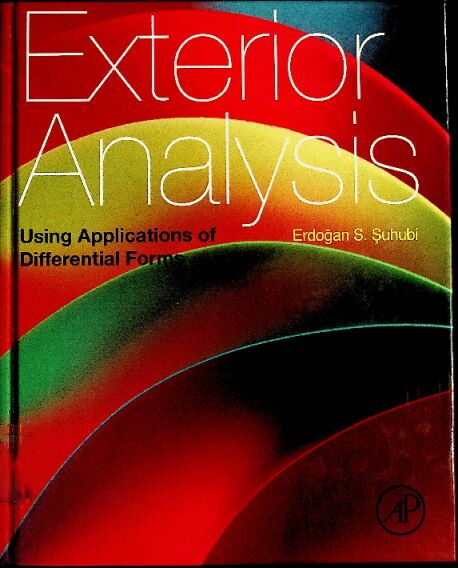
书名:Exterior analysis
ISBN\ISSN:9780124159020,0124159028
出版时间:2013
出版社:Academic Press,
前言
Exterior forms come into existence at its inception as elements of the exterior algebra, which is in essence a Grassmann algebra, formed by defining an operation of exterior product over a linear vector space. How- ever in early 2Oth century, works of Poincaré, and particularly of Cartan make it possible to extend this algebraic structure as to include the exterior differential forms by employing exterior products of differentials of coordinates. Nevertheless the main impetus to the elaboration of the theory of exterior differential forms has been the development of the concept of differentiable manifolds that are topological spaces equipped with an appro- priate structure which blends topological properties with some kind of dif- ferentiability.It was then possible to define exterior differential form fields on differentiable manifolds that are locally equivalent to Euclidean spaces and to introduce an analysis of forms in which only first order derivatives survive. It was soon realised that this analysis would be one of the most powerful, perhaps indispensable tools of the modern differential geometry and many mathematical properties could be relatively easily revealed by almost algebraic operations. On the other hand,it is perhaps not wrong to claim that the mathematical structure of theoretical physics today is entirely based on the formalism of differential geometry. We also observe that this formalism is increasingly infiltrating into engineering sciences to study some fundamental problems and even in many practical applications.There- fore exterior analysis is no longer in the realm of mathematicians. It seems that it would now be quite beneficial for physicist and engineers to acquire a rather good skill in dealing with exterior forms. The aim of this book to expose the field of exterior analysis to readers of mathematical, physical or engineering origin, to acquaint them with the fundamental concepts and tools of exterior analysis, to help them gain certain competence in using these tools and to emphasise advantages provided by this approach.In doing so it is tried, without sacrificing mathematical rigor,not to expose the reader to very advanced,somewhat esoteric mathematical approaches. It is attempted to design the book as self sufficient as much as possible.An advanced mathematical background is not necessary to follow the exploration of the subject for an attentive reader.
The book comprises ll chapters. Chapter Iis a brief introduction to the exterior algebra. First,linear vector spaces over which exterior algebra will be defined are explored, linear and multilinear functionals which map vector spaces and their Cartesian products, respectively,into field of scalars are defined by means of dual spaces. Exterior forms are introduced as alternating multilinear functionals and the exterior algebra, which is essentially a Grassmann algebra, is constructed by appropriately defining a degree augmenting exterior product. Chapter I is concerned with differentiable manifolds that are topological spaces which are locally homeomorphically equivalent to Euclidean spaces. This equivalency is pro- vided by charts and atlases covering the manifold. This structure over the manifold enables one to differentiate real valued functions over manifolds and mappings between manifolds, to treat the fibre bundle obtained by joining to each point of the manifold the tangent space at that point as a differentiable manifold. A differentiable function between two manifolds generates a differential of that function which maps linearly tangent spaces one another at corresponding points.Finally, the Lie derivatives which measure variations of one vector field with respect to another and the Lie algebra which they give rise on tangent spaces are defined and its various applications are explored. Special emphasis is put on distributions and their role in forming submanifolds. Chapter III is devoted to the study of the Lie groups that are topological spaces endowed with a continuous group ope- ration.Lie algebras generated by left- and right-invariant vector fields are introduced and various properties are considered.Lie groups of transforma- tions mapping a manifold into itself are also investigated. Covariant and contravariant tensors defined previously on vector spaces and their duals are extended in Chapter IV to tensor fields on manifolds by making use of tensor products of local basis vectors on tangent spaces and their duals. Chapter V is one of the fundamental chapters of the book. It deals with exterior differential forms. Noting that differentials of local coordinates con- stitute a basis,as was observed by Cartan, for the dual of the tangent space, differential forms are defined as completely antisymmetric covariant tensors of various orders. An exterior algebra over the manifold is built by using a degree augmenting exterior product operation. Some algebraic properties of exterior forms are revealed and a degree decreasing operation called the interior product of a form with a vector field is defined.The non-zero vol- ume form on the manifold is employed to derive a new system of top-down generated basis for the exterior algebra that will prove to be extremely useful is several important applications. Then the ideals of the exterior algebra are defined, the exterior derivative of differential forms is intro- duced as to satisfy certain requirements. The Riemannian manifolds that are equipped with a metric tensor making it possible to measure distances on the manifold are explored and the Hodge dual of a form is defined.After briefly glancing over closed ideals,the Lie derivative of a form with respect to a vector field is introduced. By utilising this concept isovector fields under which an ideal remains invariant and characteristic vector fields whose interior products with forms within an ideal remains in that ideal are defined. This chapter ends with the study of exterior systems and their solu- tions. Chapter VI deals with the homotopy operator on contractible mani- folds. This operator helps us to understand the relationship between closed forms with vanishing exterior derivative and exact forms that are exterior derivatives of some other forms. The forms occupying the kernel of the homotopy operator is named as antiexact forms. Homotopy operator is then effectively employed to obtain solutions of system of exterior equations. Chapter VII is concerned with the various types of linear connections on manifolds that helps connect tangent spaces at different points. Through the connection coefficients one can define covariant derivative of tensor fields that are also tensors. Torsion and curvature tensors of the manifold are then introduced and it becomes possible to obtain more concrete forms of various differential operators in Riemannian manifolds. In Chapter VII the inte- gration of forms is examined. The integral of a form on a manifold whose dimension is equal to the degree of the form is actually an appropriately defined Riemann integral. However, in order to make this operation realisable on a manifold that might have a rather complicated structure,such a manifold must acquire some new properties. One approach is to cover a manifold with some geometric objects such as simplices of very simple shapes, chains by forming unions of simplices, cycles that are chains with vanishing boundaries. Another approach is to make use of the partition of unity that is a topological property. The fundamental result in the integra- tion of forms is Stokes' theorem which equates the integral of the exterior derivative of a form on an appropriate domain to the integral of this form on the boundary of that domain. De Rham cohomology group of a manifold is the quotient space of closed forms with respect to exact forms whereas homology group that reflects some topological properties of the manifold are defined as the quotient space of cycles with respect to cycles that are boundaries of some chains. Stokes theorem, together with properties of exact sequences, helps reveal certain very interesting relationships between these two seemingly unrelated groups. The long Chapter IXis devoted to the discussion of partial differential equations by employing exterior ana- lysis. To this end, a system of partial differential equation of finite order is enlarged to a great extent by introducing auxiliary dependent variables to a system of first order equations. It is then shown that the solution of that system of differential equations coincides with the solution of an ideal of the exterior algebra on an extended manifold generated by certain exterior forms. An important part of this chapter is devoted to the determination of isovector fields of the ideal. These vector fields will generate groups of symmetry transformations(Lie groups)that leave the system of differential equations invariant, thereby transforming one solution onto another one. The reduced determining equations for isovector components are explicitly obtained for balance equations which play an important part in physical and engineering sciences. Furthermore,the classical method of characteristics is generalised by employing isovector fields so that they yield solutions of the system for particular initial data satisfying certain requirements. In another approach,the ideal in question is enlarged as to include some arbitrariness which can then be somewhat removed by certain assumptions to lead certain particular solutions. Finally equivalence transformations that map a solution of a member of a family of differential equations with certain common pro- perties to the solution of another member of the same family are discussed, the determining equations for isovector fields are given and their explicit solutions are further provided. Chapter X contains the treatment of classical variational calculus by use of exterior analysis. The making of a functional defined by an integral stationary requires the vanishing of some exterior forms. This way one obtains the well-known Euler-Lagrange equations. Moreover,variational symmetries are defined and Noetherian vector fields generating these symmetries and resulting conservation laws are discussed. In the final Chapter XI, the application of exterior analysis to some physical fields such as analytical mechanics,electromagnetism and thermodynamics is discussed in some detail.
The book contains 115 examples which are hoped to explain and illustrate the main text and 250 exercises which may help the reader to acquire certain competence on the subject.
I gratefully acknowledge the initial support provided by Turkish Academy of Sciences during the preparation of this work.
Finally, I would like to express my sincere thanks to ELSEVIER and especially to the Acquisition Editor Ms. Patricia Osborn, the Math Publisher Ms. Paula Callaghan, the Editorial Project Manager Ms. Jessica Vaughan and the Production Manager Mr. Mohanapriyan Rajendran for their kind and constructive cooperation during the whole process of the publication of this book.
Istanbul, October 2012 Erdogan S. Suhubi
查看更多
目录
PREFACE ix
CHAPTER I EXTERIOR ALGEBRA
1.1.Scope of the Chapter 1
1.2. Linear Vector Spaces 2
1.3. Multilinear Functionals 19
1.4.Alternating k-Linear Functionals 24
1.5. Exterior Algebra 33
1.6.Rank of an Exterior Form 37
Exercises 46
CHAPTER II DIFFERENTIABLE MANIFOLDS
2.1. Scope of the Chapter 51
2.2.Differentiable Manifolds 52
2.3.Differentiable Mappings 93
2.4. Submanifolds 103
2.5. Differentiable Curves 110
2.6.Vectors.Tangent Spaces 112
2.7.Differential of a Map Between Manifolds 120
2.8. Vector Fields.Tangent Bundle 126
2.9. Flows over Manifolds 133
2.10. Lie Derivative 142
2.11.Distributions. The Frobenius Theorem 153
Exercises 168
CHAPTER III LIE GROUPS
3.1.Scope of the Chapter 175
3.2. Lie Groups 175
3.3. Lie Algebras 180
3.4.Lie Group Homomorphisms 187
3.5. One-Parameter Subgroups 189
3.6.Adjoint Representation 194
3.7.Lie Transformation Groups 197
Exercises 200
CHAPTER IV TENSOR FIELDS ON MANIFOLDS
4.1. Scope of the Chapter 207
4.2. Cotangent Bundle 208
4.3. Tensor Fields 209
Exercises 216
CHAPTER V EXTERIOR DIFFERENTIAL FORMS
5.1. Scope of the Chapter 219
5.2. Exterior Differential Forms 220
5.3. Some Algebraic Properties 224
5.4. Interior Product 226
5.5.Bases Induced by the Volume Form 236
5.6.Ideals of the Exterior Algebra A(M) 244
5.7Exterior Forms under Mappings 253
5.8.Exterior Derivative 260
5.9.Riemannian Manifolds.Hodge Dual 269
5.10. Closed Ideals 286
5.11.Lie Derivatives of Exterior Forms 290
5.12.Isovector Fields of Ideals 301
5.13.Exterior System and Their Solutions 306
5.14.Forms Defined on a Lie Group 317
Exercises 321
CHAPTER VI HOMOTOPY OPERATOR
6.1. Scope of the Chapter 327
6.2. Star-Shaped Regions 327
6.3. Homotopy Operator 330
6.4.Exact and Antiexact Forms 336
6.5. Change of Centre 340
6.6.Canonical Forms of 1-Forms, Closed2-Forms 341
6.7.An Exterior Differential Equation 352
6.8. A System of Exterior Differential Equations 355
Exercises 363
CHAPTER VII LINEAR CONNECTIONS
7.1. Scope of the Chapter 365
7.2.Connections on Manifolds 366
7.3. Cartan Connection 377
7.4. Levi-Civita Connection 388
7.5. Differential Operators 398
Exercises 401
CHAPTER VII INTEGRATION OF EXTERIOR FORMS
8.1. Scope of the Chapter 405
8.2. Orientable Manifolds 406
8.3. Integration of Forms in the Euclidean Space 414
8.4. Simplices and Chains 416
8.5. Integration of Forms on Manifolds 423
8.6. The Stokes Theorem 429
8.7. Conservation Laws 446
8.8. The Cohomology of de Rham 459
8.9.Harmonic Forms.Theory of Hodge-de Rham 476
8.10. Poincaré Duality Exercises 484
CHAPTER IX PARTIAL DIFFERENTIAL EQUATIONS
9.1. Scope of the Chapter487
9.2. Ideals Formed by Differential Equations 488
9.3. Isovector Fields of the Contact Ideal 500
9.4. Isovector Fields of Balance Ideals 520
9.5. Similarity Solutions 563
9.6. The Method of Generalised Characteristics 569
9.7. Horizontal Ideals and Their Solutions 584
9.8. Equivalence Transformations 604
Exercises 655
CHAPTER X CALCULUS OF VARIATIONS
10.1.Scope of the Chapter 657
10.2.Stationary Functionals 657
10.3.Euler-Lagrange Equations 661
10.4.Noetherian Vector Fields 670
10.5.Variational Problem for a GeneralAction Functional 679
Exercises 693
CHAPTER XI SOMIE PHYSICAL APPLICATIONS
11.1.Scope of the Chapter 695
11.2. Conservative Mechanics 696
11.3.Poisson Bracket of 1-Forms and Smooth Functions 705
11.4. Canonical Transformations 710
11.5.Non-Conservative Mechanics 716
11.6. Electromagnetism 731
11.7. Thermodynamics 742
Exercises 748
REFERENCES 751
INDEX OF SYMBOLS 755
NAME INDEX 757
SUBJECT INDEX 759
查看PDF
查看更多
馆藏单位
中科院文献情报中心