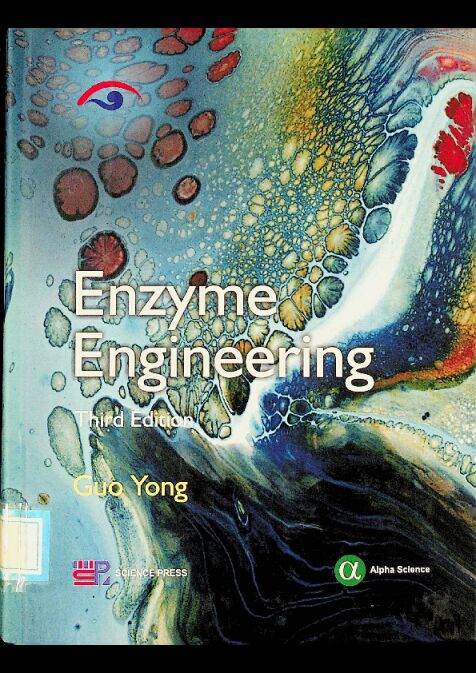
书名:Enzyme engineering
出版时间:2014
出版社:Alpha Science International Ltd.,
前言
Enzyme engineering is one of the main parts of biotechnology. Enzyme engineering has been developing quickly since 1970s; it has got great achievements in the theoretical and application researches and has been playing an important role on the development of science, technology and economy in the world. Enzyme engineering will develop even more quickly and play a much more important role.
Enzyme engineering is a technical process of enzyme production and its applications. The main tasks of enzyme engineering are obtaining the required enzymes through design and artificial operation, improving the enzyme catalytic characters with enzyme improvement technologies, and making full use of enzyme catalytic function.
This book was translated from Chinese "Enzyme Engineering" (Third Edition) published in 2009 by Science Press, Beijing, China. The contents of the book include 10 chapters which are; chapter 1: introduction; chapter 2: Enzyme production by microbial fermentation; chapter 3: Enzyme production by animal and plant cell culture; chapter 4: Extraction, isolation and purification of enzymes; chapter 5: Enzyme molecular modifications; chapter 6: Immobilization of Enzymes, Cells and Protoplasts; chapter 7: Enzyme catalysis in non-aqueous phases; chapter 8: Enzyme directed evolutions; chapter 9: Enzyme reactors and chapter 10: Applications of enzymes. There is a review and thinking section given at the of each chapter. Chapter 1, chapter 3 and chapter 7 were translated by Prof. GUO Yong; chapter 2 and chapter 6 were translated by Dr. ZHENG Suiping; chapter 4 and chapter 10 were translated by Prof. LIN Ying; chapter 5 was translated by Dr. HAN Shuangyan; chapter 8 was translated by Dr. WANG Bin and; chapter 9 was translated by Dr. ZHU Mingjun.
The book could be used as a text book for the undergraduate or graduate students specializing in biotechnology, bioengineering, biochemical engineering, enzyme engineering, fermentation engineering, and bioscience and so on. It also could be used at conferences for teachers, scientists, engineers and technicians working in the related fields.
During the writing and the translating of this book, I received a lot of intellectual and insightful assistance from numerous colleagues and friends. I wish to acknowledge their invaluable help. I also wish to acknowledge the pleasant cooperation and assistance provided by the members of the translation committee and the editors involved in the completion of this book.
查看更多
目录
Preface
Chapter 1 Introduction 1
1.1 Conception of Enzyme and Its Development 2
1.2 The Characteristics of Enzyme Action 3
1.3 Factors that Affecting Enzyme Action 7
1.4 Classification and Nomenclature of Enzymes 11
1.5 Determination of Enzyme Activity 19
1.6 Methods for Enzymes Production 24
1.7 Development Survey of Enzyme Engineering 28
Review and Thinking 32
Chapter 2 Enzyme Production by Microbial Fermentation 33
2.1 Regulation of Enzyme Biosynthesis in Microbial Cells 34
2.2 Characteristic of Microbes for Enzyme Production 49
2.3 Fermentation Process Conditions and Its Control 53
2.4 Enzyme Fermentation Kinetics 65
2.5 Enzyme Production by Immobilized Cell Fermentation 71
2.6 Enzyme Production by Immobilized Protoplast Fermentation 78
Review and Thinking 80
Chapter 3 Enzyme Production by Animal and Plant Cell Cultures 81
3.1 The Regulation of Enzyme Biosynthesis in Animal and Plant Cells 82
3.2 Enzyme Production by Plant Cell Culture 86
3.3 Enzyme Production by Animal Cell Culture 97
Review and Thinking 105
Chapter 4 Extraction, Separation and Purification of Enzymes 106
4.1 Cell Disruption 106
4.2 Enzyme Extraction 110
4.3 Precipitation Separation 113
4.4 Centrifugal Separation 118
4.5 Filtration and Membrane Separation 124
4.6 Chromatographic Separation 130
4.7 Electrophoresis Separation 150
4.8 Extraction Separation 160
4.9 Crystallization 167
4.10 Concentration and Drying 170
Review and Thinking 172
Chapter 5 Enzyme Molecular Modification 174
5.1 Metal Ion Substitution Modification 175
5.2 Macromolecular Binding Modification 177
5.3 Side Chain Group Modification 181
5.4 Peptide Chain Limited Hydrolysis Modification 187
5.5 Nucleotide Chain Cleavage Modification 188
5.6 Amino Acid Substitution Modification 189
5.7 Nucleotide Substitution Modification 192
5.8 Physical Modification 193
5.9 Application of Enzyme Molecular Modification 194
Review and Thinking 200
Chapter 6 Immobilization of Enzymes, Cells and Protoplasts 201
6.1 Enzyme Immobilization 203
6.2 Cell Immobilization 216
6.3 Protoplast Immobilization 228
Review and Thinking 231
Chapter 7 Enzyme Catalysis in Non-aqueous Phases 232
7.1 The Main Scopes of Enzyme Catalysis in Non-aqueous Phase 233
7.2 Effects of Water and Organic Solvents on Enzyme Catalysis in Organic Media 234
7.3 The Catalytic Characters of Enzymes in Organic Media 240
7.4 Conditions of Enzyme Catalytic Reaction in Organic Media and Its Control 244
7.5 Application of Enzyme Catalysis in Non-aqueous Phase 251
Review and Thinking 260
Chapter 8 Enzyme Directed Evolution 261
8.1 The characteristics of Enzyme Directed Evolution 263
8.2 Random Mutation of Enzyme Gene 264
8.3 Directed Selection of Enzyme Gene Mutants 270
8.4 The Applications of Enzyme Directed Evolution 281
Review and Thinking 283
Chapter 9 Enzyme Reactors 285
9.1 Types of Enzyme Reactors 286
9.2 Choice of Enzyme Reactors 292
9.3 Design of Enzyme Reactors 296
9.4 Enzyme Reactor Operation 301
Review and Thinking 306
Chapter 10 Applications of Enzymes 307
10.1 Enzymes Application in Pharmaceutical Industry 307
10.2 Application of Enzymes in Food 328
10.3 Enzyme Application in Light and Chemical Industries 342
10.4 Enzyme Application in Environmental Protection 349
10.5 Enzyme Application in Biotechnology 352
Review and Thinking 358
Main references 359
查看更多
馆藏单位
中科院文献情报中心