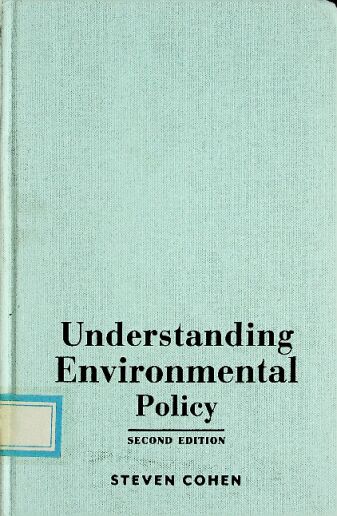
书名:Understanding environmental policy
出版时间:2014
出版社:Columbia University Press,
前言
This volume represents my effort to revisit the primer that I wrote about environmental policy nearly a decade ago. I thought it was time to reexamine the framework I developed for understanding environ�mental policy and to apply it to some newer, more contemporary cases, to see if the analytic framework remains useful. While I am biased, I think it still pro�vides a usefiil way to explore this complex policy arena. I think it makes sense to understand environmental sustainability issues by examining them as issues of values, politics, policy design, science and technology management capacity; and as a combination of several of these factors.
查看更多
目录
Preface to the Second Edition ix
Acknowledgments xiii
PART I. DEVELOPING A FRAMEWORK
1. UNDERSTANDING ENVIRONMENTAL POLICY 3
Differing Perspectives on Environmental Policy 3
Developing a Framework to Help Understand Environmental Issues 4
Applying the Framework to a Set of Environmental Issues 5
Toward an Interdisciplinary Understanding of Environmental and Sustainability Policy 10
2. A FRAMEWORK FOR UNDERSTANDING THE ENVIRONMENTAL POLICY ISSUE 11
Values 14
Environmental Politics 18
Science,Technology, and the Environment 32
Environmental Policy Design and Economic Factors as an Influence on Damaging Corporate and Private Behaviors 36
Environmental and Sustainability Management 48
Next Steps 53
PART II. APPLYING THE FRAMEWORK
3. WHY CAN'T NYC GET A CONGESTION CHARGE? 57
The Nature of the Problem: Traffic Gridlock and Congestion Pricing in New York City 57
Congestion Pricing as an Issue of Vlues 75
Congestion Pricing as a Political Issue 76
Congestion Pricing as an Issue of Science and Technology 78
Congestion Pricing as a Public Policy Design Issue 78
Congestion Pricing as a Management Issue 80
Summary of the Multiple Dimensions of Congestion Pricing 80
Conclusions 81
4. WHO IS RESPONSIBLE FOR E-WASTE AND HOW CAN WE ENSURE ITS SAFE DISPOSAL? 82
The Nature of the Problem: The Case of Electronic Waste 82
E-Wiste Disposal as an Issue ofVdues 90
E-Wiste Disposal as a Political Issue 94
E-Waste Disposal as an Issue of Science and Technology 98
E-Wiste Disposal as a Public Policy Design Issue 100
E-Waste Disposal as a Management Issue 102
Summary of the Multiple Dimensions of
Electronic Waste 103
Conclusions 105
5. WHY IS HYDROFRACKING CONTENTIOUS? 106
The Nature of the Problem: Hydraulic Fracturing 106
Hydrofracking as an Issue of Values 118
Hydrofracking as a Political Issue 120
Hydrofracking as a Public Policy Design Issue 123
Hydrofracking as a Management Issue 125
Hydrofracking as an Issue of Science and Technology 125
Summary of the Multiple Dimensions of Hydrofracking 126
Conclusions 127
6. HOW CAN WE ASSESS THE RISKS OF, PREPARE FOR, AND SLOW CLIMATE CHANGE? 128
The Nature of the Problem of Global Climate Change 128
Global Climate Change as an Issue of Values 138
Global Climate Change as a Political Issue 140
Global Climate Change as an Issue of Science and Technology 145
Global Climate Change as an Issue of Policy Design 148
Global Climate Change as a Management Issue 150
Global Climate Change: A Summary of Its Multiple Dimensions 151
Conclusions 153
PART III. UNDERSTANDING, DEVELOPING, AND IMPLEMENTING ENVIRONMENTAL POLICY
7.WHAT HAS THE FRAMEWORK TAUGHT US ABOUT THESE ENVIRONMENTAL SUSTAINABILITY PROBLEMS AND WHAT ELSE DO WE NEED TO KNOW? 159
A Summary of the Framework 159
Applying the Framework: What Did It Tell Us? 160
Values and Environmental Policy 163
Politics and Environmental Policy 166
Science, Technology and Environmental Policy 168
The Design of Environmental Policy and the Impact of Economics on Enxdronmental Policy 169
Implementing Environmental Sustainability Policy 170
Limitations to the Framework and Possible Modifications 172
8. CONCLUSIONS: IMPROVING ENVIRONMENTAL POLICY 174
Accomplishments of Environmental Governance 175
Improvements Needed 181
Next Steps 189
References 193
Notes 205
Index 207
查看更多
馆藏单位
中科院文献情报中心