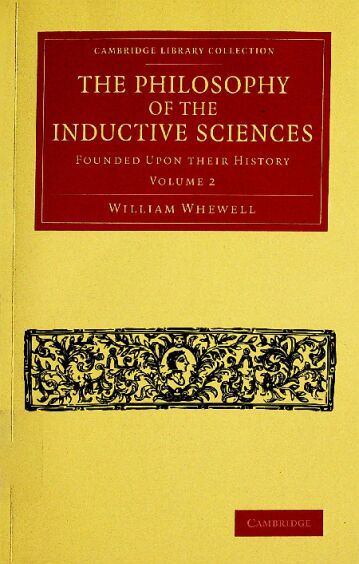
书名:The philosophy of the inductive sciences
出版时间:2014
出版社:Cambridge University Press,
前言
First published in 1840, this two-volume treatise by Cambridge polymath William Whewell (1794–1886) remains significant in the philosophy of science. The work was intended as the 'moral' to his three-volume History of the Inductive Sciences (1837), which is also reissued in this series. Building on philosophical foundations laid by Immanuel Kant and Francis Bacon, Whewell opens with the aphorism 'Man is the Interpreter of Nature, Science the right interpretation'. Whewell's work upholds throughout his belief that the mind was active and not merely a passive receiver of knowledge from the world. A key text in Victorian epistemological debates, notably challenged by John Stuart Mill and his System of Logic, Whewell's treatise merits continued study and discussion in the present day. Volume 1 investigates the philosophy underlying pure, classificatory and mechanical sciences. Volume 2 includes a selective review of opinions on the nature of knowledge and the means of seeking it, beginning with Plato.
查看更多
目录
PART I.—OF IDEAS, comtinued.
BooK IX.—THE PALosoPHY oF BroLocY.
CHAP.1.Anlogy of Biology with other Science 3
2. Successive Biological Hypotheses 8
3. Attempts to Analyze the Idea of Life 30
4.Attempts to form Ideas of Separate Vital Forees;and first, of Assimilation and Secretion 39
5. Attempts to form Ideas of Separate Vital Forees,continued—Voluntary Motion 58
6. Of the Idea of Final Causes 77
BooK X.—TEE PHLosoPEY oF PALETToLoGY.
CHAP.l1.Of Palætiological Sciences in general 95
2.Of the Three Members ofa Palatiological Science 100
3. Of the Doctrine of Catastrophes and the Doctrine of Uniformity 123
4.Of the Relation of Tradition to Palætiology 137
PART II.—OF KNOWLEDGE.
BooK XI.—OF THE CoNSTRTCTIoN oF ScIENCE.
CAAP.1.Of two principal Processes by which Science is Constructed 169
2. Of the Explication of Conceptions 171
3. Of Facts as the Materials of Science 192
4. Of the Colligation of Facts 201
5.Of certain Characteristics of Scientific Induction 212
6.Of the Logic of Induction 239
7. Of Laws of Phenomena and of Causes 260
8. Of Art and Science 271
9. Of the Classification of Sciences 277
BooK XII.—REvIEw oF OPINIoNs ON TEE NATURE OF KNOwLEDGE,AND TRE MEANS OF SEEKING IT
CHAP.1.Introduction 283
2. Plato 286
3. Aristotle 292
4. The Later Greeks 297
5. The Romans 300
6. The Schoolmen of the Middle Ages 305
7.The Innovators of the Middle Ages 319
8. The Revival of Platonism 337
9. The Theoretical Reformers of Science 352
10. The Practical Reformers of Science 366
11. Francis Bacon 388
12. From Bacon to Newton 414
13. Newton 436
14. Locke and his French Followers 457
15. The Reaction against the Sensational School 469
BooxK XIII.—OF MErHoDs EMPLoYED IN THE FoRMATION OF SCcIENCE.
CHAP.1.Introduction 482
2. Of Methods of Observation 485
3.Of Methods of Acquiring clear Scientific Ideas,and first, of Intellectual Education 505
4.Of Methods of Acquiring clear Scientific Ideas, comtinwed.—Of the Discussion of Ideas 521
5. Analysis of the Process of Induction 527
6. General Rules for the Construction of the Conception 536
7. Special Methods of Induction applicable to Quantity 542
8.Methods of Induction depending on Resemblance 559
9. Of the Application of Inductive Truths 572
10. Of the Induction of Causes 577
查看PDF
查看更多
馆藏单位
中科院文献情报中心