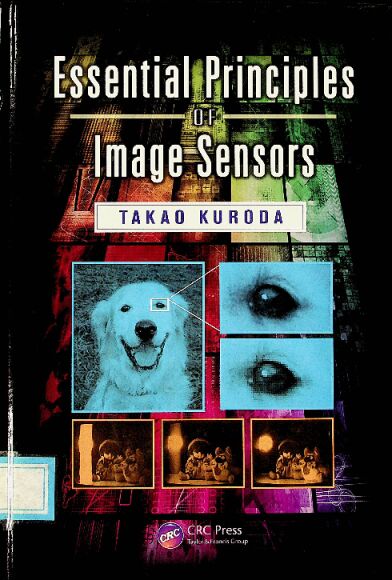
书名:Essential principles of image sensors
ISBN\ISSN:9781482220056,1482220059
摘要
Providing a succinct introduction to the systemization, noise sources, and signal processes of image sensor technology, Essential Principles of Image Sensors discusses image information and its four factors: space, light intensity, wavelength, and time. Featuring clarifying and insightful illustrations, this must-have text:
Explains how image sensors convert optical image information into image signals
Treats space, wavelength, and time as digitized built-in coordinate points in image sensors and systems
Details the operational principles, pixel technology, and evolution of CCD, MOS, and CMOS sensors with updated technology
Describes sampling theory, presenting unique figures demonstrating the importance of phase
Explores causes for the decline of image information quality
In a straightforward manner suitable for beginners and experts alike, Essential Principles of Image Sensors covers key topics related to digital imaging including semiconductor physics, component elements necessary for image sensors, silicon as a sensitive material, noises in sensors, and more.
查看更多
前言
Preface to English Edition
It is my greatest pleasure that this book concerning image sensors will be available for people to read all over the world
The Japanese edition of this book was published in December 2012. Its aim was to explain the "indispensable functions and ideal situation of image sensors" by marshal-ing the “factors defining image information quality” and understanding the "structure of image information. " It also discussed the history of image sensors and the way they tried to respond to market demands by using the best combinations of the available technology in each era. The book also attempted to investigate future directions of this field
Although this book was started only 5 months after the publication of the Japanese edition, there was significant progress in this short time, and these advances are described in this edition. While the content of this book is “essential principles, " as the title shows, it also deals with the “state of the art" regarding the surrounding issues.
This edition has come to be published thanks to Professor Dr. Jun Ohta of the Nara Institute of Science and Technology, who kindly introduced me to CRC Press/Taylor & Francis. The author genuinely expresses his gratitude. Thanks are extended to the relevant staff of CRC Press/Taylor&Francis for their hearty support.
I hope that this book enables readers to survey the whole world of image sensor technol-ogy through an understanding of the essential principles.
Finally, I gratefully acknowledge the support of my family. My wife, Toshiko, estab-lished and has been maintaining the circumstances to enable me to devote myself whole-heartedly to my job for 35 years and checked the English throughout the book. There is little doubt that this book, including the Japanese edition, would not have been born with-out her support. I thank my two daughters, Chiaki and Chihiro, who encouraged me and helped with the English and some of the artwork from overseas. I also thank my dog, Simba, who was a treasured member of our family and appears in many of the sample images throughout this book. She healed and heartened me with her gentle and friendly nature, charming and cute smile, elegant appearance, and amazing intelligence.
Takao Kuroda
Ibaraki, Osaka, Japan
Preface to Japanese Edition
More than thirty years have passed since I entered the field of image sensor technology. During this time, my main focus has been how image sensors should be understood. During these years, I have finally achieved a solution. In a sense, this book is also a reminder to sort out my remaining tasks. Thus, I ask readers for permission to present many of my own unique ways of understanding, explanations, structures of logics, and sometimes biases.
At university, I studied physics, which favors a unified perspective, and I believe that to understand is to be able to call up an image of the phenomenon in the mind. To realize my belief, I have tried to visualize physical phenomena by using my original figures to help readers' intuitive understanding.
Chapter 1 presents the structure of image information and the role of sensors to make it clear what"imaging”is, as the basis of this book. In Chapter 2, semiconductor components and circuit components, necessary for sensors, will be dealt with. In Chapter 3, the noise in sensors will be described. In Chapter 4, the scanning mode will be dealt with to conclude the preparatory stages.
Chapter 5 contains a detailed explanation of the principles, pixel technologies, and progress of CCD, MOS, and CMOS sensors. Their current situations will be compared at the end of the chapter. Chapter 6 contains an explanation of how information other than light intensity is obtained. In Chapter 7, the techniques that have improved information quality of each factor constructing the image will be described. In Chapter 8, the elements concerning the informa-tion quality of images, not of single sensors but of whole imaging systems, will be described.
In publishing this book, I am indebted to many people in this field, including my elders and seniors, some of whom have already passed away. And in my office, I was so happy to have respectable bosses, nice seniors, colleagues, and juniors, including a few people who showed examples of how not to be have. I would especially like to sincerely thank Dr. Ken ju Horii, who was my first direct boss in the office and guided me from the very beginning. My work would not have continued to today without meeting Dr. Horii. I found my true vocation by providence. I also would like to express special thanks to Mr. Yoshiyuki Matsunaga, who was seated beside me during my last years in the office. We had many discussions as engineers of image sensors and also as humans. I learned much from his words and behavior.
As I wrote this book at home, I am very grateful for the constant support of my family, wife, two daughters, and dog, Simba, who often appears in this book in the sample images and was so gentle, generous, and smart. She always cheered me up, but sadly she passed away while I was writing the final chapter of the book
In publishing this book, I specially acknowledge Professor Dr. Takayuki Hamamoto of Tokyo University of Science for his kind efforts and the relevant members of the Corona Publishing Company. I would also like to thank the authors whose figures from papers and websites I have referred to. As for the relevant literature on the fundamental tech-niques, I have tried to refer to the most original works or those published earliest
If this book is of help in guiding readers who want to understand the world of image sensors but areata loss, as I was in younger days, I will be most grateful.
Takao Kuroda
Ibaraki, Osaka, Japan
查看更多
目录
Preface to English Edition xi
Preface to Japanese Edition xi
Author xiii
1. Task of Imaging and Role of Image Sensors 1
1.1 Factors Constructing Image Information 1
1.2.Image Sensor Output and Structure of Image Signal 4
1.2.1 Monochrome Still Images 4
1.2.2 Color Still Images 5
1.2.3 Color Moving Images 6
1.3 Functional Elements of Image Sensors 9
References 10
2. Device Elements and Circuits for Image Sensors 11
2.1 Device Element Components 11
2.1.1 Foundation of Silicon Device Physics 11
2.1.2 pn-Junction 14
2.1.3 MOS Structure 17
2.1.4 Buried MOS Structure 20
2.1.5 Photogate 24
2.1.6 Photodiode 25
2.1.7 Buried Photodiode/Pinned Photodiode 25
2.2 Silicon as a Photosensitive Material 26
2.2.1 np Photodiode on p-Type Substrate 27
2.2.2 npn Photodiode on p-Well 29
2.3 Circuit Components 29
2.3.1 Floating Diffusion Amplifier 29
2.3.2 Source Follower Amplifier 30
2.3.3 Correlated Double Sampling Circuit 32
References 34
3 Major Types of Noise in Image Sensors 35
3.1 Amplitude of Noise 35
3.2 Circuitry Noise (kTC Noise) 37
3.3 Transistor Noise 39
3.3.1 1/f Noise 39
3.3.2 Thermal Noise 39
3.3.3 Random Telegraph Noise 40
3.4 Shot Noise 41
3.5 FDA Noise Reduction by CDS 43
References 45
4. Integration Period and Scanning Mode 47
4.1 Progressive Mode 47
4.2 Interlaced Mode 47
4.3 Electronic Shutter Mode 49
5. Types of Image Sensors 51
5.1 CCD Sensors 51
5.1.1 Principle of CCDs 51
5.1.1.1 Interline Transfer CCDs 57
5.1.1.2 Basic Pixel Structure of IT-CCD 59
5.1.2 Pixel Technology of IT-CCD 62
5.1.2.1 Vertical Overflow Drain Structure 63
5.1.2.2 Depleted Photodiode and Transfer Mechanism 66
5.1.2.3 Buried Photodiode/Pinned Photodiode 70
5.1.3 Progress of CCD Sensor 73
5.1.3.1 Frame Transfer CCD 73
5.1.3.2 Frame-Interline Transfer CCD 74
5.2 MOS Sensors 76
5.2.1 Principle of MOS Sensors 76
5.2.2 Pixel Technology of MOS Sensors 80
5.2.3 Progress in MOS Sensors 81
5.2.3.1 Pixel Interpolation Array Imager 81
5.2.3.2 Transversal Signal Line Imager 82
5.3 CMOS Sensors 83
5.3.1 Principle of CMOS Sensors 83
5.3.2 Pixel Technology of CMOS Sensors 84
5.3.2.1 Three-Transistor Pixel Configuration 84
5.3.2.2 Four-Transistor Pixel Configuration 90
5.3.2.3 Shared Pixel Architecture 93
5.3.3 Progress in CMOS Sensors 95
5.3.3.1 Noise Reduction Circuits in Analog Output Sensor 95
5.3.3.2 Digital Output Sensors 97
5.3.3.3 Sensitivity Improvement Technology 110
5.3.3.4 Organic Sensors 116
5.4 Electronic Shutter 120
5.4.1 Electronic Shutter of CCD Sensors 120
5.4.2 Electronic Shutter of MOS and CMOS Sensors 121
5.5 Comparison of Situation and Prospects of Each SensorType 123
References 126
6. Impacts of Digitization by Built-In Coordinate Points on Image Information Quality 131
6.1 Sampling and Sampling Theorem 131
6.2 Sampling in Space Domain 133
6.3 Sampling in Time Domain 138
6.4 Sampling in Wavelength Domain and Color Information 139
References 142
7. Technologies to Improve Image Information Quality 143
7.1 Light Intensity Information 143
7.1.1 Sensitivity 143
7.1.2 Dynamic Range 145
7.1.2.1 Hyper-DC CD 145
7.1.2.2 CMOS Image Sensor with Lateral Overflow Capacitor 146
7.2 Space Information 147
7.3 Time Information 150
7.3.1 Frame-Based Sensors 150
7.3.1.1 Parallel Output-Type Sensor 150
7.3.1.2 Column-Parallel ADC-Type Sensor 151
7.3.1.3 Burst-Type Sensor 151
7.3.1.4 Coexistence Type of Burst and Continuous Imaging Modes 153
7.3.2 Event-Driven Sensor 154
7.4 Color and Wavelength Information 155
7.4.1 Single-Chip Color Camera System 155
7.4.2 Multiband Camera System 156
7.4.3 Hyperspectral Imaging System 156
References 157
8. Imaging Systems 159
8.1 Deteriorating Elements of Image Information Quality 159
8.2 Signal Processing 162
8.2.1 Defect Correction, Brightness Correction 163
8.2.2 White Balance 163
8.2.3 Demosaic king 164
8.2.4 Color Conversion 165
8.2.5 Color and Tone Matching 165
8.2.6 Noise Reduction 166
8.2.7 Edge Enhancement 167
8.2.8 Image Format 167
8.2.9 Problem of DSP Correction Dependence Syndrome 167
8.3 Three-Chip Color Camera System 168
Reference 168
Epilogue 169
Index 171
查看更多
作者简介
Takao Kuroda received his bachelor and master's degrees in material physics and PhD from Osaka University, Osaka, Japan, in 1972, 1974, and 1978, respectively. PA\He joined Panasonic Corporation in Osaka in 1978 and started research and develop-ment of image sensors, beginning with charge-coupled devices, at the Panasonic Electronic Laboratory. He extended the field of development to shift-register addressing-type sensors in addition to charge-coupled devices. In 1981, a sensor model he designed, a solid-state single-chip color camera system, was employed for the cockpit cameras of Japan Airlines to show views at takeoff and landing to passengers for the first time. In 1985 he was in charge of evaluation in the development of the first mass-produced charged-couple device model for Panasonic's single-chip consumer color camcorder. In 1986 he developed the first charged-couple device model for consumer camcorders that featured an electronic shutter function. He also developed a very-low-smear-level charged-couple device with a new photodiode structure, which was reported at the International Solid-State Circuits Conference in 1986. PA\In 1987, he moved to Panasonic's Kyoto Research Laboratory to establish a charged-couple device developmental regime and processing line. In 1989, he happened to encounter high-energy ion implantation technology, which he instantly recognized as having remarkable potential for performance improvement of image sensors, especially for charged-couple devices. He had a clear view of their absolute necessity, as present conditions prove. After confirmation of the performance improvement of a prototype charged-couple device, he installed the equipment in the laboratory. He was the manager of the elemental technology development group. PA\He was developing image sensors considering the essentiality of imaging and future integration with computers and communication. As a result, he and his group developed a technique that could remarkably increase the maximum charge quantity transferred in charged-couple devices, as reported at the International Solid-State Circuits Conference in 1996. This brought about significant performance advances in all Panasonic charged-couple devices, some of which were used in camcorders by a competitor charged-couple device company. PA\As he had recognized the potentiality of combining complementary metal-oxide semi-conductor sensors with the pixel technology of charged-couple devices, he embarked upon this project for the first time at Panasonic in 1996, despite much dissent. PA\In 1998, he moved to the image sensor business unit to establish a business strategy, while addressing the issues of the charged-couple device mass-production line, which had shifted to the Tonami factory, and developing a complementary metal-oxide semi conduc-tor sensor. He was in charge of reinforcement of the development system and intellectual property from 2001 to 2005 PA\Initially he retired from Panasonic in December 2005, but at the request of the company in January 2006, he took up a post as advisor to the image sensor business unit to establish a technology strategy based on his views on technology and business. PA\He retired completely from Panasonic in 2011 to write a book on image sensor technol-ogy. The Japanese edition was published in 2012 by Corona Publishing Co. , Ltd. PA\Dr. Kuroda was a member of the subcommittee on imagers, microelectromechani-cal systems, and medical and display devices for the International Solid-State Circuits Conference from 2006 to 2008. He is a fellow of the Institute of Image Information and Television Engineers of Japan. PA\He holds 70 Japan patents and 15 U. S. patents.
查看更多
馆藏单位
中科院文献情报中心