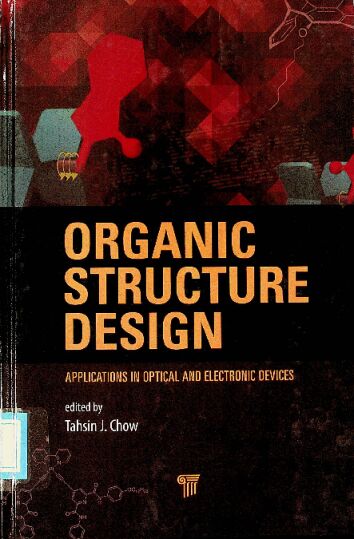
书名:Organic structure design
摘要
The development of molecular electronics has become the mainstream of scientific research in recent decades. Applications include light-emitting diodes, solar cells, thin-film transistors, and sensors, among others. New-generation organic materials possess the virtues of softness, light weight, easy processing, design flexibility, and so on. This book focuses on the preparation of new functional organic materials. It includes a brief theoretical/kinetic discussion. The text lays special emphasis on the design of organic structures and the way they perform the designated functional properties. It will help organic chemists, particularly synthetic chemists, to light up their inspirations.
查看更多
前言
The application of organic materials to optical and electronic devices is a fast-growing research area nowadays. These new type of materials are expected to be the mainstream in the next generation of smart machines. They combine the classical electronic properties of metals, yet with the advantages of organic matters, such as oftness, light weight, good solubility, and high structural flexibility. The choice of molecular structures is versatile, such as extended n-conjugate systems and macro cycles with special shapes. The functional properties include light-emitting diodes (OLEDs), organic photovoltaics (OPVs), field-effect transistors (OFETs), artificial machines, and chemical sensors. This book provides a review on several top-notch topics in these areas. The contents are mainly focused on the design and synthesis of organic functional molecules but also include related topics such as the model study on electron transfer phenomena and the fabrication technologies of organic nanostructures.
The key features in this book maybe grouped into the following categories: (1)molecular design and synthesis of functional compounds of organic and organometallic molecules in forms discrete and polymeric structures; (2)solution-processed fabrication technologies, nanostructure growth and crystallization, electro-polymerization of organic amines, supramolecular assemblies of organogels; (3) principles of long-range electron transfer through organic media, and for the design of donor-acceptor dipolar compounds; and (4) evaluation of device performance with respect to structural designs, for the application to light-emitting diodes, organic solar cells, field-effect transistors, artificial machines, and chemical sensors. The following gives a brief outline of each chapter.
To make a single molecule work as a functional device, several active sites have to be implanted onto a common molecular backbone so that they can communicate effectively in a designated manner. In these systems, electron and/or energy transfer processes are involved. In order to control the flow of electron/energy, the mechanism of electronic coupling must be realized The construction of theoretical models by using computational methods is reviewed in Chapter 1.
An overall view on organic nano- and micro materials constructed by the solution process and their applications is described in Chapter 2. The design strategies, various growth mechanisms, and device performances of OFETs, OLEDs, OPVs, photo-detectors, and super-hydrophobic materials are summarized. In comparison with physical vapor deposition, solution processing provides a more convenient and cost-effective approach to obtain organic nano- and micro materials with various morphologies, including wires, sheets, and flowers. Their relationships with the corresponding applications are discussed based on the general concepts of supramolecular chemistry.
The-π-π interaction in organic molecules plays a fundamental role in many processes, such as the self-assembly for supramolecular stacking, light-harvesting antennae for photosynthesis, amyloid fibril formation in a variety of diseases, double-helix structure of DNA, and so on. The study of electron/energy transfer processes in organic structures depends on the understanding of their π-π interactions. In Chapter 3, the electron movement in π-stacked linear arrays, namely the multilayered [3.3]paracyclophanes, is examined by their transient absorption spectra of radical cation species. Their electron/charge transfer mechanism is regarded as analogous to that of the double strand DNA molecules.
One of the ultimate goals in the development of functional molecules is to assemble an artificial machine at the molecular level. The mechanical work of ATP synthase involves the rotation of a central stalk that is powered by electrochemical potential energy created by the concentration gradient of proton across the inner membrane of mitochondria. As inspired by ATP synthase and other biological molecular machines, the development of artificial molecular machines has been an important subject of nanoscience and nanotechnology. Chapter 4 reviews the progress of molecular design and functions of molecular machines, with a special emphasis on molecular rotors. The rotation of the rotors is gated by light and/or electrical energy as energy sources.
The principle and efficiency of the related photochemistry and electrochemistry are discussed.
Supramolecular gels are semisolid materials, which can serve a variety of purposes and appear ubiquitously in our daily lives in a variety of forms. Gels are prevalent in nature, within cells and tissues of bodies, and are also present in a variety of artificial materials, including toothpaste, soap, shampoo, hair gel, contact lenses, and gel pens. These materials self-assemble through the formation of non-covalent intermolecular interactions to form supramolecular networks that trap solvent within their matrices. Because of the non-covalent nature of the forces of self-assembly, the gelationprocessis typically thermally reversible. In Chapter 5, various types of organogelators, mainly including those grafted with amide functionalities, are reviewed.
The pharmacological importance of quinoxalines and their utility as building blocks for preparing organic electronic materials have motivated a considerable number of studies in recent years. The synthetic approaches to multi-bridged U, N, and Z-shaped artificial compounds embedded with quinoxaline units are described in Chapter 6. The synthesis was executed efficiently mainly by three fundamental reactions, i.e., Diels-Alder reaction, oxidation with RuO4, and carbonyl-amine condensation reaction. These compounds may possess specific functions of interest, such as electron/energy transfer phenomena, host-guest complexation, and pharmaceutical applications.
Calixarenes are[1n] metacyclophanes, which are derived from the condensation of phenols and formaldehyde in different conditions. Gutsche coined the term "calix[4]arenes," which is derived from Latin "calyx," which means vase, pointing out the presence of a cup-shape structure in these macrocycles when they assume the cone conformation, where all four aryl groups are oriented to the same direction. In Chapter 7, a series of calix[4]arene derivatives containing various bifunctional groups were prepared by using "click chemistry," where metal ions can be encircled making them useful fluorescent sensors.
The contents of Chapter 8 are focused on the electron-transporting materials (ETMs) of OLEDs. The major objective is to glean a variety of structure types from a comprehensive survey of organic compounds that are exploited for application as ETMs and identify key structural elements/motifs that allow design and development of newer materials with improved device performances. Although limited to ETMs, the insights that are developed in this chapter will apply equally to all other types of materials, viz., hole-transporting materials, emissive materials, etc., that are relevant to OLED device constructions.
To fabricate thin-film organic electronic devices, polymeric materials are usually coated as uniform thin films directly on an electrode by spin casting. It requires good solubility of the polymers in an appropriate solvent. The low solubility of conjugated polymers limits their use on optoelectronic applications. Direct film formation on ITO glass by electro-polymerization provides an option to bypass the solubility problem. In Chapter 9, some fundamental properties about the chemical reactivity of carbazole and triphenylamine derivatives toward electro-polymerization are reviewed.
Acenes exhibit a strong tendency to form highly ordered films in various substrates under different growth conditions. They can display a high charge mobility in an electric field and, therefore, are recognized as promising materials for the application on OFETs. However, the low solubility of pentacene in most solvents is a major drawback that limited its utility through solution processes. Many efforts have been attempted to prepare "soluble" pentacene precursors in order to go around this problem. In Chapters 10 and 11, new methods for the preparation of acenes are summarized. Workable synthetic schemes are outlined, and can be used as practical guide for the preparation of similar poly-aromatic materials.
The authorship of this book includes eleven renowned professors in the top-rated universities and institutions in Asia: Kyushu University (Teruo Shinmyozu), Peking University (Jian Pei), IIT Kanpur (J. N. Moorthy), National Taiwan University (Jye-Shane Yang and Man-kit Leung), National Chiao Tung University (Wen-Sheng Chung), National Chung Cheng University (Teh-Chang Chou), and Academia Sinica (Chao-Ping Hsu, Shih-Sheng Sun, Chih-Hsiu Lin, and Tahsin J. Chow) . Many of the authors have developed long-term research collaboration among themselves. They have made significant efforts to summarize their best results and integrated into the contents of this book. It provides the first-hand reference information to the readers who are interested in the progresses of the emerging new field of organic optoelectronic materials.
查看更多
目录
Preface xiii
1 Theoretical Modeling for Electron Transfer in Organic Materials 1
Robert C.S noe berger III, Bo-Chao Lin, and Chao-Ping Hsu
1.1 Introduction 1
1.1.1 Theoretical Modeling for Electron Transfer in Solar Cells 3
1.1.1.1 The influence of energy gaps 3
1.1.1.2 Charge separation and recombination 4
1.1.2 Theoretical Modeling for Charge Transport 7
1.1.2.1 The hopping models 7
1.1.2.2 Polaron models 10
1.2 Electronic Coupling 11
1.2.1 Structural Models 12
1.2.1.1 Idealized models 12
1.2.1.2 Crystal structures 13
1.2.1.3 Simulated morphology 14
1.2.2 Calculation of Electronic Coupling 14
1.2.2.1 Energy gap 15
1.2.2.2 Direct coupling 17
1.2.2.3 The generalized Mulliken-Hush and fragment charge difference schemes 20
1.3 Conclusion 23
2. Organic Structure Design and Applications in Solution-Processed Organic Micro-and Nanomaterials 33
Ting Lei Jie-Yu Wang, and Jian Pei
2.1 Introduction 34
2.2 Main Approaches to Organic Micro/Nanomaterials 35
2.2.1 Template Synthesis 36
2.2.2 Electro spinning 37
2.2.3 Lithography 39
2.2.4 Physical Vapor Transport 40
2.2.5 Solution Process 43
2.2.5.1 Vapor diffusion 43
2.2.5.2 Phase transfer 44
2.2.5.3 Rapid solution dispersion 44
2.2.5.4 Sol-gel process 45
2.3 Molecular Design Strategy for Solution Processed Organic Micro/Nanomaterials 45
2.3.1 π-π Interaction 45
2.3.2 Donor-Acceptor Interaction 48
2.3.3 Sulfur-Sulfur Interaction 49
2.3.4 Hydrophobic Interaction 51
2.3.5 Hydrogen-Bonding Interaction 52
2.4 Impact Factors and Growth Mechan is of Organic Micro/Nanomaterials 54
2.4.1 Alkyl Chain Effect and n-n Stacking 54
2.4.2 Isomeric Effect and Solvent Effect 56
2.4.3 Organic Micro twist and Temperature Effect 59
2.4.4 Organic Micro/Nanotube Formed by Etching 60
2.4.5 Organic Flowers Formed by Hierarchical Self-Assembly 61
2.4.6 "Oriented Attachment" Mechanism 64
2.5 Applications of Organic Micro/Nanomaterials 66
2.5.1 Organic Field-Effect Transistors 66
2.5.2 Organic Light-Emitting Diodes and Organic Photovoltaics 71
2.5.3 Photodetector 72
2.5.4 Photowaveguide 73
2.5.5 Gas and Explosive Detection 75
2.5.6 Superhydrophobic Material 76
2.6 Surface Modification of Organic Micro/Nanomaterials 77
2.7 Summary and Perspectives 79
3. Synthesis, Structure, and Electronic and Photophysical Properties of Donor-Acceptor Cyclophanes 95
Masahiko Shibahara, Motonori Watanabe, Takaaki Miyazaki, Jun-ichi Fuji shige, Yuki Matsunaga, Keisuke Tao, Zhang Hua, Kenta Goto, and Teruo Shinmyozu
3.1 Introduction 95
3.2 Structural, Photophysical, and Charge Transfer Interaction of Multilayered[3.3] Paracyclophanes 100
3.3 Synthesis, Structure, Electronic, and Photophysical and Properties of[2.2] Benzothiadiazolophane 115
3.4 Synthesis, Structure, Electronic and Photophysical Properties of Two-and Three-Layered [3.3] Paracyclophane-Based Donor-Acceptor Systems 122
3.5 Conclusion and Future Remarks 130
4. Light-and Electricity-Gated Internal Rotation of Molecular Rotors: Toward Artificial Molecular Machines 137
lye-Shane Yang and Wei-Ting Sun
4.1 Introduction 137
4.2 cis-trans Photoisomerization 141
4.3 Chemicals-Gated Molecular Brakes 152
4.4 Light-Gated Molecular Brakes 160
4.5 Electricity-Gated Molecular Brakes 168
4.6 Concluding Remarks and Perspectives 172
5. Supramolecular Assemblies of Organogels Featuring -Conjugated Framework with Long-Chain Dicarboxamides 185
M.Rajeswara Rao and Shih-Sheng Sun
5.1 Introduction 186
5.2 Classification of Gels 186
5.2.1 Organogelators Based on Elongated Hydrocarbons, Fatty Acids, and Esters 188
5.2.2 Organogelators Based on Saccharides 189
5.2.3 Organogelators Based on Steroids 190
5.2.4 Organogelators Based on Aromatic Molecules 190
5.2.5 Binary Organogelators 191
5.2.6 Metal Complex Based Organogelators 193
5.2.7 Organogelators Based on Amino Acids and Ureas 194
5.3 Organogelators Based on Amides 196
5.4 Conclusions 220
6. Quinoxaline-Based Polycyclic Molecules Having Defined Shapes:From Orthocyclophanes to Polyazaacenes 229
Teh-Chang Chou
6.1 Introduction 229
6.2 Prologue 232
6.3 U-and Z-Shaped Multi-Bridged [n,n'] Orthocyclophanes 235
6.3.1 The Quadruple-Bridged [5, 5] Orthocyclophanes and [6,6] Orthocyclophanes 236
6.3.2 The U-Shaped Septuple-Bridged [7,7] Orthocyclophanes 242
6.3.3 The Z-Shaped[6,4] Orthocyclophanes 248
6.4 N-Shaped π,π-Stacking Molecules 252
6.5 Multi-Functionalized Polyazaacenes 259
6.5.1 Multi-Functionalized Chlorinated Polyacenoquinone Esters 261
6.5.2 Mechanistic Consideration for Fragmentation of Chlorinated Polyacenoquinone Esters 268
6.5.3 Amination of Chlorinated Polyacenoquinone Esters 272
6.6 Closing Remarks 275
7. Fluorogenic Sensors of Heavy Metal lons Based on Calix[4] arenes Functionalized by 1,3-Dipolar Cycloaddition
Reactions 287
Wen-Sheng Chung
7.1 Introduction of Calixarenes 287
7.2 1,3-Dipolar Cycloaddition Reactions and Subsequent Ring-Opening Reactions 290
7.3 Calix[4]arenes with Upper-and Lower-Rim Isoxazolines and Isoxazoles 293
7.4 Fluorogenic Sensors of Calix[4]arenes with Lower-Rim 1, 2, 3-Triazoles 299
7.5 Metal Ion Sensing and Ditopic Sensing Based on Calix[4]arenes Functionalized by 1,3-Dipolar Cycloaddition Reactions 309
7.6 Summary and Perspective 319
8. Electron Transport Materials inrganic Light-Emitting Diodes: Design Considerations and Structural Diversity 327
Samik Jhulki, Ishita Neogi, and Jarugu Narasimha Moorthy
8.1 Introduction 327
8.2 Metal Chelates 330
8.3 Six-Membered Heterocycles 332
8.3.1 Pyridines 333
8.3.2 Quinoxaline 336
8.3.3 Naphthyridines 337
8.3.4 Phenanthrolines 338
8.3.5 Pyrazines 340
8.3.6 Pyrimidines 341
8.3.7 Quinoxaline 342
8.3.8 Anthrazolines 344
8.3.9 Triazines 345
8.4 Five-Membered Heterocycles 346
8.4.1 Isobenzofurans 348
8.4.2 0xazoles 349
8.4.3 Benzimidazoles 349
8.4.4 Benzo thiazoles 351
8.4.5 Oxadiazoles 352
8.4.6 Triazoles 354
8.5 Perfluorinated Compounds 356
8.6 Metalloles 359
8.7 Miscellaneous 361
8.8 Electron-Transporting Materials for Phosphorescent Organic Light-Emitting Diodes 366
8.9 Structural Determinants for Better ETMs: Our Perspective 367
8.10 Conclusions and Outlook 389
9. Electrochemical Deposition of Carbazole and Triarylamine Derivatives and Their Polymeric Optoelectronic Applications 399
Man-kit Leung
9.1 Introduction 399
9.2 Hole Mobility in Triarylamine-Based Materials 400
9.2.1 Hole-Mobility in Organic Glass 401
9.2.2 Hole-Mobility in Liquid Films 403
9.3 Electrochemical Deposition of Tri arylamine-Based Materials 403
9.3.1 Electrochemical Polymerization of Carbazole 405
9.3.2 Electrochemical Polymerization of Dicarbazole, Polycarbazole, and Carbazole Dendrimers 408
9.3.3 Electrochemical Polymerization of Triphenyl amine Derivatives 416
9.3.4 Electrochemical Polymerization of Diphenylamine 419
9.3.5 Electrochemical Polymerization of 4-(1-Hydro-xyethyl) Triphenylamine 420
9.3.6 Electrochemical Polymerization of bis(Triphenylamine)s 422
9.3.7 Electrochemical Polymerization of Poly,Hyperbranched, and Dendritic Triphenylamines 428
9.4 Lithography and Nanopatterning 436
9.4.1 Electrochemical Nanolithography 437
9.4.2 Colloidal Template Electropolymerization 438
9.4.3 Electropolymerization of Macromonomer Bearing Photolabile Linker for Imaging 440
10. Solution-Processed Acenes and Their Applications on Field-Effect Transistor 455
Motonori Watanabe and Tahsin J.Chow
10.1 Introduction 455
10.2 Synthesis of Acenes from Norbornadienone Type Precursors 457
10.2.1 Precursors of Pentacene 458
10.2.2 Precursors of Tetracene and Hexacene 462
10.3 Physical Properties of Acene Precursors 463
10.3.1 Pentacene Precursors 464
10.3.2 Tetracene and Hexacene 467
10.3.3 Solution-Processed Thin-Film Transistor 469
10.3.4 0FETs Made with Single Crystals of Acenes 470
10.4 HigherAcenes with Functional Substituents 472
10.4.1 Acenes Containing Trialkylsilylethynyl Substituents 472
10.4.2 Acenes Containing Thiolyl Substituents 476
10.5 TwistedAcenes from Lactam-Bridged Precursors 477
10.6 Summary 479
11. New Synthetic Route to Acenes 487
Chih-Hsiu Lin
11.1 Introduction 487
11.2 New Methodology in Acene Synthesis 489
11.2.1 Novel Convenient One-Step Reduction of Acenoquinone to Acene Derivatives 489
11.2.2 One-Pot Syntheses of Tetracene Sulfoxide and Tetracene Sulfone Compounds via Cascade Cyclization 491
11.2.3 Synthesis of Ladder-Type Oligonaphthalene Derivatives via Cationic Cyclization 493
11.2.4 Iterative Synthesis of Acene Diesters and Acene Dinitriles 496
11.2.5 Synthesis of Hetero-Acene and Perylene Derivatives Conjugated Systems Using Elongation Protocol 503
11.2.6 Direct Derivatization of Acene Skeletons: Ether-Ether, Ether-Sulfide, Ether-Selenide Exchange Reactions 505
11.3 Summary and Conclusion 510
Index 513
查看更多
作者简介
Tahsin J. Chow is a research fellow in the Institute of Chemistry, Academia Sinica, Taiwan, and an adjunct professor in the Department of Chemistry at National Taiwan University. He obtained his BS from National Taiwan University in 1972 and a PhD from the University of Cincinnati, USA, in 1980. Prof. Chow has been an Alexander von Humboldt scholar in 1988–1989 and became a fellow of the Federation of Asian Chemical Societies in 2005. His research interests are in the field of organic and physical organic chemistry, and in recent years, he has especially focused on organic electronic materials.
查看更多
馆藏单位
中科院文献情报中心