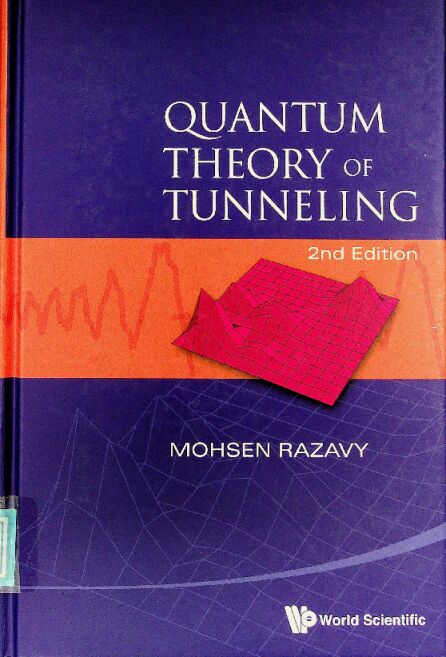
书名:Quantum theory of tunneling
责任者:Mohsen Razavy | University of Alberta | Canada.
出版时间:2014
出版社:World Scientific,
前言
In this revised and expanded edition, in addition to a comprehensible introduction to the theoretical foundations of quantum tunneling based on different methods of formulating and solving tunneling problems, different semiclassical approximations for multidimensional systems are presented. Particular attention is given to the tunneling of composite systems, with examples taken from molecular tunneling and also from nuclear reactions. The interesting and puzzling features of tunneling times are given extensive coverage, and the possibility of measurement of these times with quantum clocks are critically examined.
In addition by considering the analogy between evanescent waves in waveguides and in quantum tunneling, the times related to electromagnetic wave propagation have been used to explain certain aspects of quantum tunneling times. These topics are treated in both non-relativistic as well as relativistic regimes. Finally, a large number of examples of tunneling in atomic, molecular, condensed matter and nuclear physics are presented and solved.
查看更多
目录
Preface to the Second Edition vii
Preface to the First Edition ix
Introduction xix
1 A Brief History of Quantum Tunneling 1
2 Some Basic Questions Concerning Quantum Tunneling 8
2.1 Tunneling and the Uncertainty Principle 9
2.2 Asymptotic Form of Decay After a Very Long Time 11
2.3 Initial Stages of Decay 12
2.4 Solvable Models Exhibiting Different Stages of Decay 17
3 Simple Solvable Problems 33
3.1 Confining Double-Well Potentials 33
3.2 Tunneling Through Barriers of Finite Extent 38
3.3 Tunneling Through a Series of Identical Rectangular Barriers 49
3.4 Eckart's Potential 54
3.5 Double-Well Morse Potential 57
3.6 A Solvable Asymmetric Double-Well Potential 60
4 Time-Dependence of the Wave Function in One-Dimensional Tunneling 64
4.1 Time-Dependent Tunneling for a -Function Barrier 65
4.2 An Asymptotic Expression in Time for the Transmission of a Wave Packet 73
5 Semiclassical Approximations 78
5.1 The WKB Approximation 78
5.2 Method of Miller and Good 88
5.3 Calculation of the Splitting of Levels in a Symmetric Double-Well Potential Using WKB Approximation 97
5.4 Energy Eigenvalues for Motion in a Series of Identical Barriers 100
5.5 Tunneling in Momentum Space 103
5.6 The Bremmer Series 105
6 Generalization of the Bohr-Sommerfeld Quantization Rule and Its Application to Quantum Tunneling 110
6.1 The Bohr-Sommerfeld Method for Tunneling in Symmetric and Asymmetric Wells 114
6.2 Numerical Examples 117
7 Gamow's Theory, Complex Eigenvalues, and the Wave Function of a Decaying State 120
7.1 Solution of the Schrodinger Equation with Radiating Boundary Condition 120
7.2 Green's Function for the Time-Dependent Schrodinger Equation with Radiating Boundary Conditions 124
7.3 The Time Development of a Wave Packet Trapped Behind a Barrier 133
7.4 Method of Auxiliary Potential 137
7.5 Determination of the Wave Function of a Decaying State 143
7.6 Some Instances Where WKB Approximation and the Gamow Formula Do Not Work 154
8 Tunneling in Symmetric and Asymmetric Local Potentials and Tunneling in Nonlocal and Quasi-Solvable Barriers 159
8.1 Tunneling in Double-Well Potentials 160
8.2 Tunneling When the Barrier is Nonlocal 165
8.3 Tunneling in Separable Potentials 169
8.4 Quasi-Solvable Examples of Symmetric and Asymmetric Double-Wells 171
8.5 Gel'fand-Levitan Method 174
8.6 Darboux's Method 176
8.7 Optical Potential Barrier Separating Two Symmetric or Asym-metric Wells 178
9 Classical Descriptions of Quantum Tunneling 186
9.1 Coupling of a Particle to a System with Infinite Degrees of Freedom 186
9.2 Classical Trajectories with Complex Energies and Quantum Tunneling 192
10 Tunneling in Time-Dependent Barriers 198
10.1 Multi-Channel Schrodinger Equation for Periodic Potentials 199
10.2 Tunneling Through an Oscillating Potential Barrier 201
10.3 Separable Tunneling Problems with Time-Dependent Barriers 210
10.4 Penetration of a Particle Inside a Time-Dependent Potential Barrier 217
11 Decay Width and the Scattering Theory 221
11.1 One-Dimensional Scattering Theory and Escape from a Poten-tial Well 222
11.2 Scattering Theory and the Time-Dependent Schrodinger Equation 230
11.3 An Approximate Method of Calculating the Decay Widths 235
11.4 Time-Dependent Perturbation Theory Applied to the Calcula-tion of Decay Widths of Unstable States 240
11.5 Early Stages of Decay via Tunneling 244
11.6 An Alternative Way of Calculating the Decay Width Using the Second Order Perturbation Theory 246
11.7 Tunneling Through Two Barriers 249
11.8 R-matrix Formulation of Tunneling Problems 253
11.9 Decay of the Initial State and the Jost Function 258
12 The Method of Variable Reflection Amplitude Applied to Solve Multichannel Tunneling Problems 267
12.1 Mathematical Formulation 268
12.2 Variable Partial Wave Phase Method for Central Potentials 275
12.3 Matrix Equations and Semi-classical Approximation for Many-Channel Problems 277
13 Path Integral and Its Semiclassical Approximation in Quantum Tunneling 284
13.1 Application to the S-Wave Tunneling of a Particle Through a Central Barrier 288
13.2 Method of Euclidean Path Integral 291
13.3 Other Applications of the Path Integral Method in Tunneling 296
13.4 Complex Time, Path Integrals and Quantum Tunneling 302
13.5 Path Integral and the Hamilton-Jacobi Coordinates 305
13.6 Path Integral Approach to Tunneling in Nonlocal Barriers 308
13.7 Remarks About the Semiclassical Propagator and Tunneling Problem 313
14 Heisenberg's Equations of Motion for Tunneling 318
14.1 The Heisenberg Equations of Motion for Tunneling in Symmetric and Asymmetric Double-Wells 319
14.2 Heisenberg's Equations for Tunneling in a Symmetric Double-Well 325
14.3 Heisenberg's Equations for Tunneling in an Asymmetric Double-Well 326
14.4 Tunneling in a Potential Which is the Sum of Inverse Powers of the Radial Distance 327
14.5 Klein's Method for the Calculation of the Eigenvalues of a Confining Double-Well Potential 333
14.6 Finite Difference Method for Tunneling in Confining Potentials 340
14.7 Finite Difference Method for One-Dimensional Tunneling 343
15 Wigner Distribution Function in Quantum Tunneling 349
15.1 Wigner Distribution Function and Quantum Tunneling 353
15.2 Wigner Trajectory for Tunneling in Phase Space 356
15.3 Entangled Classical Trajectories 361
15.4 Wigner Distribution Function for an Asymmetric Double-Well 364
15.5 Wigner Trajectory for an Oscillating Wave Packet 365
15.6 Margenau-Hill Distribution Function for a Double-Well Potential 365
16 Decay Widths of Siegert States, Complex Scaling and Dilatation Transformation 369
16.1 Siegert Resonant States 370
16.2 A Numerical Method of Determining Siegert Resonances 371
16.3 Riccati-Padé Method of Calculating Complex Eigenvalues 373
16.4 Complex Rotation or Scaling Method 376
16.5 Milne's Method 380
16.6 Complex Energy Resonance States Calculated by Milne's Differential Equation 382
16.7 S-Wave Scattering from a Delta Function Potential 384
16.8 Resonant States for Solvable Potentials 386
17 Multidimensional Quantum Tunneling 391
17.1 The Semiclassical Approach of Kapur and Peierls 392
17.2 Wave Function for the Lowest Energy State 396
17.3 Calculation of the Low-Lying Wave Functions by Quadrature 398
17.4 Semiclassical Wave Function 402
17.5 Tunneling of a Gaussian Wave Packet 408
17.6 Interference of Waves Under the Barrier 413
17.7 Penetration Through Two-Dimensional Barriers 419
17.8 Method of Quasilinearization Applied to the Problem of Multi-dimensional Tunneling 423
17.9 Solution of the General Two-Dimensional Problems 428
17.10 The Most Probable Escape Path 432
17.11 An Extension of the Hamilton-Jacobi Theory and Its Applica-tion for Solving Multidimensional Tunneling Problems 438
17.12 A Time-Dependent Approach to the Problem of Tunneling in Two Dimensions 444
18 Group and Signal Velocities 453
18.1 Exact Solution of the Problem of Tunneling in a Constant Barrier 459
19 Time-Delay, Reflection Time Operator and Minimum Tunneling Time 468
19.1 Time-Delay Caused by Tunneling 469
19.2 Time-Delay for Tunneling of a Wave Packet 473
19.3 Landauer and Martin Criticism of the Definition of the Time-Delay in Quantum Tunneling 482
19.4 Other Approaches to the Tunneling Time Problem 485
19.5 Time-Delay in Multichannel Tunneling 488
19.6 Reflection Time in Quantum Tunneling 491
19.7 Minimum Tunneling Time 496
19.8 Traversal-Time Wave Function 498
20 More About Tunneling Time 505
20.1 Dwell and Phase Tunneling Times 506
20.2 Büttiker and Landauer Time 516
20.3 Larmor Clock for Measuring Tunneling Times 520
20.4 Tunneling Time and Its Determination Using the Internal En-ergy of a Simple Molecule 524
20.5 Intrinsic Time 526
20.6 Measurement of Tunneling Time by Quantum Clocks 529
20.7 A Critical Study of the Tunneling Time Determination by a Quantum Clock 531
20.8 Tunneling Time According to Low and Mende 537
21 Tunneling of a System with Internal Degrees of Freedom 545
21.1 Lifetime of Coupled-Channel Resonances 545
21.2 Two-Coupled Channel Problem with Spherically Symmetric Barriers 547
21.3 Tunneling of a Simple Molecule 551
21.4 Tunneling of a Homonuclear Molecule in a Symmetric Double-Well Potential 554
21.5 Tunneling of a Molecule in Asymmetric Double-Wells 556
21.6 Tunneling of a Molecule Through a Potential Barrier 561
21.7 Tunneling of Composite Systems in Nuclear Reactions 573
21.8 Antibound State of a Molecule 580
22 Motion of a Particle in a Waveguide with Variable Cross Section and in a Space Bounded by a Dumbbell-Shaped Object 584
22.1 An Exactly Solvable Quantum Waveguide 587
22.2 Motion of a Particle in a Space Bounded by a Surface of Revolution 594
22.3 Testing the Accuracy of the Present Method 598
22.4 Calculation of the Eigenvalues 600
22.5 Quantum Wires 603
23 Relativistic Formulation of Quantum Tunneling 611
23.1 One-Dimensional Tunneling of the Electrons 611
23.2 Relativistic Effects in Time-Dependent Tunneling 616
23.3 Tunneling of Spinless Particles in One Dimension 621
23.4 Tunneling Time in Special Relativity 624
23.5 Quantum Tunneling Times for Relativistic Particles 630
24 Inverse Problems of Quantum Tunneling 641
24.1 A Method for Finding the Potential from the Reflection Amplitude 642
24.2 Determination of the Shape of the Potential Barrier in One-Dimensional Tunneling 644
24.3 Construction of a Symmetric Double-Well Potential from the Known Energy Eigenvalues 649
24.4 The Inverse Problem of Tunneling for Gamow States 652
24.5 Prony's Method for Determination of Complex Energy Eigenvalues 655
25 Some Examples of Quantum Tunneling in Atomic and Molecular Physics 660
25.1 Torsional Vibration of a Molecule 660
25.2 Electron Emission from the Surface of Cold Metals 663
25.3 Ionization of Atoms in Very Strong Electric Field 667
25.4 A Time-Dependent Formulation of Ionization in an Electric Field 670
25.5 Energy Levels of the Ammonia Molecule and the Ammonia Maser 674
25.6 Optical Isomers 678
25.7 Three-Dimensional Tunneling in the Presence of a Constant Field of Force 680
26 Some Examples in Condensed Matter Physics 688
26.1 The Band Theory of Solids and the Kronig-Penney Model 688
26.2 Tunneling in Metal-Insulator-Metal Structures 692
26.3 Many-Electron Formulation of the Current 693
26.4 Excitation of Closely Spaced Energy Levels in Heterostructures: The Time-Dependent Formulation 700
26.5 Electron Tunneling Through Heterostructures 706
26.6 The Josephson Effect 711
27 Alpha Decay 722
27.1 The Time-Independent Formulation of the α Decay 725
27.2The Time-Dependent Formulation of the α Decay 729
27.3 The WKB Approximation 734
27.4 Electromagnetic Radiation by a Charged Particle While Tunneling Through a Barrier 739
27.5 Perturbation Theory Applied to the Problem of Bremsstrahlung in α-Decay 749
Index 759
查看PDF
查看更多
馆藏单位
中科院文献情报中心