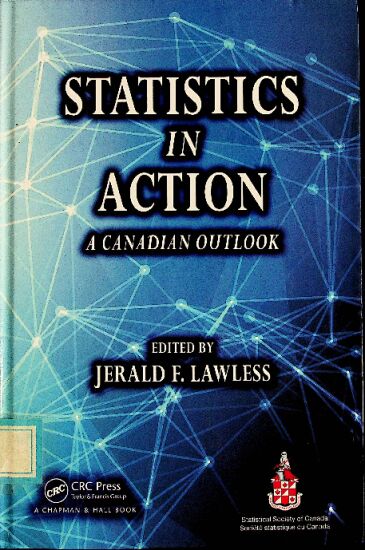
书名:Statistics in action
ISBN\ISSN:9781482236231,1482236230
摘要
Commissioned by the Statistical Society of Canada (SSC), Statistics in Action: A Canadian Outlook helps both general readers and users of statistics better appreciate the scope and importance of statistics. It presents the ways in which statistics is used while highlighting key contributions that Canadian statisticians are making to science, technology, business, government, and other areas. The book emphasizes the role and impact of computing in statistical modeling and analysis, including the issues involved with the huge amounts of data being generated by automated processes.
The first two chapters review the development of statistics as a discipline in Canada and describe some major contributions to survey methodology made by Statistics Canada, one of the world's premier official statistics agencies. The book next discusses how statistical methodologies, such as functional data analysis and the Metropolis algorithm, are applied in a wide variety of fields, including risk management and genetics. It then focuses on the application of statistical methods in medicine and public health as well as finance and e-commerce. The remainder of the book addresses how statistics is used to study critical scientific areas, including difficult-to-access populations, endangered species, climate change, and agricultural forecasts.
查看更多
目录
Foreword xiii
Preface xv
About the Editor xix
Contributors xxi
1 Canadians Studying Abroad and the Development of Statistics in Canada David R. Bellhouse and Stephen E. Fienberg 1
1.1 Introduction 1
1.2 Statistics' Rise as a Modern Field in North America 2
1.3 Statistical Education in Canada between the Wars 4
1.4 World War II as a Watershed 8
1.5 A Second Early Generation of Canadian Statisticians 9
1.6 Generation of the 1950s and Early 1960s 10
1.6.1 Princeton Connection 11
1.6.2 More Migration from Toronto 12
1.6.3 Manitoba Influence 13
1.6.4 Other Notable Canadians Who Went Abroad 14
1.7 A Paradigm Shift 15
Bibliography 17
2 Some of Statistics Canada's Contributions to Survey Methodology Jean-Francois Beaumont, Susie Fortier, Jack Gambino, Mike Hidiroglou, and Pierre LavaIlee 19
2.1 Introduction 19
2.2 Sample Design 21
2.2.1 Record Linkage 21
2.2.2 Multiple Frames 22
2.2.3 Indirect Sampling 23
2.2.4 Optimal Stratification 23
2.2.5 Power Allocation 25
2.3 Edit and Imputation 25
2.4 Estimation 27
2.4.1 Generalized Estimation System 29
2.4.2 Outliers 30
2.4.3 Composite Estimation 30
2.4.4 Small Area Estimation 31
2.5 Variance Estimation 32
2.5.1 Taylor Linearization 33
2.5.2 Replication Methods 34
2.5.3 Variance Estimation in the Presence of Imputation 35
2.6 Data Analysis 36
2.7 Time Series 37
2.7.1 Seasonal Adjustment and Trend-Cycle Estimation Method 37
2.7.2 Benchmarking and Reconciliation Methods 38
2.8 Conclusion 39
Bibliography 40
3 Watching Children Grow Taught Us All We Know James O. Ramsay and Michael Hermanussen 47
3.1 Introduction 47
3.2 Modeling Growth 49
3.3 Phase/Plane Plots of Derivative Interactions 50
3.4 Identification and Analysis of Phase or Tempo Variation 53
3.5 Conclusion 56
Bibliography 56
4 Modeling Dependence beyond Correlation Christian Genest and Johanna G. Našlehová 59
4.1 Beyond the Normal Brave Old World 59
4.2 Dangers of Ignoring Non-Normality 62
4.3 Copulas to the Rescue 64
4.3.1 Fréchet's Problem 64
4.3.2 Measuring Association 65
4.3.3 Stress Testing 66
4.3.4 Validate, Validate, Validate! 69
4.4 Proof of the Pudding Is in the Ranking 70
4.5 Applications and Future Challenges 74
Bibliography 75
5 Lasso and Sparsity in Statistics Robert J. Tibshirani 79
5.1 Sparsity, l1 Penalties and the Lasso 79
5.2 Some Background 82
5.3 A History for Coordinate Descent for the Lasso 84
5.4 An Example in Medicine 85
5.5 Nearly Isotonic Regression 87
5.6 Conclusion 89
Bibliography 89
6 Optimizing and Adapting the Metropolis Algorithm Jeffrey S. Rosenthal 93
6.1 Introduction 93
6.2 Monte Carlo Algorithms 94
6.3 Markov Chain Monte Carlo (MCMC) 95
6.4 Metropolis Algorithm 96
6.5 Goldilocks Principle 97
6.6 Optimal Scaling 100
6.7 Proposal Shape 101
6.8 Adaptive MCMC 103
6.9 Summary 105
Bibliography 106
7 Design of Computer Experiments for Optimization, Estimation of Function Contours, and Related Objectives Derek Bingham, Pritam. Ranjan, and William. J. Welch 109
7.1 Introduction 109
7.2 Expected Improvement and Sequential Design: Basic Ideas 110
7.2.1 Optimization 110
7.2.2 Contour Estimation 114
7.3 Expected Improvement Criteria 116
7.3.1 EI for Global Optimization 116
7.3.2 EI for Contour Estimation 117
7.4 Gaussian Process Models and Predictive Distributions 118
7.5 Other EI-Based Criteria 120
7.6 Summary 122
Bibliography 123
8 Statistical Genetic Modeling and Analysis of Complex Traits Shelley B. Bull, Jinko Graham, and Celia M. T. Greenwood 125
8.1 Introduction and Overview 125
8.2 Essentials of Statistical Genetic Methods 127
8.2.1 Modeling Genetic Sharing in Sibships and Relative Pairs 129
8.2.2 Models for Genetic Transmission in Families 131
8.2.3 Genetic Association in Unrelated Individuals 133
8.3 Advances in Statistical Genetic Methods 135
8.3.1 Linkage with Covariate Data 135
8.3.2 Effect Estimation in Genome-Wide Analysis 138
8.4 Commentary: Current and Emerging Issues 140
Bibliography 142
9 Bayesian Methods in Fisher's Statistical Genetics World Radu V. Craiu and Lei Sun 147
9.1 Background and Introduction 147
9.1.1 Basic Genetic Terminology 148
9.1.2 Statistical Set-Up of Genetic Association Studies: Two Intertwined Issues 148
9.1.3 GWAS and an Example 150
9.2 Identification of Trait-Associated SNPs 151
9.2.1 p-Value 151
9.2.2 Bayes Factor 152
9.2.3 Additional Considerations 153
9.3 Replication of a Significant Finding 155
9.3.1 Conditional MLE vs. Bayesian Model Averaging 155
9.3.2 Computational Considerations 157
9.4 Conclusion and Discussion 158
Bibliography 159
10 Bayesian Statistical Methodology for Observational Health Sciences Data Paul Gustafson 163
10.1 Introduction 163
10.2 Case-Control Studies 165
10.3 Bayesian Analysis 167
10.4 Exposure Misclassification 168
10.5 Going Further with Bayesian Analysis 172
Bibliography 174
11 Statistical Models for Disease Processes: Markers and Skeletal Complications in Cancer Metastatic to Bone Richard J. Cook 177
11.1 Skeletal Complications in Individuals Suffering from Cancer Metastatic to Bone 177
11.2 Bone Markers and Prognosis for Adverse Events 180
11.3 Joint Models for Dynamic Bone Markers and Adverse Events 183
11.4 Discussion 189
Bibliography 191
12 Analysis of Biased Survival Data: The Canadian Study of Health and Aging and beyond Masoud Asgharian, Christina Wolfson, and David B. Wolfson 193
12.1 Introduction 193
12.2 Nonparametric Estimation of the Survivor Function 196
12.3 Checking for Stationarity of the Incidence Process 200
12.4 Estimating the Incidence Rate 201
12.5 Covariates 202
12.6 Concluding Remarks 203
Bibliography 205
13 Assessing the Effect on Survival of Kidney Transplantation with Higher-Risk Donor Kidneys Douglas E. Schaubel and John D. Kalbfleisch 209
13.1 Introduction 209
13.2 Study Population and Notation 211
13.3 Analysis Based on Time-Dependent Treatment Indicator 213
13.4 Modification to Time-Dependent Analysis 216
13.5 Sequential Stratification 217
13.6 Discussion 219
Bibliography 222
14 Risk-Adjusted Monitoring of Outcomes in Health Care Stefan H. Steiner 225
14.1 Introduction 225
14.2 Motivation and Background 226
14.3 Monitoring Industrial Processes 227
14.4 Monitoring Outcomes in Health Care: Issues and Challenges 229
14.5 Monitoring Outcomes in Health Care: Methods 231
14.5.1 Variable Life-Adjusted Display Chart 232
14.5.2 Exponentially Weighted Moving Average Chart 232
14.5.3 Risk-Adjusted Cumulative Sum Chart 234
14.6 Monitoring Outcomes in Health Care: Uses and Future 237
Bibliography 239
15 Statistics in Financial Engineering Bruno Rémillard 243
15.1 Introduction 243
15.2 Modeling 244
15.2.1 Black—Scholes—Merton Model 244
15.2.2 Extensions of the BSM Model 246
15.2.3 Choice of Distribution for the Innovations 247
15.2.4 Challenge of Model Validation 249
15.3 Applications to Financial Engineering 250
15.3.1 Portfolio Management 250
15.3.2 Option Pricing 252
15.3.3 Risk Management 253
15.4 Final Comment 255
Bibliography 256
16 Making Personalized Recommendations in E-Connnerce Mu Zhu 259
16.1 Introduction 259
16.2 Nearest Neighbors 261
16.3 Matrix Factorization 261
16.4 Matrix Completion 262
16.5 Content-Boosted Matrix Factorization 264
16.6 Discussion 267
Bibliography 267
17 What Do Salmon and Injection Drug Users Have in Common? Laura L. E. Cowen, Wendell O. Challenger, and Carl J. Schwarz 269
17.1 Methodology Background 269
17.2 Closed Population Models and Two-Sample Experiments 270
17.2.1 Victoria's Injection Drug Users 273
17.2.2 Rotary Screw Traps and the Time Stratified Petersen Estimator 274
17.2.3 Extending the Closed Population Models 276
17.3 Open Populations 277
17.3.1 Novel Applications — Pacific Ocean Shelf Tracking 278
17.4 Additional Complications 282
17.5 Concluding Remarks 283
Bibliography 284
18 Capture–Recapture Methods for Estimating the Size of a Population: Dealing with Variable Capture Probabilities Louis-Paul Rivest and Sophie Baillargeon 289
18.1 Estimating Abundance with Marked Units 289
18.2 Datasets 292
18.3 Estimation of Population Size Using Aggregated Data 293
18.3.1 Homogeneity Model 293
18.3.2 A Probability Plot and a Lower Bound Estimate 295
18.3.3 Parametric Models with Random Capture Probabilities 298
18.4 Modeling Capture Probabilities with Unit Level Covariates 300
18.5 Discussion 302
Bibliography 303
19 Challenges in Statistical Marine Ecology Joanna Mills Flemming and Christopher A. Field 305
19.1 Introduction 305
19.2 Sustaining North Atlantic Cod Stocks 307
19.2.1 Results 309
19.3 Conserving the Endangered Hammerhead Shark 312
19.3.1 Results 315
19.4 Conclusions 317
Bibliography 318
20 Quantifying the Human and Natural Contributions to Ob-served Climate Change Francis W. Zwiers, Gabriele C. Hegerl, Xuebin Zhang, and Qiuzi Wen 321
20.1 Introduction 321
20.2 Scope of the Problem 322
20.3 A Weighted Regression Approach 324
20.4 Role of the Global Climate Models 327
20.5 A Slightly More Detailed Regression Model 329
20.6 Interpreting the Results 331
20.7 Discussion 335
Bibliography 338
21 Data Hungry Models in a Food Hungry World: An Interdis-ciplinary Challenge Bridged by Statistics Louis Kouadio and Nathaniel Newlands 341
21.1 Big Challenges for Future Global Crop Production 341
21.2 Differing Needs for Crop Yield "Outlook" Forecasts 342
21.3 Use of Satellite Remote Sensing Data 344
21.4 Regional-Scale Crop Outlooks 348
21.5 More Reliable Forecasting 353
Bibliography 354
Index 357
查看PDF
查看更多
作者简介
Jerald F. Lawless is distinguished professor emeritus in the Department of Statistics and Actuarial Science at the University of Waterloo, where he was a faculty member from 1972 to 2007. His research interests include biostatistics, survival and event history analysis, reliability, and general methodology. He is the author of three books and numerous research articles. He has also con-sulted and collaborated widely in fields that include manufacturing, medicine, risk and safety analysis, social sciences, and law. He is a past editor of Tech-nometrics and a former president of the Statistical Society of Canada (SSC). He has received the SSC Gold Medal for research and the Shewhart Medal of the American Society for Quality. He is an elected fellow of the Royal Society of Canada, a fellow of the American Statistical Association, and a fellow of the Institute of Mathematical Statistics.
查看更多
馆藏单位
中科院文献情报中心