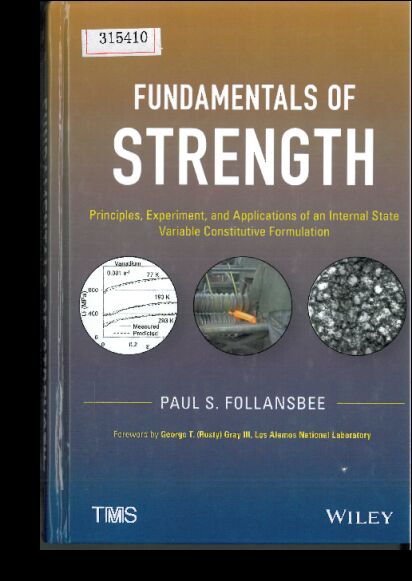
书名:Fundamentals of Strength
责任者:Paul S. Follansbee (Ed.) | Follansbee, Paul S.
出版时间:2014
出版社:John Wiley & Sons, Inc.
前言
This monograph was compiled to accomplish several objectives. First, I have enjoyed the opportunity to work with undergraduate students at Saint Vincent College (SVC) in Latrobe, Pennsylvania, on projects related to deformation modeling in metals. While I teach an introductory materials course, I have found that each time I take on a student I have spent considerable time independently teaching the student about the basis of the mechanical threshold stress (MTS) constitutive model - an internal state variable formulation. I have found it necessary to review topics related to mechanical testing, crystal structure, thermodynamics, dislocation motion, dislocation–obstacle interactions, hardening through dislocation accumulation, and deformation kinetics. Thus, I chose to write this monograph so that information they needed would be available in a single source. This monograph touches upon some topics that are covered in much more detail in available introductory materials textbooks. The chapter on structure and bonding, for instance, introduces the student to interatomic forces and dislocations, because these are essential to the understanding of strength. However, the material is incomplete and is not intended to replace the level of coverage found in an introduction to materials engineering textbook.
A second objective has been to document as completely as possible the mechanistic basis of the MTS model. The model has been under development for 25 years and has experienced use and evolution by multiple investigators. I believed a monograph focused on the elements of the model would assist others in its application. To accomplish this, I have tried to be clear about parts of the model that are soundly based-and I attempt to describe this-and others that are based on less-sound assumptions. A chapter has also been included to instruct investigators how to develop MTS model constants. I created a fictitious metal-FoLLyalloy-to demonstrate the required experimental test matrix and how measurements are analyzed.
Finally, I have included numerous examples of model implementation. In most cases, data available in the open literature have been used. Often, data have been extracted from a published figure using a digitization protocol, followed by curve smoothing to remove digitization errors if the published curve is smooth. Experience suggests that the digitized data agree within 2% of the actual data. Analysis of published data is not intended to repeat work in the literature but to show how experience with the MTS model has evolved, how this experience has eased model implementation, and how the MTS model can be used to understand the effects of new strengthening mechanisms, for example, fine grain processing or irradiation damage, when deformation in the base alloy is well understood.
查看更多
目录
FOREWORD xi
PREFACE xiii
ACKNOWLEDGMENTS xv
HOW TO USE THIS BOOK xvii
LIST OF SYMBOLS xxi
1 MEASURING THE STRENGTH OF METALS 1
1.1 How Is Strength Measured? 1
1.2 The Tensile Test 3
1.3 Stress in a Test Specimen 6
1.4 Strain in a Test Specimen 6
1.5 The Elastic Stress versus Strain Curve 7
1.6 The Elastic Modulus 8
1.7 Lateral Strains and Poisson’s Ratio 9
1.8 Defining Strength 11
1.9 Stress–Strain Curve 12
1.10 The True Stress–True Strain Conversion 16
1.11 Example Tension Tests 18
1.12 Accounting for Strain Measurement Errors 22
1.13 Formation of a Neck in a Tensile Specimen 25
1.14 Strain Rate 27
1.15 Measuring Strength: Summary 29
Exercises 29
References 35
2 STRUCTURE AND BONDING 36
2.1 Forces and Resultant Energies Associated with an Ionic Bond 36
2.2 Elastic Straining and the Force versus Separation Diagram 39
2.3 Crystal Structure 40
2.4 Plastic Deformation 42
2.5 Dislocations 46
2.6 Summary: Structure and Bonding 51
Exercises 52
References 53
3 CONTRIBUTIONS TO STRENGTH 54
3.1 Strength of a Single Crystal 54
3.2 The Peierls Stress 59
3.3 The Importance of Available Slip Systems and Geometry of HCP Metals 61
3.4 Contributions from Grain Boundaries 63
3.5 Contributions from Impurity Atoms 66
3.6 Contributions from Stored Dislocations 68
3.7 Contributions from Precipitates 71
3.8 Introduction to Strengthening: Summary 71
Exercises 72
References 75
4 DISLOCATION–OBSTACLE INTERACTIONS 76
4.1 A Simple Dislocation–Obstacle Profile 76
4.2 Thermal Energy: Boltzmann’s Equation 77
4.3 The Implication of 0 K 78
4.4 Addition of a Second Obstacle to a Slip Plane 79
4.5 Kinetics 80
4.6 Analysis of Experimental Data 83
4.7 Multiple Obstacles 87
4.8 Kinetics of Hardening 88
4.9 Summary 89
Exercises 90
References 92
5 A CONSTITUTIVE LAW FOR METAL DEFORMATION 94
5.1 Constitutive Laws in Engineering Design and Materials Processing 94
5.2 Simple Hardening Models 98
5.3 State Variables 102
5.4 Defining a State Variable in Metal Deformation 103
5.5 The Mechanical Threshold Stress Model 104
5.6 Common Deviations from Model Behavior 109
5.7 Summary: Introduction to Constitutive Modeling 112
Exercises 113
References 115
6 Further MTS Model Developments 117
6.1 Removing the Temperature Dependence of the Shear Modulus 117
6.2 Introducing a More Descriptive Obstacle Profile 119
6.3 Dealing with Multiple Obstacles 122
6.4 Defining the Activation Volume in the Presence of Multiple Obstacle Populations 131
6.5 The Evolution Equation 132
6.6 Adiabatic Deformation 133
6.7 Summary: Further MTS Model Developments 135
Exercises 137
References 141
7 DATA ANALYSIS: DERIVING MTS MODEL PARAMETERS 142
7.1 A Hypothetical Alloy 142
7.2 Pure Fosium 143
7.3 Hardening in Pure Fosium 145
7.4 Yield Stress Kinetics in Unstrained FoLLyalloy 146
7.5 Hardening in FoLLyalloy 150
7.6 Evaluating the Stored Dislocation–Obstacle Population 151
7.7 Deriving the Evolution Equation 160
7.8 The Constitutive Law for FoLLyalloy 163
7.9 Data Analysis: Summary 164
Exercises 165
8 APPLICATION TO COPPER AND NICKEL 167
8.1 Pure Copper 168
8.2 Follansbee and Kocks Experiments 169
8.3 Temperature-Dependent Stress–Strain Curves 177
8.4 Eleiche and Campbell Measurements in Torsion 181
8.5 Analysis of Deformation in Nickel 187
8.6 Predicted Stress–Strain Curves in Nickel and Comparison with Experiment 192
8.7 Application to Shock-Deformed Nickel 195
8.8 Deformation in Nickel plus Carbon Alloys 198
8.9 Monel 400: Analysis of Grain-Size Dependence 200
8.10 Copper–Aluminum Alloys 205
8.11 Summary 211
Exercises 213
References 214
9 APPLICATION TO BCC METALS AND ALLOYS 216
9.1 Pure BCC Metals 217
9.2 Comparison with Campbell and Ferguson Measurements 225
9.3 Trends in the Activation Volume for Pure BCC Metals 228
9.4 Structure Evolution in BCC Pure Metals and Alloys 231
9.5 Analysis of the Constitutive Behavior of a Fictitious BCC Alloy: UfKonel 232
9.6 Analysis of the Constitutive Behavior of AISI 1018 Steel 237
9.7 Analysis of the Constitutive Behavior of Polycrystalline Vanadium 248
9.8 Deformation Twinning in Vanadium 256
9.9 A Model for Dynamic Strain Aging in Vanadium 258
9.10 Analysis of Deformation Behavior of Polycrystalline Niobium 263
9.11 Summary 272
Exercises 275
References 280
10 APPLICATION TO HCP METALS AND ALLOYS 282
10.1 Pure Zinc 283
10.2 Kinetics of Yield in Pure Cadmium 288
10.3 Structure Evolution in Pure Cadmium 292
10.4 Pure Magnesium 296
10.5 Magnesium Alloy AZ31 300
10.6 Pure Zirconium 311
10.7 Structure Evolution in Zirconium 317
10.8 Analysis of Deformation in Irradiated Zircaloy-2 325
10.9 Analysis of Deformation Behavior of Polycrystalline Titanium 333
10.10 Analysis of Deformation Behavior of Titanium Alloy Ti–6Al–4V 350
10.11 Summary 356
Exercises 360
References 364
11 APPLICATION TO AUSTENITIC STAINLESS STEELS 367
11.1 Variation of Yield Stress with Temperature and Strain Rate in Annealed Materials 367
11.2 Nitrogen in Austenitic Stainless Steels 372
11.3 The Hammond and Sikka Study of 316 381
11.4 Modeling the Stress–Strain Curve 382
11.5 Dynamic Strain Aging in Austenitic Stainless Steels 386
11.6 Application of the Model to Irradiation-Damaged Material 391
11.7 Summary 394
Exercises 396
References 400
12 APPLICATION TO THE STRENGTH OF HEAVILY DEFORMED METALS 403
12.1 Complications Introduced at Large Deformations 404
12.2 Stress Dependence of the Normalized Activation Energy 404
12.3 Addition of Stage IV Hardening to the Evolution Law 408
12.4 Grain Refinement 411
12.5 Application to Large-Strain ECAP Processing of Copper 417
12.6 An Alternative Method to Assess ECAP-Induced Strengthening 423
12.7 A Large-Strain Constitutive Description of Nickel 427
12.8 Application to Large-Strain ECAP Processing of Nickel 431
12.9 Application to Large-Strain ECAP Processing of Austenitic Stainless Steel 435
12.10 Analysis of Fine-Grain Processed Tungsten 444
12.11 Summary 447
Exercises 449
References 452
13 SUMMARY AND STATUS OF MODEL DEVELOPMENT 455
13.1 Analyzing the Temperature-Dependent Yield Stress 456
13.2 Stress Dependence of the Normalized Activation Energy goε 459
13.3 Evolution 460
13.4 Temperature and Strain-Rate Dependence of Evolution 461
13.5 The Effects of Deformation Twinning 466
13.6 The Signature of Dynamic Strain Aging 468
13.7 Adding Insight to Complex Processing Routes 473
13.8 Temperature Limits 479
13.9 Summary 483
References 485
INDEX 488
查看PDF
查看更多
馆藏单位
机械工业信息研究院