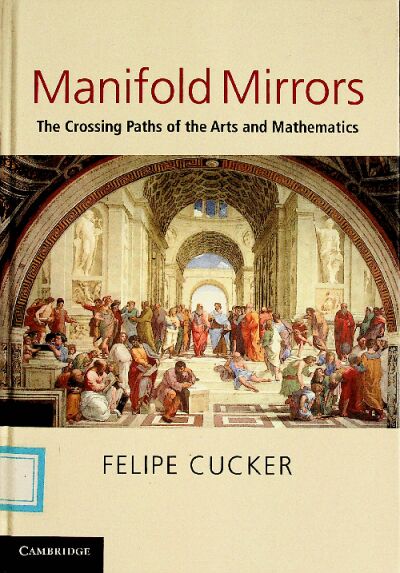
书名:Manifold mirrors
ISBN\ISSN:9780521429634,0521429633,9780521728768,0521728762
出版时间:2013
出版社:Cambridge University Press,
摘要
Most works of art, whether illustrative, musical or literary, are created subject to a set of constraints. In many (but not all) cases, these constraints have a mathematical nature, for example, the geometric transformations governing the canons of J. S. Bach, the various projection systems used in classical painting, the catalog of symmetries found in Islamic art, or the rules concerning poetic structure. This fascinating book describes geometric frameworks underlying this constraint-based creation. The author provides both a development in geometry and a description of how these frameworks fit the creative process within several art practices. He furthermore discusses the perceptual effects derived from the presence of particular geometric characteristics. The book began life as a liberal arts course and it is certainly suitable as a textbook. However, anyone interested in the power and ubiquity of mathematics will enjoy this revealing insight into the relationship between mathematics and the arts.
查看更多
目录
Mathematics: user's manual page ix
Appetizers 1
A.1 Martini 1
A.2 On their blindness 3
A.3 The Musical Offering 7
A.4 The garden of the crossing paths 10
1 Space and geometry 11
1.1 The nature of space 11
1.2 The shape of things 12
1.3 Euclid 14
1.4 Descartes 18
2 Motions on the plane 27
2.1 Translations 27
2.2 Rotations 29
2.3 Reflections 29
2.4 Glides 30
2.5 Isometries of the plane 31
2.6 On the possible isometries on the plane 36
3 The many symmetries of planar objects 39
3.1 The basic symmetries 41
3.1.1 Bilateral symmetry: the straight-lined mirror 41
3.1.2 Rotational symmetry 42
3.1.3 Central symmetry: the one-point mirror 42
3.1.4 Translational symmetry: repeated mirrors 44
3.1.5 Glidal symmetry 46
3.2 The arithmetic of isometries 47
3.3 A representation theorem 52
3.4 Rosettes and whirls 55
3.5 Friezes 59
3.5.1 The seven friezes 59
3.5.2 A classification theorem 64
3.6 Wallpapers 69
3.6.1 The seventeen wallpapers 69
3.6.2 A brief sample 76
3.6.3 Tables and flowcharts 77
3.7 Symmetry and repetition 80
3.8 The catalogue-makers 81
4 The many objects with planar symmetries 83
4.1 Origins 83
4.2 Rugs and carpets 89
4.3 Chinese lattices 103
4.4 Escher 106
5 Reflections on the mirror 111
5.1 Aesthetic order 111
5.2 The aesthetic measure of Birkhoff 116
5.3 Gombrich and the sense of order 120
5.4 Between boredom and confusion 125
6 A raw material 128
6.1 The veiled mirror 128
6.2 Between detachment and dilution 134
6.3 A blurred boundary: I 138
6.4 The amazing kaleidoscope 146
6.5 The strictures of verse 152
7 Stretching the plane 158
7.1 Homothecies and similarities 158
7.2 Similarities and symmetry 162
7.3 Shears, strains and affinities 166
7.4 Conics 174
7.5 The eclosion of ellipses 177
7.6 Klein (aber nur der Name) 184
8 Aural wallpaper 188
8.1 Elements of music 189
8.2 The geometry of canons 193
8.3 The Musical Offering (revisited) 198
8.4 Symmetries in music 206
8.4.1 The geometry of motifs 208
8.4.2 The ubiquitous seven 210
8.5 Perception, locality and scale 213
8.6 The bare minima (again and again) 216
8.7 A blurred boundary: II 220
9 The dawn of perspective 225
9.1 Alberti's window 227
9.2 The dawn of projective geometry 240
9.2.1 Bijections and invertible functions 243
9.2.2 The projective plane 245
9.2.3 A Kleinian view of projective geometry 251
9.2.4 Essential features of projective geometry 253
9.3 A projective view of affine geometry 254
9.3.1 A distant vantage point 255
9.3.2 Conics revisited 258
10 A repertoire of drawing systems 260
10.1 Projections and drawing systems 260
10.1.1 Orthogonal projections 263
10.1.2 Oblique projections 269
10.1.3 On tilt and distance 277
10.1.4 Perspective projection 282
10.2 Voyeurs and demiurges 286
11 The vicissitudes of perspective 293
11.1 Deceptions 293
11.2 Concealments 295
11.3 Bends 298
11.4 Absurdities 306
11.5 Divergences 311
11.6 Multiplicities 315
11.7 Abandonment 317
12 The vicissitudes of geometry 321
12.1 Euclid revisited 321
12.2 Hyperbolic geometry 325
12.3 Laws of reasoning 328
12.3.1 Formal languages 328
12.3.2 Deduction 330
12.3.3 Validity 333
12.3.4 Two models for Euclidean geometry 335
12.3.5 Proof and truth 338
12.4 The Poincaré model of hyperbolic geometry 339
12.5 Projective geometry as a non-Euclidean geometry 346
12.6 Spherical geometry 353
13 Symmetries in non-Euclidean geometries 357
13.1 Tessellations and wallpapers 357
13.2 Isometries and tessellations in the sphere and the projective plane 359
13.3 Isometries and tessellations in the hyperbolic plane 363
14 The shape of the universe 373
Appendix: Rule-driven creation 381
Compliers/benders/transgressors 381
Constrained writing 386
References 395
Acknowledgements 402
Index of symbols 404
Index of names 405
Index of concepts 409
查看PDF
查看更多
馆藏单位
中科院文献情报中心