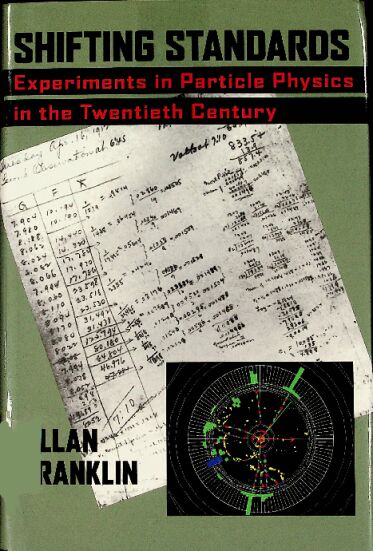
书名:Shifting standards
ISBN\ISSN:9780822944300,0822944308
出版时间:2013
出版社:University of Pittsburgh Press,
前言
In his one-paragraph short story"On Exactitude in Science,"the great Argentinian writer Jorge Luis Borges presents a literary forgery, where the following quotation is fictitiously attributed to Suårez Miranda∶"...In that Empire,the Art of Cartography attained such Perfection that the map of a single Province occupied the entirety of a City, and the map of the Empire,the entirety of a Province.In time,those Unconscionable Maps no longer satisfied,and the Cartographers Guilds strucka Map of the Empire whose size was that of the Empire,and which coincided point for point with it"(Borges 1971,123).A writer who wishes to discuss experiment, even if restricted only to physics, would be faced with a similar problem. Experimental practice is so varied that in order to discuss it fully one might very well have to summarize all experimental papers.I suspect that there are no typical experiments that could be used as exemplars.In this book I will discuss the changes in experimental practice in the twentieth century, restricting myself to experiments in particle physics. There are several reasons for this restriction.First,it makes the discussion tractable. Second,some of the changes discussed, particularly those of scale,are best illustrated in particle physics. Third,particle physics is the field of physics I know best.I strongly believe that knowledge of the science is essential for historical and philosophical study of any science.Although I believe that some of the changes discussed are valid for other fields of experimental physics,and possibly for other scientific disciplines,I do not have sufficient knowledge of those fields to make any useful comments.
The reader will notice,particularly in the prologue, that numerous elementary particles,such as theπ,ᴧ,μ,w,and p,are mentioned in the text. None of the discussion demands knowledge of these particles and their properties. The symbols should be read as the names of characters in the studies. They do, however, serve to show that the practices discussed are used in a wide variety of experiments in particle physics.In addition,including the particle names is required for historical accuracy.pa\Similarly, various mathematical and statistical techniques are mentioned and discussed briefly. Some,like the standard deviation (sigma) and x,are discussed briefly in the text and in more detail in the notes. Others,such as Boosted decision tree,neural network discriminants,and matrix element discriminant,are merely mentioned. These are advanced techniques and certainly exceed my own knowledge. The important point is that several of these methods are used in a single experiment and their agreement argues for the robustness and correctness of the results.In addition,these results are checked against actual data,providing more confidence in the results.
This project would not have started without a question,combined with later valuable discussions,from Harry Collins,who,to use his felicitous expression, is"my onetime bitter academicenemy and now valued col- league."Harry asked me about the changing standards for discovery in high-energy physics, which led to the study documented in the prologue. The discussions,along with Harry's fine book Gravity's Ghost, were essential in this work and also helped in my investigation of other aspects of experiment that have changed with time.
This book could not have been completed without the assistance of my colleagues in the experimental high-energy physics group at the University of Colorado: John Cumalat,Brian Drell, Bill Ford,Eduardo Luiggi, Jim Smith,Kevin Stenson,Keith Ulmer,and Steve Wagner. They took time out from actually doing physics to answer my questions and to provide very helpful discussions and material. Thanks also to Josh Ellenbogen for discussions on experiment in general and in particular on the philosophy of Duhem.I am also grateful to Jim Bogen and Giora Hon for carefully reading the manuscript and offering constructive and helpful suggestions. Thanks are also due to Alex Wolfe for his careful and thoughtful editing of the manuscript.
None of this work would have been possible without the support of my wife, and best friend, Cynthia Betts.
查看更多
目录
Preface vii
Prologue: The Rise of the Sigmas ix
Introduction 1
Chapter 1."Some Measurements of the Temperature Variation in the Electrical Resistance of a Sample of Copper" 11
Chapter 2."Do Falling Bodies Move South?" 17
Chapter 3."The Isolation of an Ion,a Precision Measurement of Its Charge,and the Correction of Stokes's Law" 26
Chapter 4."Directed Quanta of Scattered X-rays"38
Chapter 5."A Determination of e/m for an Electron by a New Deflection Method" 46
Chapter 6. An Uncertain Interlude 55 Chapter 7."Electron Polarization"65
Chapter 8."Mean Lifetime of V-Particles and Heavy Mesons" 73
Chapter 9."Detection of the Free Antineutrino" 83
Chapter 10."Measurement of the K。t Branching Ratio" 98
Chapter 11."Determination of K, Form Factors from Measurements of Decay Correlations and Muon Polarizations"111
Chapter 12. Bad Data: An Interlude 124
Chapter 13."Measurement ofthe Antineutron-Proton Cross Section at Low Energy" 149
Chapter 14."New Measurements of Properties of the Ω- Hyperon" 157
Chapter 15. The Coherent Scattering of Neutrinos 168
Chapter 16."Search for Neutral Weakly Interacting Massive Particles in the Fermilab Tevatron Wideband Neutrino Beam" 184
Chapter 17."Measurement of the B+Total Cross Section and B+ DiierentialCross Section do/dp-in pp Collisions at Vs=1.8 TeV" 194
Chapter 18."B Meson Decays to Charmless Meson Pairs Containing ŋ or ŋ Mesons" 205
Chapter 19. The Case of the Disappearing Sigmas 212
Chapter 20.Conclusion 221
Notes 251
Refererces 275
Index 291
查看PDF
查看更多
馆藏单位
中科院文献情报中心