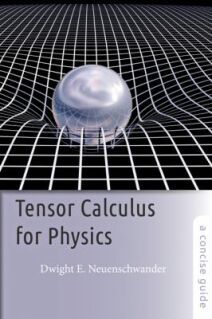
书名:Tensor calculus for physics
责任者:Dwight E. Neuenschwander.
ISBN\ISSN:9781421415642,142141564X
出版时间:2015
出版社:Johns Hopkins University Press,
前言
By the standards of tensor experts, this book will be deemed informal, re pet i-tious, and incomplete. But it was not written for those who are already experts. It was written for physics majors who are new to tensors and find themselves intrigued but frustrated by them.
The typical readers I have in mind are undergraduate physics majors intheir junior or senior year. They have taken or are taking courses in classic amechanics and electricity and magnetism, have become acquainted with special relativity, and feel a growing interest in general relativity.
According to Webster's Dictionary, the word "concise" means brief and to the point. However, tensor initiates face a problem of so much being left unsaid. Few undergraduates have the opportunity to take a course dedicated to tensors. We pick up whatever fragments about them we can along the way. Tensor calculus textbooks are typically written in the precise but specialized jargon of mathematicians. For example, one tensor book "for physicists" opens with a discussion on "the group G。and a fine geometry. " While appropriate as a logical approach serving the initiated, it hardly seems a welcoming invitation for drawing novices into the conversation. This book aims to make the conversation accessible to tensor novices.
An undergraduate who recently met the inertia and electric quadrupole ten-sors may feel eager to start on general relativity. However, upon opening some modern texts on the subject, our ambitious student encounters a new barrier in the language of differential forms. Definitions are offered, but to the novice the motivations that make those definitions worth developing are not apparent. One feels like having stepped into the middle of a conversation. So one falls back on older works that use "contravariant and covariant" language, eventhough newer books sometimes call such approaches "old-fashioned." Fashionable or not, atleast they are compatible with a junior physics major's background and offer a useful place to start.
In this book we "speak tensors" in the vernacular. Chapter 1 review sun-der graduate vector calculus and should be familiar to my intended audience; Iwant to start from common ground. However, some issues taken for granted in familiar vector calculus are the tips of large icebergs. Chapter 1thus contains both review and foreshadowing. Chapter 2 introduces tensors through scenar-ios encountered in an undergraduate physics curriculum. Chapters 3-6 further develop tensor calculus proper, including derivatives of tensors in spaces with curvature. Chapter 7re-derives important tensor results through the use of basis vectors. Chapter 8 offers an informal introduction to differential forms, to show why these strange mathematical objects are beautiful and useful.
Jacob Bronowski wrote in Science and Human Values, "The poem or the discovery exists in two moments of vision: the moment of appreciation as much as that of creation. . . . We enact the creative act, and we ourselves make the discovery again. " I thank the reader for accomm pan ying me as I retrace in these pages the steps of my own journey incoming to terms with tensors.
查看更多
目录
Preface xi
Acknowledgments xiii
Chapter 1. Tensors Need Context 1
1.1Why Aren't Tensors Deined by What They Are? 1
1.2 Euclidean Vectors, without Coordinates 3
1.3 Derivatives of Euclidean Vectors with Respect to a Scalar 5
1.4 The Euclidean Gradient 6
1.5 Euclidean Vectors, with Coordinates 7
1.6 Euclidean Vector Operations with and without Coordinates 11
1.7 Transformation Coefficients as Partial Derivatives 18
1.8 What Is a Theory of Relativity? 20
1.9 Vectors Represented as Matrices 23
1.10 Discussion Questions and Exercises 28
Chapter 2.Two-Index Tensors 33
2.1 The Electric Susceptibility Tensor 33
2.2 The Inertia Tensor 34
2.3 The Electric Quadrupole Tensor 37
2.4 The Electromagnetic Stress Tensor 39
2.5 Transformations of Two-Index Tensors 42
2.6 Finding Eigenvectors and Eigenvalues 46
2.7 Two-Index Tensor Components as Products of Vector Components 50
2.8 More Than Two Indices 51
2.9 Integration Measures and Tensor Densities 51
2.10 Discussion Questions and Exercises 53
Chapter 3.The Metric Tensor 63
3.1 The Distinction between Distance and Coordinate Displacement 63
3.2 Relative Motion 65
3.3 Upper and Lower Indices 72
3.4 Converting between Vectors and Duals 77
3.5 Contravariant, Covariant, and "Ordinary" Vectors 79
3.6 Tensor Algebra 83
3.7 Tensor Densities Revisited 84
3.8 Discussion Questions and Exercises 90
Chapter 4.Derivatives of Tensors 97
4.1 Signs of Trouble 97
4.2 The Affine Connection 99
4.3 The Newtonian Limit 101
4.4 Transformation of the Affine Connection 103
4.5 The Covariant Derivative 105
4.6 Relation of the A fine Connection to the Metric Tensor 107
4.7 Divergence, Curl, and Laplacian with Covariant Derivatives 109
4.8 Disccussion Questions and Exercises 113
Chapter 5.Curvature 119
5.1 What Is Curvature? 119
5.2 The Riemann Tensor 122
5.3 Measuring Curvature 125
5.4 Linearity in the Second Derivative 128
5.5 Discussion Questions and Exercises 131
Chapter 6.Covariance Applications 137
6.1 Covariant Electrodynamics 137
6.2 General Covariance and Gravitation 143
6.3 Discussion Questions and Exercises 148
Chapter 7.Tensors and Manifolds 155
7.1 Tangent Spaces, Charts, and Manifolds 157
7.2 Metrics on Manifolds and Their Tangent Spaces 161
7.3 Dual Basis Vectors 163
7.4 Derivatives of Basis Vectors and the Affine Connection 167
7.5 Discussion Questions and Exercises 171
Chapter 8.Getting Acquainted with Differential Forms 175
8.1Tensorsas Multilinear Forms 176
8.2 1-Forms and Their Extensions 180
8.3 Exterior Products and Differential Forms 190
8.4 The Exterior Derivative 195
8.5 An Application to Physics: Maxwell's Equations 198
8.6 Integrals of Differential Forms 200
8.7 Discussion Questions and Exercises 203
Appendix A: Common Coordinate Systems 209
Appendix B: Theorem of Alternatives 211
Appendix C: Abstract Vector Spaces 213
Bibliography 215
Index 221
查看更多
馆藏单位
中科院文献情报中心