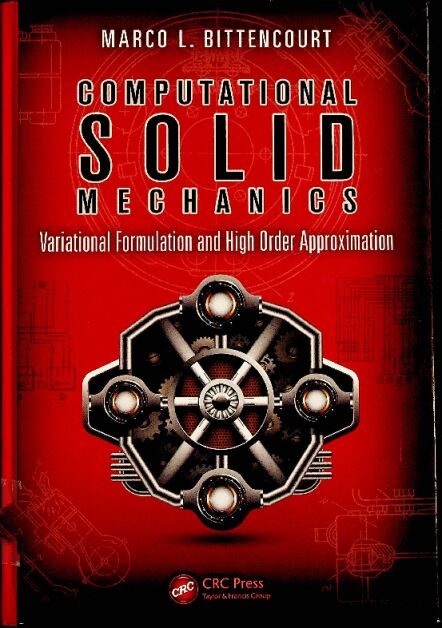
书名:Computational solid mechanics
责任者:Marco L. Bittencourt.
ISBN\ISSN:9781439860014,1439860017
出版时间:2015
出版社:CRC Press/Taylor & Francis Group,
前言
Nowadays computationalsimulation is a basic tool in the development of engineering projects.Due to the increase of computing resources, it has become possible to consider together many aspects the mechanical models.
Simulation software,such as ANSYS,ABAQUS,and NASTRAN,implement a discrete version of continuous mathematical models. As the numerical models become more complex, engineers require a strong and fundamental background to confidently use the software features.Learning the fundamental concepts of mechanics and approximation in a general way should be the starting point for the application of computers in solving real engineering applications. The impossibility of understanding clearly the fundamental assumptions and limitations of the mechanical and numeri- cal models makes it highly likely that engineers will obtain computational solutions which do not represent the actual behavior of mechanical components.
There have been many books presenting the formulation and finite element approximation of solid mechanical models. Relative to the books on formulation of mechanical models, particular cases in nonpedagogical and/or very formal approaches are presented. Books on finite elements do not make clear the boundary between the mechanical models and their approximations.These aspects make the learning process of engineering students difficult. Another aspect is that in the computer era, it is crucial to organize the way that the information is supplied to students,as they have access to many information sources from the Internet. Using standard procedures to formulate and approximate models and at the same time illustrating their application by software are very important aspects. This book intends to address these points.
In terms of formulation of mechanical models, the basic tool considered here is the variational formulation based on the principle of virtual work(PVW).All models are presented following the same sequence of steps, which includes kinematics, strain measure,rigid body deformation,inter- nal loads, external loads,equilibrium,constitutive equations,and structural design.This sequence allows the reader to establish a logical reasoning for the treatment of any mechanical model.In ad- dition,all aspects of a mechanical model are presented in each chapter and not spread out in many chapters,as is common in many books on solid mechanics.Mechanical models for plates and solid models are also considered using the same approach.
In terms of finite element approximation,the book starts with simple applications of low-order approximation to bars and shafts elements.The main concepts are introduced gradually in the oth- ers chapters, including high-order approximations. As in the formulation,all approximations are presented following the same sequence of steps which includes the definition of strong form,weak form,global and local approximations,finite elements, and applications.
In terms of software,MATLAB scripts and an object-oriented high-order program are supplied with the book to run examples.
Taking into consideration these three main aspects, readers should learn the limitations and strengths of the considered mechanical models,their approximations,and how they are implemented in computer software.
The book is intended for theuse by undergraduate and beginning graduate students in engineerig. Most of thechapters include many examples,problems,and software applications.This edition will be limited to models with small deformation and linear materialbehavior. The bookis organized in 10 chapters. Chapter 1 provides a generalintroduction tovariational formulation and an overview of the mechanical models to be presented in the other chapters.Chapter2 presents areview about he Newton and variational formulations, the principle of virtual work,and the equilibrium of par- ticles and rigid bodies using the PVW. The main idea is to use the concepts on equilibrium that readers should already have to introduce basic notions on kinematics, virtual work,and the PVW.
Chapters 3 to 10 present mechanical models,approximations, and applications to bars,shafts, beams, beams with shear, general two-and three-dimensional beams, solids,plane models,and general torsion, and plates.In particular, Chapter 8 presents the most general case of solids using two approaches.The first one follows the basic idea of the other chapters.In the second approach, the concept of second-order tensor is introduced using a Taylor expansion,and the solid model is reformulated using again the same previously formulation steps.In this case,small and large deformations are considered. After the presentation of elastic solids,thekinematical hypotheses of the previously considered problems are introduced in this model.It is then possibleto observe where the simplifications areintroduced in the solids to formulate the previous cases. Chapter9 presents a more formal introduction to variational formulation based on the general steps applied to the other chapters
I believe that the main features of the book are: the systematic and pedagogical approaches to formulate and approximate solid mechanical models,starting from simple cases and going to more complex models; a clear separation of formulation and finite element approximation; and the user-
查看更多
目录
Chapter1 INTRODUCTION 1
1.1 Initial Aspects 2
1.1.1 Objectives of Continuum Mechanics 2
1.1.2 Definition of Bodies 2
1.1.3 Analytic and Newtonian Formulations 3
1.1.4 Formulation Methodology 5
1.2BarS 6
1.3 Shafts 8
1.4 Beams 8
1.5 Two-Dimensional Models 10
1.6 Plates 10
1.7 Linear Elastic Solids 11
Chapter 2EQUILIBRIUM OF PARTICLES AND RIGID BODIES 15
2.1 Introduction 15
2.2 Diagrammatic Conventions 15
2.2.1 Supports 15
2.2.2 Loadings 16
2.3Equilibrium of Particles 17
2.4Equilibrium of Rigid Bodies 19
2.5 Principle of Virtual Power(PVP) 24
2.6Some Aspects about the Definition of Power 42
2.7Final Comments 42
2.8 Problems 43
Chapter 3FORMULATION AND APPROXIMATION OF BARS 45
3.1Introduction 45
3.2Kinematics 45
3.3Strain Measure 48
3.4Rigid Actions 50
3.5Determination of Internal Loads 50
3.6Determination of External Loads 53
3.7 Equilibrium 54
3.8 Material Behavior 60
3.8.1 Experimental Traction and Compression Diagrams 60
3.8.2 PoisSon Ratio 65
3.8.3 Hooke's Law 66
3.9 Application of the Constitutive Equation 67
3.10 Design and Verification 71
3.11 Bars Subjected to Temperature Changes 73
3.12 Volume and Area Strain Measures 75
3.13 Singularity Functions for External Loading Representation 77
3.14 Summary of the Variational Formulation of Bars 94
3.15 Approximated Solution 96
3.15.1 Analogy of the Approximated Solution with Vectors 96
3.15.2 Collocation Method 99
3.15.3 Weighted Residuals Method 101
3.15.4 Least Squares Method 102
3.15.5 Galerkin Method 104
3.15.6 Finite Element Method (FEM) 110
3.16 Analysis of Trusses 115
3.17 Final Comments 121
3.18 Problems 121
Chapter 4FORMULATION AND APPROXIMATION OF SHAFTS 127
4.1 Introduction 127
4.2 Kinematics 127
4.3 Strain Measure 132
4.4 Rigid Actions 136
4.5 Determination of Internal Loads 137
4.6 Determination of External Loads 139
4.7 Equilibrium 140
4.8 Material Behavior 146
4.9 Application of the Constitutive Equation 148
4.10 Design and Verification 154
4.11 Singularity Functions for ExternalLoading Representation 155
4.12 Summary of the Variational Formulation of Shafts 165
4.13 Approximated Solution 167
4.14 Mathematical Aspects of the FEM 172
4.15 Local Coordinate Systems 174
4.16 One-Dimensional Shape Functions 176
4.16.1 Nodal Basis 176
4.16.2 Modal Basis 181
4.16.3 Schur's Complement 183
4.16.4 Sparsity and Numerical Conditioning 185
4.17 Mapping 187
4.18 Numerical Integration 193
4.19 Collocation Derivative 196
4.20 Final Comments 199
4.21 Problems 199
Chapter 5FORMULATION AND APPROXIMATION OF BEAMS 203
5.1 Introduction 203
5.2 Kinematics 204
5.3 Strain Measure 207
5.4 Rigid Actions 209
5.5 Determination of Internal Loads 209
5.6 Determination of ExternalLoads 212
5.7 Equilibrium 213
5.8 Application of the Constitutive Equation 222
5.9 Design and Verification 229
5.10 Singularity Functions for External Loading Representation 230
5.11 Summary of the Variational Formulation for the Euler-Bernoulli Beam 255
5.12 Buckling of Columns 256
5.12.1 Euler Column 258
5.13 Approximated Solution 263
5.14 High-Order Beam Element 274
5.15 Mathematical Aspects of the FEM 280
5.16 Final Comments 286
5.17 Problems 286
Chapter 6FORMULATION AND APPROXIMATION OF BEAM IN SHEAR 291
6.1 Introduction 291
6.2 Kinematics 291
6.3 Strain Measure 294
6.4 Rigid Actions 296
6.5 Determination of Internal Loads 296
6.6 Determination of External Loads 300
6.7 Equilibrium 300
6.8 Application of the Constitutive Equation 302
6.9Shear Stress Distribution 314
6.9.1 Rectangular Cross-Section 315
6.9.2 Circular Cross-Section 319
6.9.3 I-shaped Cross-Section 321
6.10 Design and Verification 327
6.11 Standardized Cross-Section Shapes 329
6.12 Shear Center 331
6.13 Summary of the Variational Formulation of Beams with Shear 334
6.14 Energy Methods 335
6.14.1 Strain Energy 336
6.14.2 Complementary Strain Energy 339
6.14.3 Complementary External Work 339
6.14.4 Principle of Energy Conservation 340
6.14.5 Method of Virtual Forces 342
6.15 Approximated Solution 348
6.16 Mathematical Aspects of the FEM 356
6.17 Final Comments 356
6.18 Problems 357
Chapter 7FORMULATION AND APPROXIMATION OF TwO/THREE-DIMENSIONAL BEAMS 359
7.1 Introduction 359
7.2 Two-Dimensional Beam 361
7.2.1 Kinematics 361
7.2.2 Strain Measure 363
7.2.3 Rigid Body Actions 363
7.2.4 Determination of Internal Loads 364
7.2.5 Determination of External Loads 365
7.2.6 Equilibrium 367
7.2.7 Application of the Constitutive Equation 368
7.2.8 Stress Distributions 369
7.2.9 Design and Verification 372
7.3 Three-Dimensional Beam 382
7.3.1 Kinematics 382
7.3.2 Strain Measure 386
7.3.3Rigid Body Actions 386
7.3.4Determination of Internal Loads 387
7.3.5Determination of External Loads 389
7.3.6Equilibrium 390
7.3.7Application of the Constitutive Equation 392
7.3.8 Stress Distributions 394
7.3.9 Design and Verification 397
7.4 BeamLab Program 417
7.5 Summary of the Variational Formulation of Beams 418
7.6 Aproximated Solution 420
7.7 Final Comments 433
7.8 Problems 433
Chapter 8FORMULATION AND APPROXIMATTON OF SOLIDS 439
8.1 Introduction 439
8.2 Kinematics 439
8.3 Strain Measure 440
8.4 Rigid Actions 446
8.5 Determination of Internal Loads 447
8.6 Determination of External Loads 450
8.7 Equilibrium 453
8.8 Generalized Hooke'sLaw 456
8.9 Application of the Constitutive Equation 460
8.10 Formulation Employing Tensors 461
8.10.1 Body 461
8.10.2 Vectors 462
8.10.3 Kinematics 464
8.10.4 Strain Measure 464
8.10.5 Rigid Actions 475
8.10.6 Determination of InternalLoads 477
8.10.7 Equilibrium 482
8.10.8 Application of the Constitutive Equation 482
8.11 Verification of Linear Elastic Solids 484
8.11.1 Transformation of Vectors and Tensors 484
8.11.2 Eigenvalue Problem 487
8.11.3 Principal Stresses and Principal Directions 490
8.11.4 Principal Stresses for a Plane Stress Problem 490
8.11.5 Mohr's Circle 494
8.11.6 Maximum Shear Stress Theory (Tresca Criterion) 498
8.11.7 Maximum Distortion Energy Theory(von Mises Criterion) 501
8.11.8 Rankine Criterion for Brittle Materials 503
8.11.9 Comparison of Tresca, von Mises,and Rankine Criteria 504
8.12 Approximation of Linear Elastic Solids 505
8.12.1 Weak Form 505
8.12.2 Shape Functions for Structured Elements 509
8.12.3 Shape Functions for Nonstructured Elements 523
8.12.4 Mapping 535
8.12.5 Surface Jacobian 540
8.13 Final Comments 544
8.14 Problems 544
Chapter 9FORMULATION AND APPROXIMATION OF PLANE PROBLEMS 547
9.1 Plane Stress State 547
9.2 Plane Strain State 548
9.3Compatibility Equations 549
9.4 Analytical Solutions for Plane Problems in Linear Elasticity 554
9.5Analytical Solutions for Problems in Three-Dimensional Elasticity 558
9.6 Plane State Approximation 567
9.7(hp)2fem Program 568
9.8 Torsion of Generic Sections 570
9.8.1 Kinematics 570
9.8.2 Strain Measures 571
9.8.3 Rigid Actions 573
9.8.4 Determination of Internal Loads 574
9.8.5Determination of External Loads and Equilibrium 576
9.8.6 Application of the Constitutive Equation 577
9.8.7Shear Stress Distribution in Elliptical Cross-Section 579
9.8.8Analogy with Membranes 582
9.8.9 Summary of the Variational Formulation of Generic Torsion 583
9.8.10 Approximated Solution 585
9.9 Multidimensional Numerical Integration 588
9.10 Summary of the Variational Formulation of Mechanical Models 591
9.10.1 External Power 592
9.10.2 Internal Powe r596
9.10.3 Principle of Virtual Power (PVP) 599
9.11 Final Comments 600
9.12 Problems 600
Chapter 10 FORMULATION AND APPROXIMATION OF PLATES 603
10.1 Introduction 603
10.2 Kinematics 603
10.3 Strain Measure 608
10.4 Rigid Actions 610
10.5 Determination of Internal Loads 612
10.6 Determination of External Loads and Equilibrium 622
10.7 Application of the Constitutive Equation 624
10.8 Approximated Solution 627
10.8.1 Plate Finite Elements 632
10.8.2 High-Order Finite Element 636
10.9 Problems 638
References 639
IndeX 641
查看PDF
查看更多
馆藏单位
中科院文献情报中心