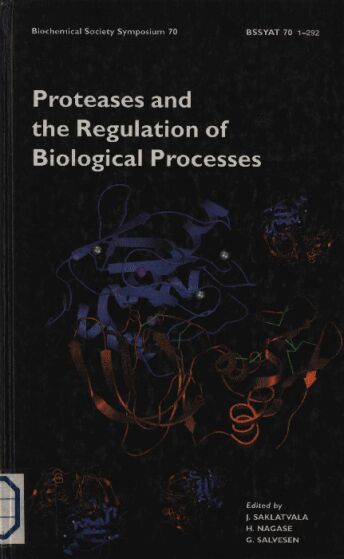
书名:Proteases and the regulation of biological processes
责任者:J. Saklatvala | H. Nagase and G. Salvesen
出版时间:2003
出版社:London,Portland Press
前言
The Biochemical Society’s Annual Symposium for 2002, Proteases and the Regulation of Biological Processes, was held at Imperial College, London on 16-18 December. It was dedicated to Dr Alan J. Barrett, on the occasion of his 65th birthday, to honour his research achievements and contributions to the field of proteolytic enzymes. The meeting brought together international leaders in the field to discuss recent advances in protease research. This volume contains contributions from the speakers at the Symposium and their colleagues.
Proteases were originally identified as protein-degrading enzymes in digestive juice or tissue homogenates, which led to the concept that they completely ‘destroy’ proteins. The current view, however, sees proteases much more as conducting specific, limited proteolysis and thereby, playing pivotal roles in many biological processes such as fertilization, development, morphogenesis, cell signalling, transcriptional control, blood coagulation, cell division, migration, growth, apoptosis and the activation of cytokines and growth factors. In fact, approximately 2% of human genes encode proteolytic enzymes, which emphasizes the importance of proteolysis. Under physiological conditions, proteolytic processes are precisely regulated. Dysregulation of proteolysis in organisms is deleterious: abnormal development and diseases are attributed to aberrant activities of proteases. Thus, the field has attracted researchers from many different scientific disciplines including biology, biochemistry, biophysics, medicinal chemistry, medicine, dentistry, veterinary medicine and agriculture.
The Symposium’s scientific session was opened by Wolfram Bode’s lecture on structure-function relationships of matrix metalloproteinases (MMPs) and tissue inhibitors of metalloproteinases (TIMPs). Dus an Turk then discussed new structures of lysosmal cysteine proteases and challenges for the design of synthetic inhibitors. In the session on antigen presentation, Jennifer Rivett gave a presentation on the role of proteasomes in the MHC class I pathway and Colin Watts discussed the role of legumain (asparaginyl endopeptidase) in the MHC class II pathway. Pericellular proteolysis by membrane-bound proteases has made considerable advancement in recent years; Roy Black discussed the biochemistry of ADAM-17 [a disintegrin and metalloproteinase (tumour necrosis factor a-converting enzyme)], and Judith Bond gave a presentation on the regulation of meprin assembly and activation. Gillian Murphy then explained how membrane-bound MMPs and ADAMs are regulated by TIMPs, and Richard Farndale discussed structural interactions between collagen and cell surface proteins.
The session on inflammation and tissue destruction began with Jeremy Saklatvala's presentation on inflammation and intracellular signalling path-ways. Tim Cawston described the regulation of collagenolysis by cytokines, and John Mort discussed the role of MMPs and aggrecanases in the destruction of the cartilage matrix. Roger Dean then described protein oxidation and proteolysis in diseased tissues. Robin Poole, who was scheduled to talk on collagenases and osteoarthritis, was unable to attend the meeting, but we are very pleased that he has contributed to this volume.
In the session devoted to proteinase inhibitors and potential therapy, Andy Docherty reviewed the successes and failures of therapeutic intervention with protease inhibitors and newer approaches to therapies. Robin Carrell presented elegant video depictions of the conformational changes in serpins, showing how they form irreversible complexes with target proteases. Magnus Abrahamson reviewed the structure and function of cystatins, and Hideaki Nagase presented mutagenesis studies that were aimed at generating selective TIMPs. A lot of progress has been made towards our understanding of how P-amyloid is generated from the membrane-bound precursor protein. Jordan Tang described memapsin 2 (p-secretase or BACE) as a drug target for Alzheimer’s disease. Robert Rawson discussed the intricate regulation of the release of sterol regulatory element binding protein as an example of regulated intramembranous proteolysis.
As part of the intracellular proteolysis session, Guy Salvesen presented a hypothesis for the activation of apical caspases, a key step in apoptosis, and Frank Uhlmann presented separase, a new cysteine protease involved in chromosomal segregation, uncovered by bioinformatic tools pioneered by Alan Barrett. The final area to be covered at the Symposium was proteases and cancer. Bonnie Sloane discussed the role of cathepsin B in cancer progression, and Motoharu Seiki described the dynamics of membrane-type 1 MMP in cell migration. The Symposium ended with Peter Friedl’s fascinating demonstration of the distinctions between protease-dependent and protease-independent tumour cell migration.
The field of proteases is vast and is still growing rapidly, with continued discoveries of new enzymes and delineation of the biological roles of known ones. The topics selected for this 3-day meeting could not cover every aspect of the field, but it is our hope that the reader will find this volume a concise overview of recent progress in the field. We are most grateful to the authors for their contributions.
We also would like to thank Rhonda Oliver, of Portland Press, for suggesting the meeting, and Mike Cunningham, also of Portland Press, for his assistance in compiling this volume.
查看更多
目录
Preface vii
A tribute to Alan J. Barrett ix
Abbreviations xi
1 Structural basis of matrix metalloproteinase function [By W. Bode] 1
2 Papain-like lysosomal cysteine proteases and their inhibitors: drug discovery targets? [By D. Turk, B. Turk and V. Turk] 15
3 Roles for asparagine endopeptidase in class II MHC-restricted antigen processing [By C. Watts, D. Mazzeo, M.A. West, S.P. Matthews, D. Keane, G. Hamilton, L.V. Persson, J.M. Lawson, B. Manoury and C.X. Moss] 31
4 Substrate specificity and inducibility of TACE (tumour necrosis factor a-converting enzyme) revisited: the Ala-Val preference, and induced intrinsic activity [By R.A. Black, J.R. Doedens, R. Mahimkar, R. Johnson, L. Guo, A. Wallace, D. Virca, J. Eisenman, J. Slack, B. Castner, S.W. Sunnarborg, D.C. Lee, R. Cowling, G. Jin, K. Charrier, J.J. Peschon and R. Paxton] 39
5 Meprin proteolytic complexes at the cell surface and in extracellular spaces [By J.Y. Villa, G.P. Bertenshaw, J.E. Bylander and J.S. Bond] 53
6 Role of TIMPs (tissue inhibitors of metalloproteinases) in pericellular proteolysis: the specificity is in the detail [By G. Murphy, V. Knauper, M.-H. Lee, A. Amour, J. Worley, M. Hutton, S. Atkinson, M. Rapti and R. Williamson] 65
7 Collagen-platelet interactions: recognition and signalling [By R.W. Farndale, P.R.-M. Siljander, D.J. Onley, P. Sundaresan, C.G. Knight and M.J. Barnes] 81
8 Control of the expression of inflammatory response genes [By J. Saklatvala, J. Dean and A. Clark] 95
9 Use of anti-neoepitope antibodies for the analysis of degradative events in cartilage and the molecular basis for neoepitope specificity [By J S. Mort, C.R. Flannery, J. Makkerh, J.C. Krupa and E.R. Lee] 107
10 Proteolysis o£ the collagen fibril in osteoarthritis [By A.R. Poole, F. Nelson, L. Dahlberg, E. Tchetina, M. Kobayashi, T. Yasuda, S. Laverty, G. Squires, T. Kojima, W. Wu and R.C. Billinghurst] 115
11 Cytokine synergy, collagenases and cartilage collagen breakdown [By T.E. Cawston, J.M. Milner, J.B. Catterall and A.D. Rowan] 125
12 Proteolytic ‘defences’ and the accumulation of oxidized polypeptides in cataractogenesis and atherogenesis [By R.T. Dean, R. Dunlop, P. Hume and KJ. Rodgers] 135
13 Proteases as drug targets [By A.J.P. Docherty, T. Crabbe, J.P. O’Connell and C.R. Groom] 147
14 A How serpins change their fold for better and for worse [By R.W. Carrell and J.A. Huntington] 163
15 Cystatins [By M. Abrahamson, M. Alvarez-Fernandez and C.-M. Nathanson] 179
16 Designing TIMP (tissue inhibitor of metalloproteinases) variants that are selective metalloproteinase inhibitors [By H. Nagase and K. Brew] 201
17 Memapsin 2, a drug target for Alzheimer’s disease [By G. Koelsch, R.T. Turner III, L. Hong, A.K. Ghosh and J. Tang] 213
18 Control of lipid metabolism by regulated intramembrane proteolysis of sterol regulatory element binding proteins (SREBPs) [By R.B. Rawson] 221
19 Caspase activation [By K.M. Boatright and G.S. Salvesen] 233
20 Separase regulation during mitosis 243 [By F. Uhlmann]
21 Membrane-type 1 matrix metalloproteinase and cell migration J [By M. Seiki, H. Mori, M. Kajita, T. Uekita and Y. Itoh] 253
22 Cathepsin B and its role(s) in cancer progression [By I. Podgorski and B.F. Sloane] 263
23 Proteolytic and non-proteolytic migration of tumour cells and leucocytes [By P. Friedl and K. Wolf] 277
Subject index 287
查看PDF
查看更多
馆藏单位
中国农科院农业信息研究所 中国化工信息中心