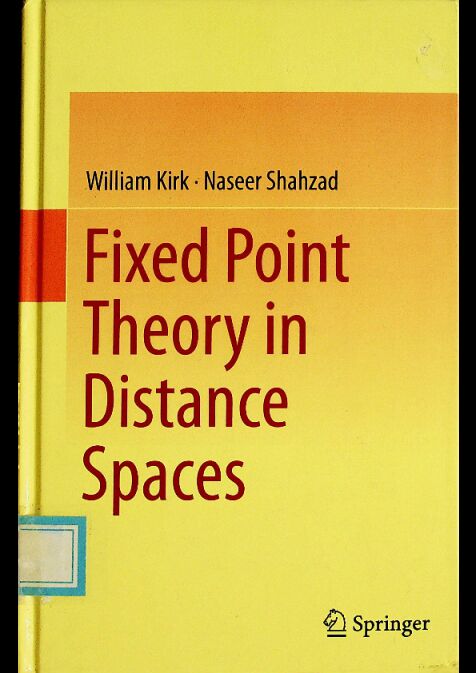
书名:Fixed point theory in distance spaces
责任者:William Kirk | Naseer Shahzad.
ISBN\ISSN:9783319109268,331910926X
前言
Mathematicians interested in topology typically give an abstract set a "topological structure" consisting of a collection of subsets of the given set to determine when points are "near" each other. People interested in geometry need a more rigid notion of nearness. This usually begins with assigning a symmetric "distance" to each two points of a set, resulting in the notion of a semimetric. With the addition of the triangle inequality, one passes to a metric space. This will be our point of departure.
There are four classical fixed point theorems against which metric extensions are usually checked. These are, respectively, the Banach contraction mapping principle, Nadler's well-known set-valued extension of that theorem, the extension of Banach's theorem to nonexpansive mappings, and Caristi's theorem. These comparisons form a significant component of this survey.
This exposition is divided into three parts. In Part I we discuss some aspects of the purely metric theory, especially Caristi's theorem and its relatives. Among other things, we discuss these theorems in the context of their logical foundations. We omit a discussion of the well-known Banach Contraction Principle and its many generalizations in Part I because this topic is well known and has been reviewed extensively elsewhere (see, e.g., [117]). In Part II we discuss classes of spaces which, in addition to having a metric structure, also have geometric structure. These specifically include the geodesic spaces, length spaces, and CAT(0) spaces. In Part III we turn to distance spaces that are not necessarily metric. These include certain distance spaces which lie strictly between the class of semimetric spaces and the class of metric spaces, as well as other spaces whose distance properties do not fully satisfy the metric axioms.
We make no attempt to explain all aspects of the topics we cover nor to present a compendium of all known facts, especially since the theory continues to expand at a rapid rate. Any attempt to provide the latest tweak on the various theorems we discuss would surely be outdated before reaching print. Our objective rather is to present a concise accessible document which can be used as an introduction to the subject and its central themes. We include proofs selectively, and from time to time we mention open problems. The material in this exposition is collected together here for the first time. Those wishing to investigate these topics deeper are referred to the original sources. We have attempted to include details in those instances where the sources are not readily available. This might be the case, for example, when the source is in a conference proceedings. Also some results appear here for the first time.
Many of the concepts introduced here have found interesting applications. Indeed some were motivated by attempts to address both mathematical and applied problems. Other concepts we discuss are more formal in nature and have yet to find any serious application; indeed some may never. However our hope is that this discussion will suggest directions for those interested in further research in this area.
The first author lectured on portions of the material covered in this monograph to students and faculty at King Abdulaziz University. He wishes to thank them for providing an attentive and critical audience. Both authors express their gratitude to Rafa Espínola for calling attention to a number of oversights in an earlier draft of this manuscript.
查看更多
目录
Preface VII
Contents IX
Part I. Metric Spaces 1
Chapter 1. Introduction 3
Chapter 2. Caristi's Theorem and Extensions 7
2.1. Introduction 7
2.2. A Proof of Caristi's Theorem 9
2.3. Suzuki's Extension 11
2.4. Khamsi's Extension 11
2.5. Results of Z. Li 16
2.6. A Theorem of Zhang and Jiang 18
Chapter 3. Nonexpansive Mappings and Zermelo's Theorem 19
3.1. Introduction 19
3.2. Convexity Structures 19
Chapter 4. Hyperconvex Metric Spaces 23
Chapter 5. Ultrametric Spaces 25
5.1. Introduction 25
5.2. Hyperconvex Ultrametric Spaces 27
5.3. Nonexpansive Mappings in Ultrametric Spaces 28
5.4. Structure of the "Fixed Point Set" of Nonexpansive Mappings 30
5.5. A Strong Fixed Point Theorem 31
5.6. Best Approximation 35
Part II. Length Spaces and Geodesic Spaces 37
Chapter 6. Busemann Spaces and Hyperbolic Spaces 39
6.1. Convex Combinations in a Busemann Space 42
Chapter 7. Length Spaces and Local Contractions 47
7.1. Local Contractions and Metric Transforms 54
Chapter 8. The G-Spaces of Busemann 61
8.1. A Fundamental Problem in G-Spaces 63
Chapter 9. CAT(0) Spaces 65
9.1. Introduction 65
9.2. CAT(k) Spaces 66
9.3. Fixed Point Theory 70
9.4. A Concept of "Weak" Convergence 81
9.5. △-Convergence of Nets 83
9.6. A Four Point Condition 86
9.7. Multimaps and Invariant Approximations 89
9.8. Quasilinearization 93
Chapter 10. Ptolemaic Spaces 95
10.1. Some Properties of Ptolemaic Geodesic Spaces 96
10.2. Another Four Point Condition 98
Chapter 11. R-Trees (Metric Trees) 99
11.1. The Fixed Point Property for R-Trees 100
11.2. The Lifšic Character of R-Trees 102
11.3. Gated Sets 105
11.4. Best Approximation in R-Trees 106
11.5. Applications to Graph Theory 109
Part III. Beyond Metric Spaces 111
Chapter 12. b-Metric Spaces 113
12.1. Introduction 113
12.2. Banach's Theorem in a b-Metric Space 115
12.3. b-Metric Spaces Endowed with a Graph 116
12.4. Strong b-Metric Spaces 121
12.5. Banach's Theorem in a Relaxedp Metric Space 124
12.6. Nadler's Theorem 125
12.7. Caristi's Theorem in sb-Metric Spaces 128
12.8. The Metric Boundedness Property 129
Chapter 13. Generalized Metric Spaces 133
13.1. Introduction 133
13.2. Caristi's Theorem in Generalized Metric Spaces 136
13.3. Multivalued Mappings in Generalized Metric Spaces 139
Chapter 14. Partial Metric Spaces 141
14.1. Introduction 141
14.2. Some Examples 143
14.3. The Partial Metric Contraction Mapping Theorem 143
14.4. Caristi's Theorem in Partial Metric Spaces 144
14.5. Nadler's Theorem in Partial Metric Spaces 148
14.6. Further Remarks 152
Chapter 15. Diversities 153
15.1. Introduction 153
15.2. Hyperconvex Diversities 155
15.3. Fixed Point Theory 155
Bibliography 159
Index 173
查看更多
馆藏单位
中科院文献情报中心