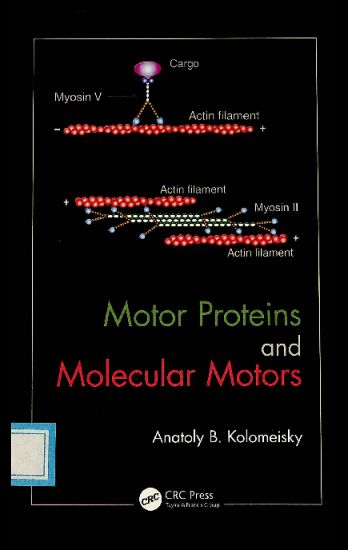
书名:Motor proteins and molecular motors
责任者:Anatoly B. Kolomeisky | Rice University | Houston | Texas.
出版时间:2015
出版社:CRC Press, Taylor & Francis Group,
分类号:生物科学
页数:xxi, 200 pages
前言
Life is a motion! This is true at all levels of living systems, from cells to organisms, but in most cases we still do not fully understand the fundamental origin of such dynamics. In this book we would like to explore and discuss mechanisms of cellular functioning associated with several specific enzymatic molecules that are called motor proteins.
Motor proteins, also known as molecular motors, play important roles in living systems by supporting cellular transport and force generation via transformation of chemical energy into mechanical work. Examples include gene replication and transcription, protein synthesis and degradation, muscle contraction, signal transduction, transport of proteins, vesicles and organelles, cell motility, and segregation of chromosomes during cell division. Significant research activities have been undertaken in order to understand molecular mechanisms of motor protein motility and functioning. Furthermore, these efforts are also stimulated by the technological and medical needs of developing new drugs, nanoscale devices, and materials that would lead to desirable biochemical and biophysical properties of biological molecular motors. Because of the strong interdisciplinary nature of motor proteins, this research area has attracted a large and diverse set of scientists from various fields ranging from cell biology, biochemistry and biophysics to physics, materials science, and bioengineering. This field also strongly requires a unified molecular picture for analyzing motor proteins. The central idea associated with motor protein functioning is the concept of transformation of one type of energy (chemical) into another one (mechanical). This is further complicated by the fact that molecular motors operate in solutions at isothermal but highly non-equilibrium conditions; their dynamics is coupled with multiple biochemical transitions. In addition, motor proteins move along cytoskeleton protein filaments or nucleic acid molecules in a crowded and confined cellular environment, involving a variety of chemical, mechanical, electrostatic, and hydrodynamic interactions. Taking all these factors into account in explaining the complex behavior of motor proteins is not an easy task! To develop a unified microscopic approach for analyzing complex processes in molecular motors, an application of fundamental concepts from physics and chemistry is required.
With this goal in mind, in this book we present a summary of established results, theoretical methods, and experimental observations related to biological molecular motors. In our approach we utilize fundamental physica Preface chemical ideas and methods in order to develop a systematic theoretical framework for understanding motor protein dynamics. The main ideas and concepts are presented using simple arguments that avoid heavy mathematical derivations in favor of more intuitive physical understanding. Although the book assumes some rudimentary knowledge of cell biology, calculus, and basic ideas from chemistry and physics, for most presented results, explanations and derivations are given. It is important to note that the book is not a comprehensive review of all known experimental and theoretical results on motor proteins. We aim here to connect major experimental facts on molecular motors to principal theoretical concepts that are consistent with the fundamental laws of chemistry and physics. It is our intention to produce a book on motor proteins that will be accessible to undergraduate, graduate students, and other researchers from a wide range of scientific fields including biology, biochemistry, biophysics, chemistry, physics, materials science, and engineering.
查看更多
目录
List of Figures xi
List of Tables xv
Preface xvii
Acknowledgments xix
Author xxi
Chapter 1 Introduction 1
1.1 MOTOR PROTEINS IN BIOLOGICAL SYSTEMS 1
1.2 SINGLE-MOLECULE EXPERIMENTS 6
1.3 DISCUSSION OF THEORETICAL MODELS FOR MOLECULAR MOTORS 7
1.4 MOTOR PROTEINS AS NANOSCALE MACHINES 9
1.5 OUTLOOK 10
Chapter 2 Basic Properties of Motor Proteins 13
2.1 HISTORY OF MOTOR PROTEINS 13
2.2 CLASSIFICATION OF BIOLOGICAL MOLECULAR MOTORS 18
2.3 STRUCTURES OF MOTOR PROTEINS 22
2.4 BIOLOGICAL FUNCTIONS OF MOLECULAR MOTORS 25
2.5 SUMMARY 27
Chapter 3 Experimental Studies of Motor Proteins 29
3.1 INTRODUCTION 29
3.2 BULK CHEMICAL-KINETIC MEASUREMENTS 30
3.3 STRUCTURAL STUDIES 35
3.4 SINGLE-MOLECULE FORCE SPECTROSCOPY 37
3.4.1 Optical-Trap Spectroscopy 39
3.4.2 Magnetic Tweezers Spectroscopy 41
3.4.3 Atomic-Force Microscopy 44
3.5 FLUORESCENT LABELING AND SUPERRESOLUTION TECHNIQUES 47
3.6 MAJOR EXPERIMENTAL OBSERVATIONS 51
3.7 SUMMARY 52
Chapter 4 Fundamental Physical Concepts: Equilibrium Approaches 53
4.1 INTRODUCTION 53
4.2 BASIC EQUILIBRIUM THERMODYNAMICS 54
4.3 BASIC STATISTICAL MECHANICS 63
4.4 APPLICATION FOR MOTOR PROTEINS 67
4.5 SUMMARY 68
Chapter 5 Fundamental Physical Concepts: Non-Equilibrium Approaches 69
5.1 INTRODUCTION 69
5.2 MACROSCOPIC CHEMICAL KINETICS 70
5.2.1 Irreversible Processes 72
5.2.2 Reversible Processes 76
5.2.3 Temperature Dependence 78
5.3 RANDOM WALKS 80
5.4 FIRST-PASSAGE PROCESSES 86
5.5 SUMMARY 90
5.6 MATHEMATICAL APPENDIX 90
5.6.1 Irreversible Second-Order Chemical Reactions 90
5.6.2 Reversible Chemical Reactions 91
5.6.3 Calculations of Average Properties for the Simplest One-Dimensional Random Walk 92
5.6.4 Calculations of First-Passage Probabilities and Dynamic Properties 94
Chapter 6 Motor Proteins as Enzymes 97
6.1 INTRODUCTION 97
6.2 CATALYSIS 98
6.3 ENZYMATIC PROCESSES 101
6.4 SUMMARY 106
6.5 MATHEMATICAL APPENDIX 107
6.5.1 Michaelis–Menten Mechanism 107
6.5.2 Inhibition Processes 108
6.5.3 Single-Molecule Derivation of the Michaelis–Menten Equation 109
Chapter 7 Theory for Motor Proteins: Continuum Ratchets 113
7.1 INTRODUCTION 113
7.2 CONTINUUM RATCHET POTENTIALS 115
7.3 CRITICAL ANALYSIS 121
7.4 SUMMARY 122
Chapter 8 Theory for Motor Proteins: Discrete-State Stochastic Models 125
8.1 INTRODUCTION 125
8.2 DISCRETE-STATE STOCHASTIC APPROACH 126
8.2.1 Linear Sequential Models 126
8.2.2 Forces in Motor Proteins 131
8.2.3 Dwell Times and First-Passage Analysis 135
8.2.4 Efficiency of Motor Proteins 138
8.2.5 Discrete-State Stochastic Models for Systems with Complex Biochemical Pathways 141
8.3 CRITICAL ANALYSIS 142
8.4 SUMMARY 144
8.5 MATHEMATICAL APPENDIX 145
8.5.1 Calculation of Dynamic Properties of Motor Proteins Using Derrida’s Method 145
8.5.2 Calculation of First-Passage Probabilities and Dynamic Properties for N = 2 Linear DiscreteState Models 149
Chapter 9 Collective Properties of Motor Proteins 151
9.1 COOPERATIVITY AND INTERACTIONS IN MOTOR PROTEINS DYNAMICS 151
9.2 EXPERIMENTAL OBSERVATIONS 152
9.3 THEORETICAL IDEAS 156
9.4 SUMMARY 160
Chapter 10 Artificial Molecular Motors and Rotors 163
10.1 INTRODUCTION 163
10.2 BIOLOGICAL ARTIFICIAL MOLECULAR MOTORS 164
10.3 NON-BIOLOGICAL ARTIFICIAL MOLECULAR MOTORS 170
10.4 ARTIFICIAL MOLECULAR ROTORS 173
10.5 SUMMARY 175
Chapter 11 Future Directions in Studies of Motor Proteins and Molecular Motors 177
11.1 WHAT WE UNDERSTAND NOW ABOUT MOTOR PROTEINS AND MOLECULAR MOTORS 177
11.2 OPEN QUESTIONS AND PROBLEMS 178
11.3 LOOKING INTO THE FUTURE 182
Bibliography 183
Index 197
查看更多
馆藏单位
中科院文献情报中心