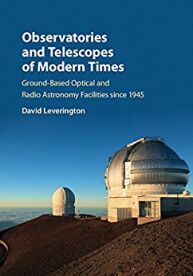
书名:Observatories and telescopes of modern times
ISBN\ISSN:9780521899932,0521899931
出版时间:2017
出版社:Cambridge University Press,
分类号:天文学、地球科学
页数:xii, 490 pages
摘要
This volume gives an historical overview of the development of professional optical and radio observatories from 1945 to today. It covers the environment in which these facilities were developed by organisations in the United States, Europe and elsewhere, often led by larger-than-life individuals, as well as exploring the financial and political factors that both constrained and encouraged progress. As ever more expensive optical facilities were built, they exploited new technologies to significantly improve their performance: CCDs, active and adaptive optics, and spun honeycomb and segmented mirrors. The second half of this volume turns to the parallel history of radio astronomy facilities throughout the world, finishing with the ALMA observatory in Chile. This is the ground-based companion to the author's previous work on space astronomy, New Cosmic Horizons (2001). It is written for both technical and non-technical readers interested in the modern history of astronomy and its observational facilities.
查看更多
目录
Preface page xi
Part 1 Optical Observatories
1 Palomar Mountain Observatory 3
1.1 The 200 inch (5.1 m) HaleTelescope 3
1.2 Palomar Schmidt Telescope 11
2 The United States Optical Observatory 16
2.1 Introduction 16
2.2 Founding of Association of Universities for Research in Astronomy (AURA) 17
2.3 The National Observatory Telescopes on Kill Peak 20
The 84 inch (2.1 1m) Telescope 20
McMath-Pierce Solar Telescope 21
Kitt Peak Vacuum Telescope 23
Mayall 158 inch (4.0 m) Telescope 23
Remote Control Telescope 25
Restructuring 26
2.4 Other Telescopes on Kitt Peak 27
Steward Observatory's 36 inch (0.9 m) and the Spacewatch Project 27
Steward Observatory's 90 inch (2.3 111) Bok Telescope 27
University of Michigan's 52 inch (J.3 m) and the McGraw-Hill Observatory 29
Move of the Burrell Schmidt 30
Hilmer 2.4m Telescope 30
2.5 National Observatory Funding Problems 31
WYN 3.5 m Telescope 32
SARA 0.9 m Telescope 33
Tum of rile Century and Beyond 33
2.6 Cerro Tololo and its National Observatory Telescopes 35
Blanco 158 inch (4.0m) Telescope 39
2.7 Other Telescopes on Cerro Tololo 41
3 From the Next Generation Telescope to Gemini and SOAR 47
3.1 Next Generation Telescope (NGT) 47
3.2 National New Technology Telescope (NNTT) 48
3.3 Gemini 52
3.4 SOAR 63
4 Competing Primary Mirror Designs 67
4.1 Spun Honeycomb Mirrors 67
4.2 Segmented Mirrors 71
Keck Telescopes 72
Hobby -Eberly Telescope 82
SALT 84
LAMOST 86
4.3 Thin Meniscus Mirrors 87
4.4 Metal Mirrors 89
4.5 Liquid Mirror Telescopes 90
5 Active Optics, Adaptive Optics and Other Technical Innovations 96
5.1 Active Optics 96
5.2 Adaptive Optics 100
Curvature Sensor and Bimorph Systems 102
Altitude-Conjugate Systems 102
Laser Guide Star Systems 103
Multi -Conjugate Systems 105
Adaptive Secondary Mirrors 106
5.3 The Change 10 Altazimth Mounts 107
5.4 Charge-Coupled Devices 109
6 European Northern Observatory and Calar Alto 114
6.1 European Northern Observatory, Canary Islands 114
Night -time Telescopes on Tenerife 114
Night -time Telescopes on La Palma 118
Solar Telescopes 125
6.2 Calar Alto 128
7 European Southern Observatory 131
7.1 La Silla 131
European Southern Observatory's Early Telescopes 131
Notional Telescopes on la Silla 140
ESO 's New Technology Telescope 144
la Silla Today 145
7.2 Cerro Paranal 146
The VLT 146
VISTA 162
VLT Sruvey Telescope (VST) 164
7.3 OWL and the E-ELT 166
8 Mauna Kea Observatory 175
8.1 Introduction 175
8.2 Canada-France-Hawaii(CFH) Telescope 178
8.3 NASA lnfraRed Telescope Facility (IRTF) 179
8.4 United Kingdom lnfraRed Telescope (UKIRT) 180
8.5 Subaru 181
8.6 The Kecks and Gemini North 183
8.7 Environmental and Other Concerns 184
9 Australan Optical Observatories 189
9.1 Mount Stromlo, the Early Years 189
9.2 Siding Spring 191
Anglo ·Australian Observatory 193
Advanced Technology Telescope 201
9.3 Bushfires on Mount Stromlo 202
9.4 Optical Interferometers 204
10 Mount Hopkins' \Whipple Observatory and the MMT 207
11 Apache Point Observatory 216
11.1 ARC 3.5m Telescope 216
11.2 Sloan Digital Sky Survey (SDSS) 220
11.3 ARC 0.5 m Photometric Telescope 227
11.4 NMSU One-Meter Telescope 227
12 Carnegie Southern Observatory (Las Campanas) 229
12.1 lrenee du Pont Telescope 231
12.2 Giant Magellan Telescope 232
13 Mount Graham International Optical Observatory 238
13.1 Vatican Advanced Technology Telescope (VATT) 238
13.2 Columbus Project or Large Binocular Telescope (LBT) 239
14 Modem Optical Interferometers 244
14.1 Mount Wilson 244
Berkeley lnfrared Spatial Interferometer (/SI) 244
Center/or High Angular Resolution Astronimy (CHARA) 245
14.2 lnterf 6 rometre :\ 2 T 61 escopes (12 T ) 246
14.3 Cambridge Optical Aperture Synthesis Telescope (COAST) 247
14.4 Infrared /Optical Telescope Array (IOTA) 248
14.5 Palomar Testbed Interferometer 249
14.6 Navy Prototype Optical Interferometer 250
15 Solar Observatories 254
15.1 Climax Observatory and the Sacmmento Peak Solar Observatory 254
15.2 Big Bear Solar Observatory 257
15.3 The GONG Helioseismology Network 259
Part 2 Radio Obscrvacorics
16 Austra lian Radio Observatories 263
16.1 Early Australian Radio Astronomy 263
Solar Observations 263
Non-Solar Observntions 265
Other Radiophysics Laboratory Observatory Stations of the Late 1940s 266
Polls Hill 268
Badgery's Creek 271
Fleurs 272
Hole-in-the-ground Antenna, Dover Heights 274
16.2 Parkes Radio Telescope 276
16.3 Culgoora and the Molonglo Cross 285
16.4 The Australia Telescope 288
16.5 The Australian Square Kilometre Array Patl1finder and Murchison Widefield An-ay 292
17 Cambridge Mullard Radio Observatory 295
17.1 The Early Years 295
17.2 Aperture Synthesis 298
17.3 Modem Instruments 300
18 Jodrell Bank 304
18.1 From Radar to Radio Astronomy 304
18.2 The 250 ft Mark I 306
18.3 Later Parabolic Radio Telescopes 315
18.4 Modifications to the Mark I 319
18.5 MERLIN 321
19 Early Radio Observatories Away from the Australian-British Axis 326
19.1 The Soviet Union 326
Lebedev Physical Institute's(LPI'S) Radio Observatory in the Crimea 327
Gorki State University's Radio Observatory 328
LPI's Radio Observatory at Pushchino 329
Pulkovo 331
RATAN-600 331
VLBI 332
19.2 France 332
Nanray 334
19.3 The Netherlands 338
20 The American National Radio Astronomy Observatory 348
20.1 AUI Feasibility Study and Early Programme of the 140 ft Telescope 349
20.2 Role of the NSF in Funding Large Facilities 354
20.3 Choice of AUI to Manage the National Radio Astronomy Observatory 354
20.4 The First Rad .io Telescopes at Green Bank 356
20.5 Green Bank Interferometer 358
20.6 The 300 ft and its Replacement 360
20.7 The 140 ft Telescope 365
20.8 Millimeter -Wave Telescope 369
20.9 Very LargeArray 373
20.10 Very Long Baseline Array 379
21 Owens Valley and Mauna Kea 385
21.1 Owens Valley Radio Observatory 385
Millimetre Arrays 390
21.2 Submillimetre RadioTelescopes on Mauna Kea 391
James Clerk Maxwell Telescope 391
Caltech Submillimeter Observatory 392
Smithsonian Submillimeter Array 395
22 Further North and Central American Observatories 400
22.1 US Naval Research Laboratory 400
22.2 MIT Lincoln Labortory, Millstone Hill and Haystack 403
22.3 Harvard Radio Astronomy Station, Fort Davis, Texas 408
22.4 Vermilion River Observatory 410
22.5 Ohio Transit Radio Telescope 413
22.6 Arecibo Radio Telescope 415
22.7 Algonquin Radio Observatory 423
22.8 Dominion Radio Astrophysical Observatory 425
22.9 Hat Creek 427
Allen Telescope Array 428
22.10 Five College Radio Astronomy Observatory and the Mexican-American Large Millimeter Telescope 430
23 Further European and Asian Radio Observatories 438
23.1 Stockert Observatory and the Effelsberg Radio Telescope 438
23.2 Chalmers Onsala Space Observatory and the Swedish-ESQ Submillimetre Telescope (SEST)444
23.3 IRAM 447
23.4 Indian RadioTelescopes 452
23.5 Nobeyama Observatory 456
Solar Telescopes 456
Millimetre-Wave Telescopes 457
23.6 Heinrich Hertz Submillimeter Telescope 459
24 ALM A and the South Pole 462
24.1 ALMA 462
24.2 South Pole 468
Name Index 473
Optical/lnfrared Observatory and Telescope Index 478
Radio Observatory and Telescope Index 482
General Index 485
查看PDF
查看更多
作者简介
David Leverington received his degree in Physics from the University of Oxford in 1963. Since then he has held a number of senior positions in the space industry, working for both the European Space Agency and British Aerospace before taking early retirement in 1992. Subsequently he has written four books: A History of Astronomy from 1890 to the Present (1996), New Cosmic Horizons: Space Astronomy from the V2 to the Hubble Space Telescope (Cambridge, 2001), Babylon to Voyager and Beyond: A History of Planetary Astronomy (Cambridge, 2003) and the Encyclopedia of the History of Astronomy and Astrophysics (Cambridge, 2013). He was also technical consultant for ABC-CLIO's Space Exploration and Humanity: A Historical Encyclopedia (2010), supported by the History Committee of the American Astronautical Society.
查看更多
馆藏单位
中科院文献情报中心