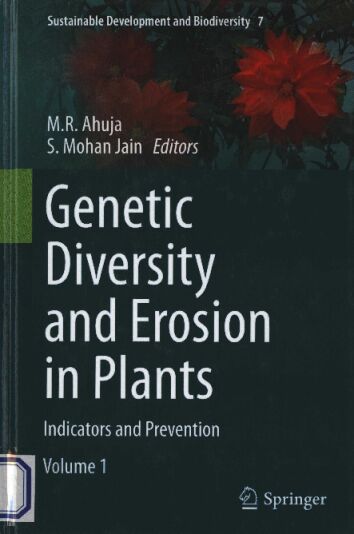
书名:Genetic diversity and erosion in plants. Volume 1, Indicators and prevention
责任者:M. R. Ahuja | S. Mohan Jain | Jain, S. Mohan,
前言
The tern erosion implies a gradual loss of something important that will eventually undermine the health or stability of dependent individuals or communities. As applied to genetic diversity, erosion is the loss of genetic diversity within a species. It can happen fairly quickly, as with a catastrophic event, or change in land use that removes large numbers of individuals and their habitat. Similarly, it can also occur more gradually and go unnoticed for a long time. Genetic erosion represents the loss of entire populations genetically differentiated from others, or the loss or change in frequency of specific alleles within a population, or the species as a whole, or the loss of allelic combinations in plants, trees, and animals.
Until the 1940s, the centers of origin of crop species and woody plants were considered limitless sources of genetic variability. After World War II, agriculture in developing countries suffered great changes. The expanded use of improved varieties resulted in the reduction of traditional varieties, a process called genetic erosion. The expansion of the agricultural frontiers also contributed to the risk of loss of the wild relatives of crop species. Some 10,000 different plant species have been used by humans for food and fodder production since the dawn of agriculture 10,000 years ago.
Yet today just 150 crops feed most humans on the planet, and just 12 crops provide 80 % of food energy, while wheat, rice, maize, and potato alone provide 60 % of stable food. Reduction of agricultural biodiversity means fewer options for ensuring more diverse nutrition, enhancing food production, raising incomes, coping with environmental constraints, and sustainably managing ecosystems. Recognizing, safeguarding, and using the potential and diversity of nature are critical for food security and sustainable agriculture. Biodiversity conservation targets three interdependent levels: ecosystems, species, and genes. Genetic erosion can represent the loss of entire populations genetically differentiated from others, the loss or change in frequency of specific alleles (i.e., different forms of a gene) within populations or over the species as a whole, or the loss of allelic combinations. Genetically eroded populations may be less competitive with introduced, new, invasive species. Genetic diversity is important to a species’ fitness, long-term viability, and ability to adapt to changing environmental conditions. Genetic erosion can be addressed at several levels in the spectrum of management activities. This book deals with a broad spectrum of topics on genetic erosion and biodiversity in crop plants, and trees.
We believe that this book will be useful to botanists, geneticists, molecular biologists, environmentalists, policy makers, conservationists, and NGOs working for the protection conservation of species in a changing environment.
查看更多
目录
1 Genetic Erosion: Context Is Key [Deborah Rogers and Patrick McGuire] 1
2 Indicators of Genetic Diversity, Genetic Erosion, and Genetic Vulnerability for Plant Genetic Resources [Anthony H.D. Brown and Toby Hodgkin] 25
3 Genetic Diversity and Modem Plant Breeding [Stephen Smith, David Bubeck, Barry Nelson, Jason Stanek and Justin Gerke] 55
4 Genetic Erosion Under Modern Plant Breeding: Case Studies in Canadian Crop Gene Pools [Yong-Bi Fu and Yi-Bo Dong] 89
5 Molecular Marker Based Assessment of Genetic Diversity in Rye [Hanna Bolibok-Bragoszewska and Monika Rakoczy-Trojanowska] 105
6 Using Molecular Techniques to Dissect Plant Genetic Diversity [Linda Mondini and Mario A. Pagnotta] 125
7 Erosion and Prevention of Crop Genetic Diversity Landraces of Georgia (South Caucasus) [Maia Akhalkatsi] 159
8 Genetic Diversity and Heavy Metal Stress in Plants [Shilpi Srivastava and Atul Bhargava] 189
9 Diversity and Erosion in Genetic Resources of Spices [K. Nirmal Babu, E.V.D. Sastry, K.V. Saji, Minoo Divakaran, H.J. Akshitha, S. Aarthi, A. Sharon, P.N. Ravindran and K.V. Peter] 225
10 Genetic Diversity and Erosion—A Global Perspective [Imke Thormann and Johannes M.M. Engels] 263
11 Diversity Arrays Technology (DArT) Markers for Genetic Diversity [Dariusz Grzebelus] 295
12 Exploring the Potential of Genetic Diversity via Proteomics: Past, Present, and Future Perspectives for Banana [S. Carpentier] 311
查看PDF
查看更多
评介
植物的遗传多样性与遗传流失
指示标记与保护,第1卷
遗传多样性是生物多样性的基础。随着人类活动的增加,自然界的生物多样性在迅速地遭到破坏;同时随着饮食习惯的变化,人类种植的农作物和经济作物的多样性也在减少。这些都造成了地球上植物遗传资源的流失。本书力图通过综合植物遗传多样性的分子指示标记和提出保护措施来减缓植物遗传多样性的流失。
全书共计12章。第1章,遗传流失:背景是关键;第2章,用于植物遗传资源的遗传多样性、遗传流失、遗传脆弱性的指示标记;第3章,遗传多样性与现代植物育种;第4章,现代植物育种下的遗传流失:以加拿大作物资源库为例;第5章,基于分子标记的黑麦遗传多样性评估;第6章,利用分子技术剖析植物遗传多样性;第7章,格鲁吉亚(南高加索)地方作物品种遗传多样性的流失与保护;第8章,遗传多样性与植物重金属胁迫;第9章,香料遗传资源的多样性与流失;第10章,遗传多样性与流失-全球视角;第11章,用于遗传多样性的多样性阵列技术(DArT)标记;第12章,通过蛋白组学探索遗传多样性的潜力:香蕉的过去、现在与未来展望。
本书编者由来自世界各地的植物学家、遗传育种学家等组成,综合了现有遗传多样性与保护的研究进展和未来发展趋势,是多国科学家研究成果的结晶。本书对于从事植物、生物技术以及环境研究的人员有参考价值,同时也可以作为政策制定者以及致力于生物多样性的非盈利组织的参考用书。
查看更多
馆藏单位
中国农科院农业信息研究所