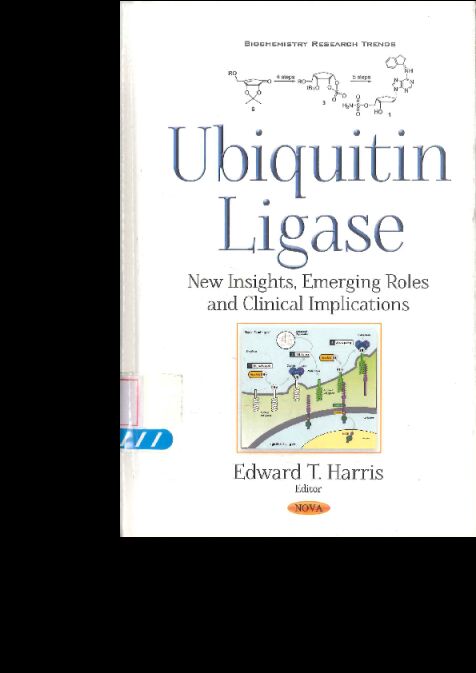
书名:Ubiquitin ligase
责任者:Edward T. Harris | Editor.
出版时间:2017
出版社:Nova Science Publishers, Inc.,
前言
The E3 ubiquitin ligases facilitate substrate specificity and isopeptide bond formation between C-terminal glycine residue of ubiquitin (Gly 76) and a lysine residue in the target protein. This book reviews several new insights, discusses emerging roles and analyzes clinical implications of uniquitin ligases.
Chapter 1 - The E3 ubiquitin ligases facilitate substrate specificity and isopeptide bond formation between C-terminal glycine residue of ubiquitin (Gly 76) and a lysine residue in the target protein. Three types of E3 ubiquitin ligases, the SCF (Skp1 or Skp2 /S-phase kinase-associated protein 1 or 2/ -cullin 1 - F-box - RING finger /Really Interesting New Gene/ - like domain containing ubiquitin ligases), CRL4~cdt2 (cullin 4-RING ubiquitin ligase with the substrate recognition factor Cdt2) and the APC/C (anaphase-promoting complex/cyclosome) play central roles in the regulation of cell cycle. SCF complexes control the abundance of cell cycle regulatory proteins including cyclins and cyclin-dependent kinase (CDK) inhibitors. APC/C is active during M and G1 phases of the cell cycle. APC/C controls SCF but the opposite is also true. Deregulation of cell proliferation is typical for cancer. Thus, aberrant expression of human Skpl and Skp2/Cull/F-box/Rocl and APC complexes may contribute to tumorigenesis by regulating the protein levels of Gl cycle regulators. The integrity of DNA is essential for the viability of all living cells. DNA double-strand breaks (DSBs) must be repaired because they are cytotoxic. CRL4~Cdt2 is critical for the proper progression through the cell cycle. CRL4~Cdt2 is also important for preventing aberrant DNA replication and for multiple DNA repair pathways. E3 ubiquitin ligases RNF8 and RNF 168 (RING finger proteins 8 and 168) generate binding sites for ubiquitin-binding domain bearing DNA repair factors at chromatin flanking DSBs. In the nucleotide excision repair (NER) pathway a UV-damaged DNA-binding component DDB (composed of subunits DDB1 and DDB2) recognizes the DNA damage for global genome repair and recruits repair factors like Xeroderma Pigmentosum, Complementation Group C (XPC) associated HR23 proteins. Polyubiquitinated XPC binds DNA for repair activity whereas polyubiquitinated DDB is degraded in proteasomes. SUMO (small ubiquitin-related modifier) -targeted ubiquitin ligases (STUbLs) play also an important role in regulation of cell cycle progression and in genome stability.
Chapter 2 - The impaired ribosome biosynthesis due to RPS14 (ribosomal protein 14 of the small ribosome subunit) gene haploinsufficiency in del(5q) myelodysplastic syndrome (MDS) hematopoietic cells leads to the E3 ubiquitin ligase HDM2 (human homologue to mouse double minute 2, major negative regulator of p53) inactivation by free ribosomal proteins, particularly RPL11. HDM2 degradation drives p53-mediated apoptosis of erythroid cells carrying the del(5q) aberration. This p53-mediated apoptosis of erythroid cells is a key effector of hypoplastic anemia in MDS patients with del(5q). RPS14 haploinsufficiency causes a block in erythroid differentiation mediated by calprotectin (the heterodimeric S100 calcium-binding proteins S100A8 and S100A9). Lenalidomide stabilizes E3 ubiquitin ligase HDM2, thereby accelerating p53 degradation. Lenalidomide inhibits phosphatases PP2a and Cdc25c (co-regulators of cell cycle; genes of these phosphatases are very commonly deleted in del(5q) MDS) with consequent G2 arrest of del(5q) MDS progenitors and their apoptosis. PP2a and Cdc25c inhibition by lenalidomide suppress HDM2 autoubiquitination and subsequent degradation.' Thus, lenalidomide reverses apoptosis within the erythroid compartment and induces apoptosis of the myeloid clone including megakaryocytes in dei(5q) MDS. Lenalidomide upregulates expression of other two haploinsufficient genes located on chromosome 5q, genes for microRNAs (miR-145 and miR-146a). These microRNAs are involved in Toll-like receptor (TLR) pathway, EL-6 induction and regulation of megakaryopoiesis. Further E3 ubiquitin ligase TRAF6 (tumor necrosis factor receptor associated factor 6) is involved in this TLR pathway. Thalidomide (founding member of immunomodulatory drugs /IMiDs/) and its derivatives lenalidomide and pomalidomide bind cereblon (CRBN) in the terminal C-region (parts of exons 10 and 11 of the CRBN gene code this IMiD binding region). CRBN is a member and substrate receptor of the cullin 4 RING E3 ubiquitin ligase complex (CRL4~CRBN). CRBN recruits substrate proteins to the CRL4 complex for ubiquitination and the subsequent degradation in proteasomes. Recent evidence shows that lenalidomide directly improves erythropoietin receptor (EPOR) signaling by EPOR upregulation mediated by a post-transcriptional mechanism. Lenalidomide stabilizes the EPOR protein by inhibition of the E3 ubiquitin ligase RNF41 (ring finger protein 41, also known as neuregulin receptor degradation protein-1 /Nrdp1/ and fetal liver ring finger /FLRF/) and induces lipid raft assembly to enhance EPOR signaling in MDS erythroid progenitors.
Chapter 3 - The ubiquitin-proteasome system (UPS) is important for balanced protein synthesis and degradation in normal healthy cells. E3 ubiquitin ligases are essential components of UPS and their deregulation can lead to the development of cancer. The clinical success of the proteasome inhibitors in treatment of hematological malignancies initiated studies of the inhibition of other components of UPS and targeting more specific E3 ubiquitin ligases selectively blocks the degradation of certain cellular proteins without unwanted degradation of other proteins. Cullin-RING E3 ubiquitin ligases (CRLs) represent the largest subclass of RING E3 ubiquitin ligases which are the largest family of E3 ubiquitin ligases. CRLs require cullin neddylation for its activation. Neddylation is very similar to ubiquitination and is initiated by a specific NEDD8 (neural precursor cell expressed, developmentally down-regulated 8) activating El enzyme (NAE). NAE is an essential regulator of the NEDD8 conjugation pathway. This pathway controls the degradation of many proteins involved in cell-cycle progression, DNA damage and stress responses. The activated NEDD8 is then transferred to the active site of the E2 enzyme specific for the NEDD8 (neddylation) pathway.
Finally, NEDD8 is conjugated on a conserved lysine near the C-terminal end of the cullin protein in the complex of Cullin-RING E3 ubiquitin ligases. Cullin neddylation is necessary for ubiquitination of CRL substrates. CRLs control the ubiquitination and turnover of many important proteins with important roles in cellular processes associated with cancer cell growth and survival pathways as are cell cycle control, nuclear factor-κB (NF-κB) signaling, hypoxia signaling, oxidative stress response and DNA replication and repair. Thus, inhibition of CRLs via inhibition of NAE is an important anticancer strategy. Pevonedistat (TAK-924/MLN4924, Millennium Pharmaceuticals, Inc.) was developed as a first-in-class, potent and selective inhibitor of NAE. Inhibition of NAE and thus CRLs, leads to cell death in cancer models. In vitro exposure of cancer cell lines to pevonedistat induces apoptosis, cellular senescence or autophagy. Despite the effect of pevonedistat in preclinical models of AML and preliminary efficacy in phase I clinical trials on patients with relapsed/refractory acute myeloid leukemia and high-risk myelodysplastic syndromes, the antileukemic activity of pevonedistat has not been completly defined and no predictive biomarkers of clinical sensitivity to this drug has been validated. Partial responses or stable disease was achieved also in phase I clinical studies of pevonedistat in patients with relapsed/ refractory multiple myeloma and lymphoma (non-Hodgkin's lymphoma).
Chapter 4 - The c-Cb1, a cellular homologue of a viral oncogene (Casitas B-lineage lymphoma oncogene), a RING finger E3 ubiquitin ligase, promotes the degradation of activated receptor tyrosine kinase (RTK), thereby negatively regulating RAS pathway signaling. Thus c-Cbl prevents excessive RTK signaling after cytokine growth factor stimulation and potentially acts as a tumor suppressor. Deregulated activation of RTKs is a frequent event in human cancers. Aberrant activation of RTKs can be induced by inappropriate ligand stimulation, by overexpression due to genetic amplification or by mutations of RTKs. The v-Fms oncogene product of the McDonough strain of feline sarcoma virus is a member of the tyrosne kinase family. Flt3 (FMS-like tyrosine kinase-3) is highly expressed in acute myeloid leukemia (AML) and deregulated Flt3 activity has important function in AML pathogenesis. Cb1-mediated regulation of Flt3 is biologically important. Cellular counterpart (c-Cb1) of a viral oncogene (v-Cb1) isolated from a transforming retrovirus that causes B-cell lymphoma and myeloid neoplasms in mice, is a 120-kDa cytoplasmic potein that is mutated in a variety of myeloid malignancies, including AML and myelodysplastic syndrome (MDS). These mutations are frequent in myelodysplastic-myeloproliferative neoplasms (MDS-MPN) include chronic myelomonocytic leukemia (CMML), juvenile myelomonocytic leukemia (JMML) and atypical chronic myeloid leukemia (aCML). Cb1 mutants enhance the survival of myeloid cells. Except for rare Cb1 mutations causing a premature truncation of the tyrosine kinase-binding (TKB) domain, most Cb1 mutations in myeloid neoplasms are missense changes at highly conserved amino acid positions within the linker and RTNG finger domains or involve splice-site sequences. The result of these mutations are amino acid deletions in these domains. Cbl mutants have compromised E3 ubiquitin ligase activity and in addition strongly inhibit E3 ubiquitin protein ligase activity of wild- type c-Cb1. Allelic conversion leading to uniparental disomy (UPD) is an important genetic mechanism of clonal evolution in the pathogenesis of MPN. This mechanism is associated not only with loss-of-function of tumor suppressor genes, but also with gain-of-function mutations of proto-oncogenes. Homozygous c-Cbl mutations that characterize a subset of MDS/MPD carrying 11q-UPD represent an example of this mechanism.
Chapter 5 - The tumor suppressor protein p53, also known as the guardian of the genome, induces growth arrest, apoptosis, senescence and autophagy. It acts not only as a tumor suppressor, but also regulates metabolism, fertility, aging and quiescence. E3 ubiquitin ligases Mdm2 and MdmX (murine double minute clone 2 and clone X) and their human homologues Hdm2 and HdmX play important roles in degradation of p53 and in inhibiting of p53 transcriptional activity and both these ubiquitin ligases maintain low intracellular levels of p53 under normal conditions although several other E3 ubiquitin ligases for p53 also exist. However, both E3 ubiquitin ligases Mdm2 and MdmX (also known as Mdm4) are over-expressed in some cancers and function as powerful oncogenes. The primary response to DNA damage and to various cellular stresses is the activation and stabilization of p53 in the cell. Activated p53 stimulates transcription of its downstream target genes to proteins involved in cell cycle arrest, apoptosis, and DNA repair. The degradation of p53 occurs by ubiquitin-dependent and ubiquitin-independent mechanisms. Unlike Mdm2, MdmX has no or only little E3 ubiquitin ligase activity. MdmX rather acts as stimulator of the E3 ubiquitin ligase activity of Mdm2 by heterocomplex Mdm2-MdmX formation. The C-terminal of Mdm2 is able to bind with the C-terminal of the highly related protein MdmX. Mdm2-MdmX heterodimer ubiquitinates p53 with higher efficiency than Mdm2 homodimers. Furthermore, Mdm2-MdmX heterodimers are fhermodynamically more stable than Mdm2 homodimers. The N-terminus of MdmX is able to bind p53 and to inhibit its transcriptional activity. Mdm2 is transcriptionally up-regulated by p53. Both Mdm2 and MdmX represent therapeutic targets for increasing wild type p53 expression and activities. In 2004, the first small molecule inhibitor nutlin-3a was discovered. Nutlin-3a binds to the hydrophobic cleft in the N-terminus of Mdm2, preventing its association with p53. Poor bioavailability, high toxicity and limited effect of nutlin-3a on MdmX over-expressing cells prevented its use in the clinic. Several new small molecule inhibitors which have better bioavailability and can target both Mdm2 and MdmX are in clinical development. Cis-imidazoline compound RG7112 has been evaluated in a phase 1 clinical trial in various relapsed/refractory leukemias. There was clinical activity in the acute myeloid leukemia patients, where 5 of 30 evaluable patients achieved either a c omplete or partial response, and another 9 patients had stable disease. Mdm2 inhibition resulted in p53 stabilization and transcriptional activation of p53 target genes. Two patients with p53 mutations (G266E and R181L) also responded to RG7112 in this trial. Further Mdm2 and MdmX inhibitors on the basis of spiro-oxindole, imidazothiazole, dihydroisoquinolinone, pyperidine, piperidinone, pyrrolidine and small peptides designated to disrupt p53 interaction with both Mdm2 and MdmX are tested in clinical trials. Inhibition of Mdm2 and MdmX can place selective pressure on cancer cells with p53 mutations but the levels of gain-of-function p53 mutations can increase after E3 ubiquitin ligases Mdm2 and MdmX inhibition.
Chapter 6 - The tripartite motif (TRIM) E3 ubiquitin ligases harbor the RING finger, B-box and coiled-coil domain motifs. The RING domain recognizes the ubiquitin-loaded E2 conjugating enzyme. B-box is a zinc-binding motif. The coiled-coil domain has helical structure which is important in protein-protein interactions. The coiled-coil region together with B-box domain may form substrate-binding pockets. The members of this TRIM family regulate various cellular processes and are particularly important for innate immune regulation. Humans have approximately 73 TRIMs. They act as E3 ubiquitin ligases but also as E3 ligases for small ubiquitin-like molecule (SUMO) and for the interferon stimulated protein of 15 kDa (ISG15). Innate immune responses against viruses include constitutively expressed proteins with intrinsic anti-microbial properties and the inducible type I interferon (IFN-1) system. After recognition of pathogen-associated molecular patterns by pattern recognition receptors (PRRs), the inducible antiviral response is initiated. PRRs including Toll-like receptors, retinoic acid-inducible gene 1 -like receptors, NOD (the nucleotide-binding oligomerization domain) - like receptors and C-type lectin receptors trigger down-stream signaling pathways responsible for activation of transcription factor NF-κB and subsequent pro-inflammatory cytokine synthesis. IFN-inducible genes interfere with the viral replication cycle. TRIM proteins can mediate antiviral activity and exert their function either by directly interfering with key steps in viral life cycles, or indirectly as regulators of antiviral cell signaling. One of the best characterized TRIMs with direct antiviral activity is TRIM5α. The detailed molecular mechanism of TRTM5α viral restriction is still under study. The inhibition of murine Friend leukemia virus occurs immediately after its entering the cells and before reverse transcription. TRIM5α has E3 ubiquitin ligase activity and can be auto-ubiquitinated leading to a rapid proteasome-dependent degradation. TRIM5α turnover by the proteasome may target human immunodeficiency virus-1 (HIV-1) for degradation. Proteasome inhibitors, however, did not rescue HIV-1 infectivity and TRIM5α mediated ubiquitination of HIV-1 capsid has not been detected. Another possibility is that TRIM5α stimulates uncoating of HIV-1 capsids and inhibition of viral reverse transcription. TRIMs can act as antiviral factors also indirectly by stimulating cytokine signaling pathways for induction of IFN-inducible genes.
Chapter 7 - Evolutionarily conserved from simple multi-cellular organisms to humans, the Notch pathway regulates short-range cell-to-cell communication in metazoans. It determines cell proliferation, cell fate, mobility, differentiation and cell death. It is required for diverse developmental processes during organogenesis and for physiological tissue homeostasis. Mutations in genes within the pathway and aberrant Notch signaling are linked to congenital disorders, inflammation and immunity-related diseases. Furthermore, hyper-activation of the Notch pathway is intimately associated with cancer development such as childhood Acute T-cell Leukemia (A-TLL), and other hematological and epithelial malignancies. The ubiquitin pathway tightly regulates the Notch pathway at multiple cellular nodes and is highly relevant to its de-regulation. In this review, the authors focus on the role of ubiquitin ligases in the biogenesis and maturation of Notch receptors and their ligands, DSL proteins. The authors will discuss the contribution of ubiquitin ligases to receptor-ligand activation and Notch-dependent transcription in the nucleus. The authors will portray the biochemical and molecular characteristics of these ligases, their function as discovered in experiments using cells and genetic model organisms, and the importance of the Notch pathway with respect to human diseases.
查看更多
目录
Preface vii
Chapter 1 The Significance of E3 Ubiquitin Ligases in Cell Cycle and Genome Stability (DNA Replication and DNA Damage) 1
Chapter 2 E3 Ubiquitin Ligases Involved in Pathogenesis and Treatment of Del(5q) Myelodysplastic Syndrome and Other Hematologic Malignancies 33
Chapter 3 Targeting of Neddylation of Cullin- RING E3 Ubiquitin Ligases with an NEDD8-Activating Enzyme Inhibitor Pevonedistat (MLN4924) in Hematologic Malignancies 63
Chapter 4 Ring Finger E3 Ubiqutin Ligase CBL Protein and Its Functional Roles and Mutations in Myeloid Malignancies 87
Chapter 5 E3 Ubiquitin Ligases Mdm2 and MdmX Regulate the Stability, Translation, subcellular localization and Transcriptional Activity of p53 Protein 109
Chapter 6 Roles of E3 Ubiquitin Ligases with a Tripartite Motif (TRIM) in Innate Immune Regulation 131
Chapter 7 Paving the Notch Pathway with Ubiquitin Ligases 147
Index 191
查看PDF
查看更多
馆藏单位
中国医科院医学信息研究所