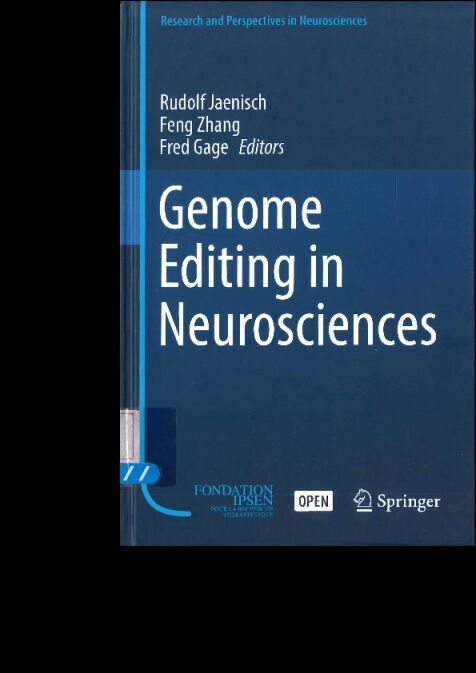
书名:Genome editing in neurosciences
责任者:Rudolf Jaenisch | Feng Zhang | Fred Gage | .
分类号:医药、卫生
页数:xi, 123 p. :
前言
It was somewhat of a surprise to the scientific community when, in 1944, Oswald Avery definitively proved that DNA encoded the blueprint to life. Many scientists at the time thought that, with just four bases, DNA was chemically too simple to contain so much information. Nearly 75 years later, though, we are still trying to parse all the information contained in a genome. This work has been greatly accelerated in the past decade by two parallel advancements: next-generation DNA sequencing technology and genome editing methods. Current sequencing capacity is leading to the generation of large amounts of genetic data, while our ability to manipulate the genome is rapidly advancing our understanding of that genetic data.
Genome editing based on the microbial CRISPR-Cas adaptive immune system has emerged in recent years as a powerful tool for dissecting genetic circuits. CRISPR-associated enzymes such as Cas9 and Cpf 1 are RNA-guided DNA endo-nucleases that can be precisely targeted to nearly any region of the genome via the guide RNA sequence. These enzymes have been used for both gene disruption and insertion in a wide range of organisms, and they have also been developed as a platform for gene activation, providing another way to modulate gene expression patterns. Finally, RNA-guided nucleases can facilitate both loss- and gain-of-function genome-wide screening applications. This technology has significantly advanced our ability to perform forward genetics in mammalian systems, model human diseases in tractable systems, and interrogate complex genetic processes. Moreover, it has the potential to revolutionize the way we treat human disease.
The Fondation IPSEN Colloque Medecine et Recherche in the Neuroscience Series, held in Paris on April 22, 2016, highlighted how genome editing is enabling breakthroughs in how we study the brain and how we may be able to apply this powerful method to understand and treat central nervous system (CNS) disorders. The use of CRISPR-Cas-based technologies was a common thread that ran throughout the meeting: it was used to either develop new cell lines relevant to studying the CNS or it made it possible to use new model organisms to study the CNS; it powered large-scale interrogation of neuronal genetic circuits; and it was used for proof-of-principle therapeutic restoration of disease-causing mutations.
In contrast to Avery's discovery, nobody has ever doubted the complexity of the human brain. Neuroscientists have struggled for decades with seemingly intractable questions about the nature of the brain, and CNS disorders have proven to be some of the most difficult human diseases to study, in large part because the tools simply were not available. Genome editing, along with other recent technological advances such as next-generation sequencing advances and optogenetics, is unlocking hundreds of new ways to study the brain. The work that is described in this volume exemplifies the lines of research that can now be pursued and offers a tantalizing glimpse of where this work will lead us. MA, USA, Feng Zhang June 2017
查看更多
目录
In Vitro Modeling of Complex Neurological Diseases 1
Aquatic Model Organisms in Neurosciences: The Genome-Editing Revolution 21
Genome-Wide Genetic Screening in the Mammalian CNS 31
CRISPR/Cas9-Mediated Knockin and Knockout in Zebrafish 41
Dissecting the Role of Synaptic Proteins with CRISPR 51
Recurrently Breaking Genes in Neural Progenitors: Potential Roles of DNA Breaks in Neuronal Function, Degeneration and Cancer 63
Neuroscience Research Using Non-human Primate Models and Genome Editing 73
Multiscale Genome Engineering: Genome-Wide Screens and Targeted Approaches 83
Using Genome Engineering to Understand Huntington's Disease 87
Therapeutic Gene Editing in Muscles and Muscle Stem Cells 103
查看PDF
查看更多
馆藏单位
中国医科院医学信息研究所