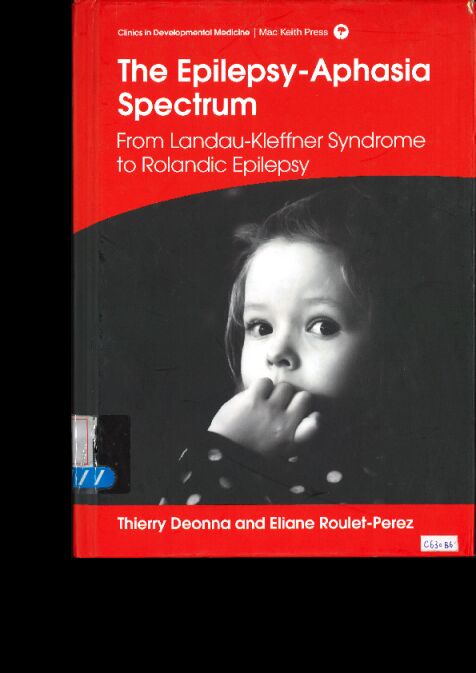
书名:The epilepsy-aphasia spectrum
责任者:Thierry Deonna and Eliane Roulet-Perez with contributions from Xavier de Tiege | Serge Goldman | Patrick van Bogaert. | Roulet-Perez, Eliane. | Tiege, Xavier de.
ISBN\ISSN:9781909962767,1909962767
出版时间:2016
出版社:Mac Keith Press
前言
It was in the early 1970s that I first met a child who presented with loss of language comprehension, mutism and cognitive regression. He had only a few seizures, but severe epi-leptiform discharges on his EEC He was thought to have an unusual kind of viral encephalitis until the unexpected course of the disorder, literature search, and discussion with colleagues prompted the recognition of similar cases in our community. We were faced with a mysterious combination of aphasia and epilepsy, without any evident cause, about which little had been written after the initial paper published by Landau and Kleffner in 1957. The prevailing hypothesis was that the epilepsy was an epiphenomenon of one or several different brain diseases, although the search for them remained elusive. During the same period, like many child neurologists around the world, we were busy in Lausanne trying to better identify the 'idiopathic focal epilepsies of childhood', a group of focal epilepsies without any identified structural lesion and a self-limited 'benign' course that seemed to occur quite frequently in otherwise typically developing children. While doing so, we became increasingly aware, like several others, of the many, but long unsuspected common features between rolandic epilepsy (or childhood epilepsy with centro-temporal spikes) and 'acquired epileptic aphasia' that unfortunately became known as Landau-Kleffner syndrome, an eponym that Landau and Kleffher themselves disapproved. The often remittent-relapsing course and, at times, spectacular remission of clinical and epileptiform EEG abnormalities (most prominent in sleep) with antiepileptic drugs or steroids clearly pointed to a direct role of the epileptic activity. Affected children exemplified the fact that an epilepsy can manifest with an acquired, insidious and puzzling disruption of language as well as other cognitive and behavioural functions. The latter can sometimes present like a developmental language disorder or an autistic spectrum disorder, whereas epileptic seizures can be rare or even absent. In short, epilepsy can no longer be regarded only as a paroxysmal disorder with various seizures types but can also present as a continuous slow progressive disorder with no evident paroxysmal features.
This prompted us to focus our research on longitudinal studies of children whose epilepsy was accompanied by a cognitive regression, developmental arrest or behavioural disruption. The aim was to try to disentangle a possible direct role of the epilepsy from all other factors that may affect cognitive function, and this in any epilepsy, regardless of type, cause or age at onset. This was a tedious, unspectacular approach, involving often single or only a few cases, each child being his or her own control. Such cases are often dismissed as anecdotal, but we thought, and still think, that their study is justified given the paucity of relevant data that emerge from many group studies and their tendency to disregard exceptional but informative cases. This led us to our first book titled Cognitive and Behavioural Disorders of Epileptic Origin (Deonna and Roulet-Perez 2005). Since then, several new tools in the domain of electrophysiology, functional imaging, genetics, neurometabolism and
查看更多
目录
AUTHORS' APPOINTMENTS vii
FOREWORDS ix
PREFACE xi
ACKNOWLEDGEMENTS xiii
1.INTRODUCTION 1
2.HISTORY OF THE LANDAU-KLEFFNER SYNDROME 4
3.CLASSIFICATION ISSUES 18
4.SPEECH PERCEPTION AND BRAIN ORGANIZATION OF LANGUAGE: RELEVANT FEATURES FOR LANDAU-KLEFFNER SYNDROME AND THE EPILEPSY-APHASIA SPECTRUM 26
5.THE DIFFERENT CLINICAL FACETS OF LANDAU-KLEFFNER SYNDROME 34
6.DEVELOPMENTAL ASPECTS OF LANDAU-KLEFFNER SYNDROME AND THE EPILEPSY-APHASIA SPECTRUM AND THE OVERLAP WITH DEVELOPMENTAL LANGUAGE DISORDERS AND AUTISM SPECTRUM DISORDER 60
7.EVOLUTION OF LANDAU-KLEFFNER SYNDROME: SHORT-,MID- AND LONG-TERM OUTCOMES 70
8.FROM ROLANDIC EPILEPSY TO LANDAU-KLEFFNER SYNDROME 78
9.LABORATORY INVESTIGATIONS IN LANDAU-KLEFFNER SYNDROME AND THE EPILEPSY-APHASIA SPECTRUM 95
10.PHYSIOPATHOLOGY OF SPEECH, LANGUAGE AND OTHER PROLONGED EPILEPTIC DYSFUNCTION IN LANDAU-KLEFFNER SYNDROME, EPILEPSY WITH CONTINUOUS SPIKE WAVES DURING SLEEP AND RELATED SYNDROMES 106
11.FUNCTIONAL NEUROIMAGING INVESTIGATIONS IN IDIOPATHIC FOCAL EPILEPSIES OF CHILDHOOD WITH COGNITIVE AND BEHAVIOURAL IMPAIRMENT 119
12.DRUG MANAGEMENT OF COGNITIVE IMPAIRMENTS IN LANDAU-KLEFFNER SYNDROME AND OTHER EPILEPSY APHASIA SPECTRUM SYNDROMES 127
13.SPEECH AND LANGUAGE, EDUCATIONAL AND PSYCHOLOGICAL REMEDIATION 137
14.PERSONAL TESTIMONIES AND UNPUBLISHED CASES 156
15.SUMMARY AND CONCLUSIONS 167
REFERENCES 170
INDEX 187
查看PDF
查看更多
馆藏单位
中国医科院医学信息研究所