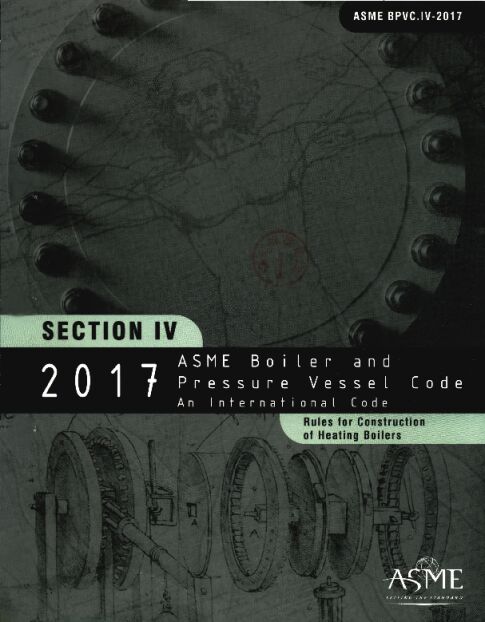
书名:Rules for construction of heating boilers, Part IV
责任者:ASME boiler and pressure vessel committee on heating boilers
出版时间:2017
出版社:The American Society of Mechanical Engineers
分类号:能源与动力工程
版次:2017 ed.
页数:254p
摘要
(a) The rules of Part HG apply to steam heating boilers, hot water heating boilers, hot water supply boilers, and to appurtenances thereto. They shall be used in conjunction with the specific requirements in Part HF, Boilers of Wrought Materials, Part HC, Cast Iron Boilers, and Part HA, Cast Aluminum Boilers whichever is applicable. The foreword provides the basis for these rules. Part HG is not intended to apply to potable water heaters except as provided for in Part HLW. Boilers with economizers shall follow the rules of Mandatory Appendix 10.
查看更多
前言
In 1911, The American Society of Mechanical Engineers established the Boiler and Pressure Vessel Committee to formulate standard rules for the construction of steam boilers and other pressure vessels###. In 2009, the Boiler and Pressure Vessel Committee was superseded by the following committees:
(a) Committee on Power Boilers (I)
(b) Committee on Materials (II)
(c) Committee on Construction of Nuclear Facility Components (III)
(d) Committee on Heating Boilers (IV)
(e) Committee on Nondestructive Examination (V)
(f) Committee on Pressure Vessels (VIII)
(g) Committee on Welding, Brazing, and Fusing (IX)
(h) Committee on Fiber-Reinforced Plastic Pressure Vessels (X)
(i) Committee on Nuclear Inservice Inspection (XI)
(j) Committee on Transport Tanks (XII)
(k) Technical Oversight Management Committee (TOMC)
Where reference is made to "the Committee" in this Foreword, each of these committees is included individually and collectively.
The Committee's function is to establish rules of safety relating only to pressure integrity, which govern the construction ** of boilers, pressure vessels, transport tanks, and nuclear components, and the inservice inspection of nuclear components and transport tanks. The Committee also interprets these rules when questions arise regarding their intent. The technical consistency of the Sections of the Code and coordination of standards development activities of the Committees is supported and guided by the Technical Oversight Management Committee. This Code does not address other safety issues relating to the construction of boilers, pressure vessels, transport tanks, or nuclear components, or the inservice inspection of nuclear components or transport tanks. Users of the Code should refer to the pertinent codes, standards, laws, regulations, or other relevant documents for safety issues other than those relating to pressure integrity. Except for Sections XI and XII, and with a few other exceptions, the rules do not, of practical necessity, reflect the likelihood and consequences of deterioration in service related to specific service fluids or external operating environments. In formulating the rules, the Committee considers the needs of users, manufacturers, and inspectors of pressure vessels. The objective of the rules is to afford reasonably certain protection of life and property, and to provide a margin for deterioration in service to give a reasonably long, safe period of usefulness. Advancements in design and materials and evidence of experience have been recognized.
This Code contains mandatory requirements, specific prohibitions, and nonmandatory guidance for construction activities and inservice inspection and testing activities. The Code does not address all aspects of these activities and those aspects that are not specifically addressed should not be considered prohibited. The Code is not a handbook and cannot replace education, experience, and the use of engineering judgment. The phrase engineering judgment refers to technical judgments made by knowledgeable engineers experienced in the application of the Code. Engineering judgments must be consistent with Code philosophy, and such judgments must never be used to overrule mandatory requirements or specific prohibitions of the Code.
The Committee recognizes that tools and techniques used for design and analysis change as technology progresses and expects engineers to use good judgment in the application of these tools. The designer is responsible for complying with Code rules and demonstrating compliance with Code equations when such equations are mandatory. The Code neither requires nor prohibits the use of computers for the design or analysis of components constructed to the requirements of the Code. However, designers and engineers using computer programs for design or analysis are cautioned that they are responsible for all technical assumptions inherent in the programs they use and the application of these programs to their design.The rules established by the Committee are not to be interpreted as approving, recommending, or endorsing any proprietary or specific design, or as limiting in any way the manufacturer's freedom to choose any method of design or any form of construction that conforms to the Code rules.The Committee meets regularly to consider revisions of the rules, new rules as dictated by technological development, Code Cases, and requests for interpretations. Only the Committee has the authority to provide official interpretations of this Code. Requests for revisions, new rules, Code Cases, or interpretations shall be addressed to the Secretary in writing and shall give full particulars in order to receive consideration and action (see Submittal of Technical Inquiries to the Boiler and Pressure Vessel Standards Committees). Proposed revisions to the Code resulting from inquiries will be presented to the Committee for appropriate action. The action of the Committee becomes effective only after confirmation by ballot of the Committee and approval by ASME. Proposed revisions to the Code approved by the Committee are submitted to the American National Standards Institute (ANSI) and published at http://go.asme.org/BPVCPublicReview to invite comments from all interested persons. After public review and final approval by ASME, revisions are published at regular intervals in Editions of the Code.The Committee does not rule on whether a component shall or shall not be constructed to the provisions of the Code. The scope of each Section has been established to identify the components and parameters considered by the Committee in formulating the Code rules. Questions or issues regarding compliance of a specific component with the Code rules are to be directed to the ASME Certificate Holder (Manufacturer). Inquiries concerning the interpretation of the Code are to be directed to the Committee. ASME is to be notified should questions arise concerning improper use of an ASME Certification Mark.When required by context in this Section, the singular shall be interpreted as the plural, and vice versa, and the feminine, masculine, or neuter gender shall be treated as such other gender as appropriate.
查看更多
目录
List of Sections xii
Foreword xiv
Statement of Policy on the Use of the Certification Mark and Code Authorization in Advertising xvi
Statement of Policy on the Use of ASME Marking to Identify Manufactured Items xvi
Submittal of Technical Inquiries to the Boiler and Pressure Vessel Standards Committees xvii
Personnel xx
Preamble xxxix
Summary of Changes xl
List of Changes in Record Number Order xlv
Cross-Referencing and Stylistic Changes in the Boiler and Pressure Vessel Code xlvii
Part HG General Requirements for All Materials of Construction 1
Article 1 Scope and Service Restrictions 1
HG-100 Scope 1
HG-101 Service Restrictions 1
HG-102 Units 1
HG-103 Tolerances 2
Article 2 Material Requirements 3
HG-200 General Material Requirements 3
HG-201 Specific Material Requirements 3
Article 3 Design 4
HG-300 Design Pressure 4
HG-301 Cylindrical Parts Under Internal Pressure 4
HG-305 Formed Heads, Pressure on Concave Side 4
HG-306 Formed Heads, Pressure on Convex Side 5
HG-307 Flat Heads 5
HG-309 Spherically Dished Covers (Bolted Heads) 9
HG-312 Cylindrical Parts Under External Pressure 11
HG-320 Openings in Boilers, General Requirements 14
HG-321 Reinforcement Required for Openings in Shells and Formed Heads 15
HG-323 Flanged-In Openings in Formed Heads 15
HG-325 Reinforcement Required for Openings in Flat Heads 16
HG-326 Limits of Metal Available for Reinforcement 17
HG-327 Strength of Reinforcement 20
HG-328 Reinforcement for Multiple Openings 20
HG-330 Inspection and Access Openings 20
HG-340 Stayed Surfaces 21
HG-341 Staybolts 23
HG-342 Dimensions of Stays 23
HG-343 Dimensions of Diagonal Stays 23
HG-345 Staying of Heads 25
HG-346 Tubesheets with Firetubes Used as Stays 26
HG-350 Ligaments 26
HG-360 Requirements for Tube Holes and Tube Attachments 29
HG-370 External Piping Connections 31
Article 4 Pressure-Relieving Devices 32
HG-400 Pressure-Relieving Valve Requirements 32
HG-401 Minimum Requirements for Safety and Safety Relief Valves 33
HG-402 Discharge Capacities of Safety and Safety Relief Valves 34
HG-403 Heating Surface 37
HG-405 Temperature and Pressure Safety Relief Valves 37
Article 5 Tests, Inspection, and Stamping 38
HG-500 Proof Tests to Establish Design Pressure 38
Article 6 Instruments, Fittings, and Controls 51
HG-600 General 51
HG-601 For Steam Heating Boilers 51
HG-610 For Hot Water Heating or Hot Water Supply Boilers 53
HG-620 For All Boilers 54
HG-630 Electric Wiring 54
HG-640 Controls and Heat Generating Apparatus 55
Article 7 Installation Requirements 56
HG-700 Installation Requirements, All Boilers 56
Part HF Requirements for Boilers Constructed of Wrought Materials 65
Article 1 General 65
HF-100 Scope 65
Article 2 Material Requirements 66
HF-200 General Material Requirements 66
HF-201 Plate 66
HF-202 Rods, Bars, and Shapes 66
HF-203 Prefabricated or Preformed Pressure Parts 66
HF-204 Pipe and Tubes 67
HF-205 Material Not Fully Identified 68
HF-206 Recertification of Material Produced to a Specification Not Permitted by This Section 69
HF-207 Austenitic Stainless Steel 69
HF-210 Maintaining Material Identification 69
Article 3 Design Stresses and Minimum Thicknesses 70
HF-300 Maximum Allowable Stress Values 70
HF-301 Minimum Thicknesses 70
HF-302 Basis for Establishing Stress Values in Table HF-300.1 (HF-300.1M) or Table HF-300.2 (HF-300.2M) 70
Part HF - Subpart HW Requirements for Boilers Fabricated by Welding 96
Article 4 General Requirements 96
HW-400 Scope 96
HW-401 Responsibility of Manufacturer or Contractor 96
Article 5 Material Requirements 97
HW-500 Permissible Materials 97
HW-501 Materials of Different Specifications 97
HW-502 Materials for Small Parts 97
Article 6 Welding Processes and Qualifications 98
HW-600 Welding Processes 98
HW-610 Welding Qualifications 98
HW-611 No Production Work Without Qualifications 98
HW-612 Interchange of Qualifying Tests Among Manufacturers Prohibited 98
HW-613 Maintenance of Records of Qualifications and Identifying Marks 98
Article 7 Design of Weldments 99
HW-700 Design of Welded Joints 99
Article 8 Fabrication Requirements 113
HW-800 Forming Plates 113
HW-801 Base Metal Preparation 113
HW-810 Assembly 113
HW-812 Alignment Tolerance 113
HW-813 Distortion 113
HW-820 Specific Welding Requirements 114
HW-830 Repair of Weld Defects 115
HW-840 Posthydrotest Welding of Nonpressure Parts to Pressure Parts 115
Article 9 Inspection 116
HW-900 Inspection During Fabrication 116
HW-910 Check of Welding Procedure Qualifications 116
HW-911 Check of Welder and Welding Operator Performance Qualifications 116
Part HF - Subpart HB Requirements for Boilers Fabricated by Brazing 117
Article 10 General Requirements 117
HB-1000 Scope 117
HB-1001 Responsibility of Manufacturer or Contractor 117
Article 11 Material Requirements 118
HB-1100 General 118
HB-1101 Combinations of Dissimilar Materials 118
HB-1102 Brazing Filler Metals 118
HB-1103 Fluxes and Atmospheres 118
Article 12 Brazing Processes, Procedures, and Qualifications 119
HB-1200 Brazing Processes 119
HB-1201 Joint Brazing Procedures 119
HB-1202 Brazing Qualifications and Records 119
Article 13 Design 120
HB-1300 Strength of Brazed Joints 120
HB-1301 Brazed Joint Efficiency Factors 120
HB-1302 Minimum Thickness 120
HB-1303 Permissible Service Temperature 120
HB-1304 Application of Brazing Filler Metal 120
HB-1305 Joint Clearance 120
HB-1306 Openings 121
HB-1307 Brazed Connections 121
Article 14 Fabrication Requirements 122
HB-1400 Cleaning of Surfaces to Be Brazed 122
HB-1401 Postbrazing Operations 122
HB-1402 Repair of Defective Brazing 122
Article 15 Inspection and Stamping 123
HB-1500 Inspection 123
Part HC Requirements for Boilers Constructed of Cast Iron 124
Article 1 General 124
HC-100 Scope 124
Article 2 Material Requirements 125
HC-200 General Material Requirements 125
HC-201 Manufacture 125
HC-202 Chemical Composition 125
HC-203 Tensile Strength Classification 125
HC-204 Test Bars 125
HC-205 Selection of Test Bar Size 125
HC-206 Molding and Pouring Test Bars 125
HC-207 Number of Tests 125
HC-208 Tension Test 127
HC-209 Tension Test Procedure 127
HC-210 Tension Retests 127
HC-211 Transverse Test 127
HC-212 Transverse Test Procedure 127
HC-213 Transverse Retests 127
HC-214 Workmanship, Finish, and Repair 128
HC-215 Examinations and Tests 129
HC-216 Test Records 129
Article 3 Design 130
HC-300 Maximum Allowable Stress Values 130
HC-301 Basis for Establishing Stress Values in Table HC-300 130
HC-310 Heads 130
HC-311 Spherically Shaped Covers 130
HC-315 Openings and Reinforcements 132
HC-320 Corners and Fillets 132
HC-325 Washout Openings 132
HC-330 Assembly Method 133
Article 4 Tests 134
HC-400 Tests to Establish Design Pressure 134
Article 5 Quality Control and Inspection 136
HC-501 General 136
HC-502 Outline of Features to Be Included in the Written Description of the Quality Control System 136
HC-510 Examination 137
HC-520 Certificates of Conformance 137
Part HA Requirements for Boilers Constructed of Cast Aluminum 139
Article 1 General 139
HA-100 Scope 139
Article 2 Material Requirements 140
HA-200 General Material Requirements 140
HA-201 Workmanship, Finish, and Repair 140
HA-202 Examinations and Tests 140
HA-203 Test Records 141
Article 3 Design 142
HA-300 Maximum Allowable Stress Values 142
HA-301 Heads and Spherically Shaped Covers 142
HA-302 Openings and Reinforcements 142
HA-303 Corners and Fillets 142
HA-304 Washout Openings 142
HA-305 Assembly Method 142
Article 4 Tests 143
HA-400 Tests to Establish Design Pressure 143
Article 5 Quality Control and Inspection 145
HA-501 General 145
HA-502 Outline of Features to Be Included in the Written Description of the Quality Control System 145
HA-503 Examination 146
HA-504 Certificates of Conformance 146
Part HLW Requirements for Potable-Water Heaters 148
Introduction 148
Article 1 General 150
HLW-100 Scope 150
HLW-101 Service Limits 150
HLW-102 Permissible Stamping 150
HLW-103 Units 150
Article 2 Material Requirements 152
HLW-200 Lining 152
HLW-201 Primary Pressure Parts Material 153
HLW-202 Acceptance of Unidentified or Small Quantities of Material 153
HLW-203 Miscellaneous Pressure Parts Material 154
HLW-204 Flanges and Pipe Fittings 154
HLW-205 Nonpressure Part Material 154
Article 3 Design 155
HLW-300 Design 155
HLW-301 Basis for Establishing Stress Values in Tables HLW-300 and HLW-301 155
HLW-302 Minimum Thicknesses 155
HLW-303 Shells Under Internal Pressure 159
HLW-305 Blank Unstayed Dished Heads, Pressure on Concave Side 159
HLW-306 Blank Unstayed Dished Heads, Pressure on Convex Side 160
HLW-307 Tubes 160
HLW-308 Openings 160
HLW-309 Tubes Attached by Rolling 160
HLW-310 Storage Tanks 160
Article 4 Design of Weldments 162
HLW-400 Design of Welded Joints 162
Article 5 Tests 177
HLW-500 Tests to Establish Maximum Allowable Working Pressure and Production Line Tests 177
Article 6 Inspection and Stamping 179
HLW-600 Inspection and Certification 179
HLW-601 Manufacturer's Data and Partial Data Reports 179
HLW-602 Stamping of Water Heaters and Storage Tanks 180
Article 7 Controls 182
HLW-700 Controls 182
Article 8 Installation Requirements 183
HLW-800 Safety Relief Valves 183
HLW-801 Mounting Safety Relief Valves 183
HLW-805 Water Supply 184
HLW-809 Provisions for Thermal Expansion in Hot Water Systems 184
HLW-810 Bottom Drain Valve 184
HLW-820 Thermometer 185
Mandatory Appendix 2 Codes, Standards, and Specifications Referenced in Text 187
2-100 Reference Standards 187
2-200 Organizations 188
Mandatory Appendix 3 Adhesive Attachment of Nameplates to Casing 189
3-100 Scope 189
3-101 Nameplate Application Procedure Qualification 189
Mandatory Appendix 4 Guide to Manufacturer's Data Report Forms 190
4-100 Introduction 190
4-200 Data Report Forms 191
4-300 Certificates of Conformance 191
Mandatory Appendix 5 Vacuum Boilers 217
5-100 Scope 217
5-200 Maximum Pressure and Temperature 217
5-300 Design Parameters 217
5-400 Welding 217
5-500 Alternative to Hydrotest 217
5-600 Instruments, Fittings, and Controls 218
5-700 Inspection Openings 218
Mandatory Appendix 6 Standard Units for Use in Equations 219
Mandatory Appendix 7 Rules for Mass-Production of Heating Boilers 220
7-100 Introduction 220
7-200 Scope 220
7-300 General 220
7-400 Quality Control Procedures 220
7-500 Data Reports 221
Mandatory Appendix 8 Criteria for Reapplication of a Certification Mark 222
8-100 Introduction 222
8-200 Conditions 222
8-300 Rules 222
Mandatory Appendix 9 Establishing Governing Code Editions, Addenda, and Cases for Heating Boilers and Replacement Parts 225
9-100 General 225
9-200 Design 225
9-300 Materials 225
9-400 Fabrication 225
9-500 Examination 225
9-600 Inspection 225
9-700 Testing 226
9-800 Overpressure Protection 226
9-900 Field Assembly 226
9-1000 Certification 226
Mandatory Appendix 10 Requirements for Feedwater Economizers 227
10-100 General 227
10-200 Design 227
10-300 Pressure Relief 227
Nonmandatory Appendix A Estimating Pressure Relief Valve Capacity Requirements 228
A-100 228
Nonmandatory Appendix B Method of Checking Safety Valve and Safety Relief Valve Capacity by Measuring Maximum Amount of Fuel That Can Be Burned 229
B-100 Procedure 229
B-101 Examples 229
B-102 Heats of Combustion of Fuels 229
Nonmandatory Appendix C Examples of Method of Calculating a Welded Ring Reinforced Furnace 231
C-100 For a Steam or Hot Water Boiler 231
C-101 For a Hot Water Boiler 232
Nonmandatory Appendix D Examples of Methods of Computation of Openings in Boiler Shells . . 233
D-100 Pad Reinforced Opening 233
D-101 Nozzle Reinforced Opening 234
Nonmandatory Appendix E Terminology 236
E-100 Terms Relating to Design 236
E-101 Terms Relating to Welding 237
Nonmandatory Appendix F Quality Control System 240
F-100 General 240
F-202 Outline of Features to Be Included in the Written Description of the Quality Control System 240
Nonmandatory Appendix H List of Abbreviations and Addresses 242
Nonmandatory Appendix K Guide to Information Appearing on Certificate of Authorization 243
Nonmandatory Appendix M Guidance for the Use of U.S. Customary and SI Units in the ASME Boiler and Pressure Vessel Code 246
M-100 Use of Units in Equations 246
M-200 Guidelines Used to Develop SI Equivalents 246
M-300 Soft Conversion Factors 248
Nonmandatory Appendix N Guide to Manufacturer's Certificate of Conformance for Pressure Relief Valves 249
Introduction 249
FIGURES
HG-307 Some Acceptable Types of Unstayed Flat Heads and Covers 6
HG-309 Spherically Dished Steel Plate Covers With Bolting Flanges 10
HG-312.4 Acceptable Type of Ring-Reinforced Furnace 12
HG-312.7 Connection Between Plain and Corrugated Furnace 13
HG-312.8 Acceptable Type of Semicircular Furnace Reinforcement 14
HG-321 Chart for Determining Values of F 16
HG-326.1 Some Representative Configurations Describing the Reinforcement Dimension, te, and the Finished Opening Dimension, d 18
HG-326.2 Nomenclature and Formulas for Reinforced Openings 19
HG-340.1 Pitch of Staybolts Adjacent to Upper Corners of Fireboxes 22
HG-340.2 Acceptable Proportions for Ends of Through-Stays 22
HG-340.3 Examples of Acceptable Corner Welds for Pressures Not Over 30 psi 22
HG-343 Details of Installation of Diagonal Stays 25
HG-345.1(a) Sketch Showing Application of HG-345.1 to the Staying of Boilers 27
HG-345.1(b) Sketch Showing Application of HG-345.1 to the Staying of Boilers 28
HG-350.1 Example of Tube Spacing With Pitch of Holes Equal in Every Row 29
HG-350.2 Example of Tube Spacing With Pitch of Holes Unequal in Every Second Row 29
HG-350.3 Example of Tube Spacing With Pitch of Holes Varying in Every Second and Third Row -- 30
HG-350.4 Example of Tube Spacing With Tube Holes on Diagonal Lines 30
HG-402 Official Certification Mark to Denote the American Society of Mechanical Engineers' Standard 35
HG-530.1 Official Certification Mark to Denote the American Society of Mechanical Engineers' Standard 44
HG-530.2 Steam and Water Boilers Form of Marking on Completed Boilers or Their Nameplates … 45
HG-530.3 Boilers Suitable for Water Only 46
HG-530.4 Steam and Water Boilers 46
HG-530.5 Boilers Suitable for Water Only 47
HG-530.6 Boilers Suitable for Water Only 47
HG-530.7 Steam and Water Boilers 47
HG-530.8 Boilers Suitable for Water Only 48
HG-703.1(a) Steam Boilers in Battery - Pumped Return - Acceptable Piping Installation 57
HG-703.1(b) Steam Boilers in Battery - Gravity Return - Acceptable Piping Installation 58
HG-703.2 Hot Water Boilers in Battery - Acceptable Piping Installation 59
HG-725(a) Spacing and Weld Details for Supporting Lugs in Pairs on Horizontal-Return Tubular Boiler 63
HG-725(b) Welded Bracket Connection for Horizontal-Return Tubular Boiler 64
HW-701.1 Butt Welding of Plates of Unequal Thickness 99
HW-701.3 Some Forms of Attachments of Pressure Parts to Flat Plates to Form a Corner Joint (Tee Joint) 101
HW-710.4(a) Some Acceptable Types of Diagonal Stays for Installation by Welding 102
HW-710.4(b) Unacceptable Types of Diagonal Stays for Installation by Welding 102
HW-715.1 Heads Attached to Shells 104
HW-731 Some Acceptable Types of Welds for Fittings, Nozzles, and Other Connections to Shells, Drums, and Headers 106
HW-740 Three-Ply Joint Assemblies 109
HW-745 Two-Ply Joint Assemblies 111
HC-204.1 Dimensions of Tensile Test Specimen 126
HC-205.1 Cast Test Bars 126
HC-311 Spherically Shaped Covers With Bolting Flanges 131
HLW-401.1 Butt Welding of Plates of Unequal Thickness 162
HLW-401.2 Typical Corner Joints 163
HLW-411 Typical Water Heater Welded Joints 165
HLW-413 Tubes Attached by Welding 167
HLW-415 Heads Attached to Shells 168
HLW-431.1 Some Acceptable Types of Welds for Fittings, Nozzles, and Other Connections to Shells and Head 170
HLW-431.5 Some Acceptable Types of Welds for Fittings, Nozzles, and Other Connections to Shells and Head 171
HLW-432.1 Some Acceptable Types of Brazed Fittings, Nozzles, and Other Connections to Copper-Lined Shells and Heads 173
HLW-602.1 Official Symbol to Denote The American Society of Mechanical Engineers' Standard 180
HLW-602.2 Form of Stamping on Completed Water Heaters 180
HLW-809.1 A Typical Acceptable Piping Installation for Storage Water Heaters in Battery 185
HLW-809.2 A Typical Acceptable Piping Installation for Flow Through Water Heater With Provisions for Piping Expansion 186
D-100 Computation of Typical Pad Reinforcement 233
D-101 Computation of a Typical Nozzle Fitting 234
K-1 Sample Certificate of Authorization 245
TABLES
HG-321 Values of Spherical Radius Factor K1 16
HG-340 Allowable Pitch of Stays, in. (mm) (Limited by HG-340.3) 24
HG-360 Permitted O-Ring Materials 31
HG-370 Minimum Thickness of Material for Threaded Connections to Boilers 31
HG-709.2 Expansion Tank Capacities for Forced Hot Water Systems 61
HG-715 Size of Bottom Blowoff Piping, Valves, and Cocks 62
HF-300.1 Maximum Allowable Stress Values for Ferrous Materials, ksi 71
HF-300.1M Maximum Allowable Stress Values for Ferrous Materials, MPa 78
HF-300.2 Maximum Allowable Stress Values for Nonferrous Materials, ksi 86
HF-300.2M Maximum Allowable Stress Values for Nonferrous Materials, MPa 91
HW-713 Firetube Extension Through Tubesheets for Welded Construction 104
HB-1305 Recommended Joint Clearances at Brazing Temperature 121
HC-212 Correction Factors for Transverse Test Bars 128
HC-214 Pipe Plug Size for Minimum Wall Thickness 128
HC-300 Maximum Allowable Stress Values in Tension for Cast Iron, ksi (MPa) 130
HLW-300 Maximum Allowable Stress Values in Tension for Lined Water Heater Materials, ksi (MPa) 156
HLW-301 Maximum Allowable Stress Values in Tension for Unlined Water Heater Materials, ksi (MPa) 158
HLW-401.3-1 Alignment Tolerance 163
HLW-809.1 Expansion Tank Capacities for a Water Heater 184
2-100 Codes, Standards, and Specifications Referenced in Text 187
4-1 Guide for the Preparation of Section IV Manufacturer's Data Report Forms 192
6-1 Standard Units for Use in Equations 219
8-200-1 Guide for Completing the Certificate of Conformance for Reapplication of the Certification Mark 224
A-100 Guide for Estimating Steaming Capacity Based on Heating Surface 228
N-1 Guide for the Preparation of Section IV Manufacturer's Certificate of Conformance Form HV-1 250
FORMS
H-2 Manufacturer's Data Report for All Types of Boilers Except Watertube and Those Made of Cast Iron 195
H-3 Manufacturer's Data Report for Watertube Boilers 197
H-4 Manufacturer's Partial Data Report 199
H-5 Manufacturer's Master Data Report for Boilers Constructed from Cast Iron 201
H-5A Manufacturer's Master Data Report for Boilers Constructed from Cast Aluminum 203
H-6 Manufacturer's Data Report Supplementary Sheet 205
HC-1 Manufacturer's Material Certificate of Conformance for Cast Iron Boiler Sections 206
HC-2 Manufacturer's Material Certificate of Conformance for Hydrostatic Testing of Cast Iron Boiler Sections 207
HC-3 Manufacturer's Report for the Application of Nameplates on Cast Iron Boilers 208
HA-1 Manufacturer's Material Certificate of Conformance for Cast Aluminum Boiler Sections 209
HA-2 Manufacturer's Material Certificate of Conformance for Hydrostatic Testing of Cast Aluminum Boiler Sections 210
HA-3 Manufacturer's Report for the Application of Nameplates on Cast Aluminum Boilers 211
HLW-6 Manufacturer's Data Report for Water Heaters or Storage Tanks 212
HLW-7 Manufacturer's Partial Data Report for Water Heaters and Storage Tanks 214
HLW-8 Manufacturer's Master Data Proof Test Report for Water Heaters or Storage Tanks 216
8-1 Certificate of Conformance for Reapplication of the Certification Mark 223
HV-1 Manufacturer's Certificate of Conformance for Pressure Relief Valves 251
ENDNOTES 253
查看更多
馆藏单位
中国标准化研究院国家标准馆