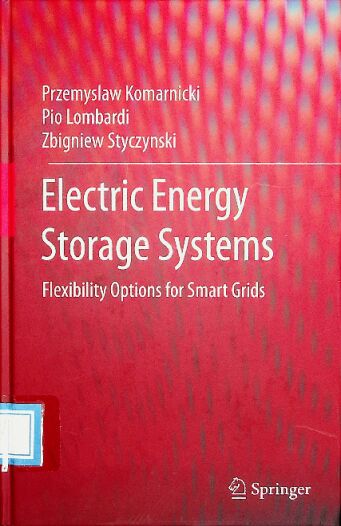
书名:Electric energy storage systems
责任者:Przemyslaw Komarnicki | Pio Lombardi | Zbigniew Styczynski.
前言
Power systems arc among the most complex technical systems built by humans. Hundreds of generators, which arc located at great distances from each other, are working synchronously day and night. They supply hundreds of millions of people with continuous, high-qualily electrical energy. This is the result of more than 140 years of power-system technology development.
Nowadays, power systems are undergoing far-reaching transformations. The imperative to contain the rate of climate change has put into question the generation of power in large coal-burning power plants. Nuclear power plants, although emission-free and efficient, have also lost societal acceptance after the catastro-phes of Chernobyl and Fukushima. Other forms of renewable energy, today mainly from wind and solar generators, are replacing the large “dirty” power plants. This conversion process has been taking place for over 20 years in developed coun-tries and has already resulted in a high share of renewable generation in today's energy mix worldwide. The member states of the European Union and the USA, China, and many other countries are increasing their respective share of clean gen-eration in the overall mix at varying speeds. In the European Union, renewable gen-eration already makes up about 20 % of overall generation and is scheduled to grow to 80 % by 2050. However, in some European countries, e.g., Denmark, Germany and Spain, the power generated by renewable technologies is already at a higher level than the maximal demand. In those countries, hours or days-e.g., sunny and windy Sundays-can be observed where 100 % of the local demand is covered by electric energy produced by renewables. In China, renewables have reached 17 % of the energy mix, and the country became the number one producer of wind energy in 2015.
Renewable generation depends strongly on the weather conditions. Solar gen-eration is possible only during daytime and can fluctuate greatly. Volatility is also a factor in wind-energy generation. The wind does not blow constantly, neither on- nor off-shore. The strict quality requirements concerning the delivery of energy (i.e., voltage and frequency) to customers-especially to modem industrial custom-ers-must be fulfilled despite the challenging conditions. Consequently, there is a strong need to find new or activate known flexibility options in power systems that would enable a smoothing of the fluctuations of RES generation. One of the best natural options to smooth the volatility of renewable generation is buffering the energy production with electric energy storage (EES).
The EES is a well-known technology, which has been used successfully from the beginning of power systems. Generally, the self-stabilizing functionality of large generators resulting from the torque of inertia did not need the smoothing function of EES in the past. Today, and even more so in the future, the use of storage for stabilizing the power system, or for the development of local power systems based on renewable energy sources (RES), will be increasingly necessary.
This book gives new insight into the use of EES in the power systems of today and the future. It concentrates on the systematic description of storage use, taking into account the technical and regulatory requirements. In this book, storage is considered to be an essential part of a power system, which plays various roles, depending on localization or technical and economic conditions. Only an integrated storage consideration will lead to a correct and complete placement of the EES in future power systems.
The book is designed as follows: Chap. 1 gives an overview of the technical and regulatory boundaries of the technological evolution of the power system towards smart grids and demonstrates the obvious need for more flexibility. Chap. 2 sys-tematically describes the general role of EES in power systems. Furthermore, the power system and electric storage devices are represented in one system using a joint formal description. This enables a deeper understanding of the systematic use of storage based on defined business cases. A generic model of EES is also developed in this chapter, and some basic algorithms arc presented to illustrate how planned processes (e.g., computing of optimal storage or storage module uni-fication) can be realized with use of complementary EES. Chap. 2 focuses on the distribution system, where most of the EES are already located to contribute to the local smoothing of RES fluctuations.
Based on those general remarks, the need for storage is discussed extensively in Chaps. 3 and 4. The results of a study undertaken by the CIGRE working group C6.15 (electric energy-storage systems) are the basis for the results presented here. This recent study (completed in 2011) was carried out under the leadership of the authors of this book. Chap. 5 deals with EES technologies. It covers standard solu-tions and trends in storage technologies. The use of battery storage in e-vehicles for power-system issues is a very recent technology which is discussed in detail in Chap. 6. The monetary aspects of storage use are analyzed in Chap. 7. Finally, the influence of storage on power-system reliability is the subject of Chap. 8.
This book is the result of more than 20 years of work by the authors in the research and application of EES. Since their contribution to the DFG German National Program “Information Technologies and Storages in Power Systems” at the beginning of the 1990s, the authors have been involved in numerous other projects and activities, such as:
EU Project “Intclligcnl Computation and Simulation in Planning and Opera-tion of Power Systems Taking into Account Energy Storages” and Smart Grid Platforms
German National Projects addressed to storage—ESPEN and Adele-Ing,
German National Project—Harz.EE-mobility,
Russian National Project—Resolution 220一Project Baikal,
Project of the German Academics of Sciences—“Flexibility options”,
Working groups of the EU, CIGRE and IEEE.
The authors are grateful lo all the members of the research groups of IBN, CIGRE, and EU. In particular, we warn to thank the following people for their intensive cooperation:
IBN : Dipl.-Ing. Klaus Krämcr†, Dr. Hermann Brinkmann†, Dipl.-Ing. Herman Dominik, Dipl.-Ing. Dieter Ausl, Prof. Dr. Jürgen Haubrich and Prof. Dr. Ed Handschicn;
EU and CIGRE : Prof. Dr. Prof. Nikos Hatziargyriou, Dr. Frantiska Adamiak, Prof. Dr. S. Chang, Prof. Dr. P.E. Mercado, Prof. Dr. Joao Pecas Lopes, Dr. Marian Pikutowski, Anthony Price, Prof. Dr. Ravi Seethapathy, Dr. Suresh Verma, Henrik Vikelgaard, Prof. Dr. Nikolai Voropai, Dr. Bartosz Wojszyczyk and other members of the CIGRE WG C6.15;
German Academy of Science project: Prof. Dr. Dirk Sauer, Prof. Dr. Dirk Wes- termann, Prof. Dr, Jutta Hanson and Dr. Marc Richter;
Project Baikal: Prof. Dr. Nikolai I. Voropai, Prof. Dr. Konstantin V. Suslov and M.Sc. Tatiana V. Sokolnikova.
The authors would also like lo thank Dr. Natalia Moskalenko, Dipl.-Ing. Chris-tian Klabunde, Dr. Bartlomiej Arcndarski, Dr. Christoph Wenge, Dr. Juan Alle- many and especially Dr. Bemd Michael Buchholz for the joint research regarding some national projects over the last 2 years, Dr. Andre Naumann and B.Sc. Polina Sokolnikova for organizational support in the preparation of this book and excellent graphical presentation of the manuscript.
Last but not least, the authors express their gratitude to Springer, particularly Eva Hestermann-Beyerle, Senior Editor, for strong support in the preparation of the concept of this book and for the many discussions and fruitful suggestions.
To the Fraunhofer Institute IFF in Magdeburg and Company 50 Hertz Trans- mission GmbH Berlin we express our gratitude for strong technical and financial support.
We wish that readers gain interesting insights into this evolving and important topic, and we welcome feedback about our book.
The book is meant for students in master-level courses, as well as planning engineers who are engaged in the electric-energy storage topic and arc interested in the optimal design of future power systems (smart grids) incorporating EES.
Chaps. 3 and 4 are partially reprinted with permission of CIGRE from ihc report Electric Energy Storage System. Report GIGRE WG C6.15. No 458. © 2011.
查看更多
目录
1 Future Power Systems 1
1.1 Introduction 1
1.2 Towards a Smart Grid 5
1.2.1 More Renewable Generation in the Future 5
1.2.2 The Core Elements of the European Smart-Grid Vision 9
1.2.3 Changes of the Energy Policy in Europe and the Consequences for Smart Grids 13
1.2.4 Power System Operation in the Future. The Need for More Flexibility in the Smart Grid 19
1.3 Regulatory Boundaries for Smart Grid and Electric Energy Storage 26
References 34
2 Electric Energy Storage System 37
2.1 Requirements for an EES System 37
2.1.1 Development of the EES Use in the Power System 37
2.1.2 Requirements for EES and Extension of Storage Usability
in the Smart Grid 43
2.2 Generic Model of EES 48
2.2.1 Standardizing Generic Model of EES 48
2.2.2 Physical Surface of the EES Model. Mathematical Generic
Model 55
2.3 EES in the Transmission and Distribution System 57
2.3.1 Factors Influencing the Value of Storage in Transmission
Networks 57
2.3.2 EES in the Distribution System 58
2.3.3 Example of Modeling and Implementation of the Models
in the Planning and Simulation in Distribution 59
2.3.4 Standardized Models of BES Using the Surface and Interface Structure (SIS) 71
2.4 Storage Systems in Isolated Power Systems 75
2.4.1 Introduction 75
2.4.2 A Case-Based Optimization of Electric Energy Storage
Size in an Isolated Power System 75
2.4.3 Multi-Criteria Optimization of IPS 83
References 94
3 International Development TVends in Power Systems 97
3.1 State of the Art 97
3.2 Smart Grid Concept for the Future Grid 98
3.3 European Scenario 99
3.4 Renewable Energy Development in the Iberian Pensinsula 101
3.5 The Danish Scenario 102
3.6 North American Scenario 102
3.7 South American Scenario 105
3.8 Japanese Scenario 107
3.9 Russian Scenario 109
3.10 Chinese Scenario 110
3.11 Australian Scenario 114
References 117
4 Need for Storage. Practical Examples 119
4.1 Methodology of Investigation 119
4.2 Example: Network-Upgrade Deferral 120
4.3 Technical Aspects. Examples from Japan 122
4.4 Storage for Full RES Integration 124
References 127
5 Storage Technologies and Systems 129
5.1 Overview 129
5.2 Energy-Storage Performance Indicators 132
5.3 Electric-Energy Storage System Classification 133
5.4 Pumped-Hydroelectric Storage 134
5.5 Flywheel-Energy Storage 136
5.6 Battery-Energy Storage Systems 140
5.7 Superconducting Magnetic Energy Storage 146
5.8 Power-to-Gas 148
5.9 Compressed-Air Energy Storage 153
References 155
7 Economics of Electric Energy Storage Systems 181
7.1 Electric-Energy Storage System Applications and Services 181
7.2 Eleclric-Energy Storage Economics 184
7.2.1 Cost Analysis 184
7.2.2 Investment and Operation Costs Analysis of EES 187
References 194
8 Reliability in Smart Grids with Energy Storage Systems 195
8.1 Reliability in Power-Energy Systems 195
8.2 Grid-Reliabilily Calculations 197
8.3 Storage-System Reliability 205
8.3.1 Case Study: Calculation of Storage-System Reliability 205
References 211
查看PDF
查看更多
馆藏单位
中科院文献情报中心