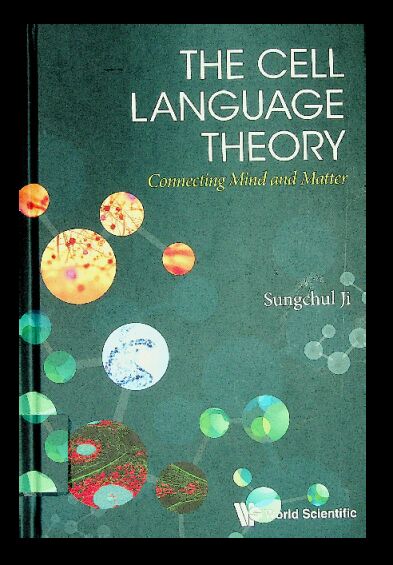
书名:The cell language theory
责任者:Sungchul Ji | Rutgers University | USA.
出版时间:2018
出版社:World Scientific,
分类号:生物科学
页数:xxx, 579 pages :
前言
This book represents the results of 45 years of research on a wide range of topics, including atomic physics, single-molecule enzymology, whole-cell metabolism, physiology, pharmacology, linguistics, semiotics, and cosmology. It describes the first comprehensive molecular theory of the genotype-phenotype coupling based on two key theoretical concepts: (i) the conformon, the conformational wave packet in biopolymers carrying both the free energy and genetic information; and (ii) the intracellular dissipative structures, the chemical concentration waves inside the cell that serve as the immediate drivers of all cell functions. Conformons provide the driving forces for all molecular machines in the cell, and intracellular dissipative structures coordinate intra- and intercellular processes such as gene expression and cell-cell communications.One of the predictions made by the cell language theory (CLT) is that there are two forms of genetic information -- the Watson-Crick genes transmitting information in time (identified with DNA), and the Prigoginian genes transmitting information in space (identified with RNA expression profiles). The former is analogous to sheet music or written language and the latter is akin to audio music or spoken language, both being coupled by conformons acting as the analog of the pianist. The new theory of DNA structure and function constructed on the basis of CLT can rationally account for most of the puzzling findings recently unearthed by the ENCODE (Encyclopedia of DNA Elements) project.The Cell Language Theory has important applications in biomedical sciences including drug discovery research and personalized medicine on the one hand and in the mind-body research and consciousness studies on the other.
查看更多
目录
Preface vii
About the Author xi
Acknowledgments xv
Chapter 1 Introduction 1
1.1 A Chronological List of the Theoretical Concepts Discussed in this Book 1
1.2 Three Stages of Development of Human Knowledge 7
1.3 Gaylord's Distinction Between Physics and Biology 7
Chapter 2 Key Terms and Concepts 11
2.1 What Is a Category? 11
2.1.1 What Is a Functor? 12
2.1.2 The Ur-Category 12
2.2 What Is Information? 15
2.2.1 The General Characteristics of Information 15
2.2.2 Shannon Information (ISh) 16
2.2.3 Planckian Information (IPl) 18
2.2.4 Peircean Information (IPe) in Relation to the Shannon Information (ISh) 19
2.3 Burgin's Parametric Definition of Information 20
2.4 Complementarity vs. Supplementarity 20
2.4.1 The Principle of Generalized Complementarity (PGC) 22
2.4.2 The Complementarian Logic 22
2.5 System vs. Systome 24
2.6 Self-Organization, Dissipative Structures (Dissipations), and Self-Organizing Whenever and Wherever Needed (SOWAWN) Machines 27
2.7 The Generalized Franck–Condon Principle 29
2.8 The Atom–Cell Isomorphism 29
2.9 The Gnergy Principle of Organization (GPO) 33
2.10 The Principle of Irreducible Triadicity 34
2.11 Symmetries and Symmetry Breakings 34
2.12 The Association–Induction Hypothesis 35
2.13 The Fourth-Phase Water 37
2.13.1 The Ling–Pollack Water Structures 39
2.13.2 Coherence Domains and the Benveniste–Montagnier Experiments BMEs 39
2.13.3 Systome Medicine: The Complementary Union of System Medicine and Environmental Medicine 41
2.14 Cell Water as a Four-Dimensional Proton Transfer Network: Water is to Cell Language What Air is to Human Language 43
2.15 The Equilibrium and Dissipative Structures of Water 47
Chapter 3 The Bhopalator 51
3.1 Three Stages of Development in Cell Biology 51
3.2 The Principles and Major Concepts Embedded in the Bhopalator Model of the Living Cell 54
3.2.1 The IDS-Cell Function Identity (ICFI) Hypothesis 56
3.2.2 The Information–Energy Complementarity in the Living Cell 58
3.2.3 Electromechanochemical Energy Transduction 58
3.2.4 The Wave–Particle Duality in the Living Cell 67
3.2.5 Three Categories of Enzyme Catalyzes 68
3.2.6 The GFCP, Pre-fit Mechanisms, and Scalar Enzyme Catalysis 70
3.2.7 The GFCP and Translational Enzyme Catalysis 71
3.2.8 The GFCP and Rotary Enzyme Catalysis 75
3.2.9 The Pre-fit Hypothesis 79
3.2.10 Allosterism, Bohr Effect, and Wyman's Pseudolinkage 83
3.2.11 The Brownian Distance of Biopolymers 92
3.2.12 The Principle of Microscopic Reversibility 92
3.2.13 The Information–Energy Complementary Landscape Theory of Protein Folding 94
3.2.14 Three Classes of Molecular Structures in the Living Cell 97
3.2.15 Five Classes of Factors Affecting the Behavior of the Living Cell 99
3.2.16 An Atom–Cell Comparison Based on Aristotle's Four Causes Doctrine 101
3.2.17 The Cell Force: A Comparison with the Gravitational Force 102
3.2.18 The Cell as the Atom of Semiosis 103
3.2.19 The Triadic Structures of the Living Cell 104
3.2.20 The Piscatawaytor: A Model of the Human Body Viewed as a Self-Organizing System of Bhopalators 105
3.2.21 The Human Body–Internet Metaphor (HIM) 107
3.3 The Mitochondrion — The Energy Source of the Living Cell 111
3.3.1 The Conformon Model of Oxidative Phosphorylation: Kinematic vs. Dynamic Aspects 115
3.3.2 Conformon Production, Transfer, and Utilization 119
3.3.3 Deconstructing the Chemiosmotic Model 122
3.3.4 A Comparison Between the Chemiosmotic and Conformon Models of Oxidative Phosphorylation 126
3.3.5 The Rochester–Noji–Helsinki (RoNoH) Model of Oxidative Phosphorylation 131
3.3.6 Mitchel vs. Williams Protons 136
3.3.7 Active vs. Passive Conformational Changes of Biopolymers 139
3.3.8 Active vs. Passive ATP Syntheses 140
3.3.9 Cytochrome c Oxidase an Electron- Driven Proton Sink and Pump 141
3.3.10 Proton-Transfer Chains/Complexes as the Fourth-Phase Water Structures of Ling and Pollack 149
3.4 The Conformon 150
3.4.1 Direct Experimental Evidence for Conformons or Conformational Waves 151
3.4.2 DNA Supercoils, the White Formula, and Conformons 151
3.4.3 Stress-Induced Duplex Destabilizations as Conformons 157
3.4.4 Virtual and Real Conformons: Mechanisms of Conformon Generation Based on the GFCP 158
3.4.5 The Quantization of Conformational Energies of Biopolymers 159
3.4.6 The Conformon Hypothesis of Energy- Coupled Processes in the Living Cell 160
3.4.7 The Conformon Model of Mechanical Force Generation from Chemical Reactions 162
3.4.8 The Conformon Model of Muscle Contraction 164
Chapter 4 Cell Language 173
4.1 Communication and Languages 173
4.1.1 Macro-, Micro-, and Holo-Communications 174
4.1.2 The Universality of Double Articulations 177
4.1.3 Cell Language (Cellese) Defined 179
4.2 Some Linguistic Terms for Non-linguists 180
4.2.1 Double Articulation Extended to Triple Articulation 180
4.2.2 Rule-Governed Creativity 181
4.2.3 Syntagmatic Relation 182
4.2.4 Paradigmatic Relation 182
4.2.5 Arbitrariness of Signs 182
4.3 Application of the Information Theory to Signal Transduction in Living Cells 183
4.4 Isomorphism Between Cell and Human Languages 185
4.5 Isomorphism Between the Immune System and Human Language 188
4.6 Triple Articulation in Cell Language 189
4.7 Decoding DNA Based on the Semiotic Lessons Learned from Decoding the Rosetta Stone 190
4.7.1 Rule-Governed Creativity 198
4.7.2 Double Articulation also called Duality 198
4.7.3 Maximum Information Principle 199
4.7.4 Discreteness 199
4.7.5 Semanticity 199
4.8 The Biology–Linguistics Connection 199
4.9 The Origin of Biological Information 202
4.10 The von Neumann Questions and the Conformon Theory 209
4.11 Water as the Medium of the Cell (Cellese) and Cosmic Languages (Cosmese) 212
4.12 Cymatics and Chladni Patterns (or Figures) 215
4.13 Water as the Molecular Sensor of Sound Waves 216
4.14 Sonocytology or “Cytocymatics” 219
4.15 Water Standing Waves (Aquaresonances) as the Possible Cause of the Origin of Life 221
4.16 Decoding CymaGlyphs May Be Akin to Decoding Hieroglyphs 221
4.17 The Water Thesis: Water Can Represent, Compute, and Communicate 222
4.18 Cosmic Language (Cosmese) as the Irreducible Triad of Wave Language (CymaGlyphs), Cell Language (e.g., RNA glyphs), and Human Language (e.g., Hieroglyphs) 225
4.19 CymaScope as an Experimental Tool for Connecting Mind and Matter 227
4.20 Life Supervenes on Water 227
4.21 The Dissipative-to-Equilibrium Reversibility(DER) Postulate of Aquastructures 231
4.22 Exosomes as Extracellular Text Messages That May Be Deciphered by Digital CymaScopy 234
Chapter 5 Matrix Mathematics of Genetics 239
5.1 The Petoukhov Coincidence 239
5.2 The Mathematical Similarity between the Genetic Code and the I-Ching Hexagrammatology 244
5.3 The Molecular Language (Moleculese) 248
Chapter 6 Biosemiotics 255
6.1 Concepts, Laws, and Principles 255
6.1.1 Molecular Machine 257
6.1.2 Dissipative Structures 257
6.1.3 Intracellular Dissipative Structures 257
6.1.4 The Law of Requisite Variety 258
6.1.5 Cell Language Theory 259
6.1.6 Biocybernetic Models of Living Systems and Processes: “Atorology” 259
6.2 A Comparison between Physics, Biology, and Philosophy 260
6.3 The Peircean Theory of Signs 261
6.3.1 Peircean Definition of Signs 261
6.3.2 Peircean Categories: Firstness, Secondness, and Thirdness 264
6.4 Macrosemiotics vs. Microsemiotics 264
6.5 Peircean Signs as Gnergons 266
6.6 The Quark Model of the Peircean Sign [279] 269
6.6.1 The Nine Types of Signs 270
6.6.2 The 10 Classes of Signs 272
6.6.3 Derivation of the 10 Classes of Signs from Nine Types of Signs Based on the Analogy between e-Signs and Quarks in Elementary Particle Physics 274
6.6.4 Derivation of “Nilsign” and Its Associated Category Called “Zeroness” Based on the Quark Model of the Peircean Sign 276
6.6.5 The Neo-Semiotics and the Possible Meaning of Zeroness 278
6.7 Application of the Concept of Signs to Molecular Biology: Microsemiotics 282
6.8 Real vs. Virtual Semiosis 283
6.9 Division of Sign Processes Based on the Nature and Size of Sign Processors 284
6.10 Peirce's Metaphysics as the Basis for Unifying Sciences 286
Chapter 7 Applications of the Cell Language Theory to Biomedical Sciences 289
7.1 The Need for a New Paradigm in Biomedical Sciences 290
7.1.1 The Inefficiency of the Current Methods of Drug Development 291
7.1.2 Precision Medicine 291
7.2 Ribonoscopy 293
7.2.1 DNA Microarrays 293
7.2.2 The Microarray Data Interpretation Problem 296
7.2.3 Ribonoscopy is to Cell Biology What Spectroscopy is to Atomic Physics 301
7.3 Analysis of Human Breast Cancer Microarray Data 305
7.3.1 The Mechanism Circle-Based Analysis 306
7.3.2 PDE-Based Method for Identifying Patient-Specific Breast Cancer Genes 315
7.3.3 Can PDE Be to Cell Biology What PRE is to Atomic Physics? 326
7.3.4 The PDE-Based Approach to Discovering Dissipative Structure (or Dissipaton)- Targeting Drugs 328
7.3.5 Conserved Transcriptional Response to Cancer (CTRC): The First Law of Transcriptomics 330
Chapter 8 The Universality of the Planckian Distribution Equation 333
8.1 Blackbody Radiation and the Planckian Distribution Equation 333
8.2 Single-Molecule Enzyme Catalysis 336
8.2.1 Observation and Data 336
8.2.2 Explanation: Quantization of Energy Levels in Enzymes 338
8.2.3 RASER Model of Enzyme Catalysis 339
8.3 Examples of Long-Tailed Histograms Fitting PDE 341
8.3.1 Atomic Physics (Figure 8.6(a)) 347
8.3.2 Protein Folding (Figure 8.6(b)) 347
8.3.3 Single-Molecule Enzyme Kinetics of Cholesterol Oxidase (Figure 8.6(c)) 349
8.3.4 mRNA Levels in Budding Yeast (Figure 8.6(d)) 349
8.3.5 RNA Levels in Human Breast Tissues (Figure 8.6(e)) 350
8.3.6 Human T-cell Receptor Variable Region Sequence Diversity (Figure 8.6(f)) 350
8.3.7 7-Mer Frequency Distribution in P. abyssi (Figure 8.6(g)) 351
8.3.8 Codon Usage Profile in the Human Genome (Figure 8.6(h)) 352
8.3.9 Protein-Length Frequency Distribution in H. influenza (Figure 8.6(i)) 352
8.3.10 Stress-Induced Alterations in the Neuroarchitecture of the Mouse Brain (Figure 8.6(j)) 353
8.3.11 Impulse-Induced Electrocorticogram (ECoG) Response of the Rabbit Olfactory System (Figure 8.6(k)) 353
8.3.12 fMRI Signals from the Human Brain before and after Psilocybin (Figure 8.6(l)) 354
8.3.13 Sentence-Length Frequency Distributions in Private Letters (Figure 8.6(m)) 354
8.3.14 Word-Length Frequency Distributions in English Text (Figure 8.6(n)) 355
8.3.15 Word-Length Frequency Distribution in Kerry's Speech (Figure 8.6(o)) 355
8.3.16 The Pitch Histogram of Sylvia Plath's Reading of Her Poem (Figure 8.6(p)) 355
8.3.17 Decision-Time Histograms (Figure 8.6(q)) 356
8.3.18 The 1996 and 2013 US Annual Income Distributions (Figures 8.6(r) and 8.6(s)) 358
8.3.19 Polarized Cosmological Microwave Background (CMB) Radiation (Figure 8.6(t)) 359
8.4 The Universality of the PDE 359
8.4.1 Planckian Processes as Selected Gaussian Processes 360
8.4.2 The Wave–Particle Duality in Biology and Medicine 361
8.5 The Planckian Information (IP) as a New Measure of Organization 361
8.5.1 The Definition of Planckian Information, IP 362
8.5.2 The First Law of Informatics: Information Can but Entropy Cannot Be Negative 363
8.5.3 The Brain Is both Entropic and Informational 366
8.6 Possible Relations among Planckian Information, Quanta, and Entropy 368
8.7 PDE-based CymaScopy (PCS) as a Novel Experimental Tool for Infostatistical Mechanics 371
Chapter 9 The Universality of the Irreducible Triadic Relation 377
9.1 The Peircean Sign as the Origin of the Irreducible Triadic Relation 377
9.2 Peirce's Simple Concepts Applicable to Every Subject 379
9.3 ITR in Peirce's Hypostatic Abstraction 383
9.4 Examples of ITRs 384
9.4.1 The Golden Ratio 384
9.4.2 The Fibonacci Numbers 386
9.4.3 Belousov–Zhabotinsky (BZ) Reaction (or the Brusselator) 389
9.4.4 Enzyme Catalysis 390
9.4.5 Gene Expression 391
9.4.6 Practopoiesis 391
9.4.7 ITR in Mathematics, Philosophy, Semiotics, and Religions 391
Chapter 10 The Philosophical Implications of the Cell Language Theory 395
10.1 Complementarism 395
10.1.1 Complementarity Between Complementarism and Merleau-Ponty's Flesh Ontology 396
10.1.2 Naturalized Phenomenology 397
10.2 Complementarism and Semiotics 398
10.3 Signs, Thoughts, and “Thoughtons” 401
10.4 The “New Jersey Theory of Mind” (NJTM) 404
10.5 A Theory of Consciousness 408
10.6 The Triadic Architectonics of Human Knowledge 410
10.7 On the Possible Relation Between Quantum Mechanics and Semiotics 411
10.8 The Hertz–Rosen–Pattee (HRP) Model of Reality 416
10.9 The Signless and the Dao as the Source of Everything Including Signs 418
10.10 Cybersemiotics 421
10.11 Practopoiesis 425
10.12 A Theory of the Origin of Information Based on Peircean Metaphysics 429
10.13 Information–Entropy Relation 432
10.14 A “Philosophical Table” for Classifying Information, Entropy, and Energy 434
10.15 The Information–Energy–Entropy Relation: The “NewJerseyator” 437
10.16 The First Law of Informatics: Information Can but Entropy Cannot Be Negative 440
10.17 Semiotics and Information Theory 441
10.18 The Model of the Universe 443
10.18.1 The Shillongator Model of the Universe 444
10.18.2 Semiotics of the Universe 449
10.18.3 Iconic Model of Reality 454
10.18.4 The Self-Knowing Universe and the Anthropic Cosmological Principle 457
10.19 The Universe as a Self-Organizing Musical Instrument (USOMI) 460
10.20 Semiotics as the Theory of Everything (TOE) 463
10.21 Triadic Monism 469
10.22 A Model of Consciousness 475
Chapter 11 Conclusions 481
References 487
Appendix I 523
Appendix II 553
Index 559
查看PDF
查看更多
馆藏单位
中科院文献情报中心