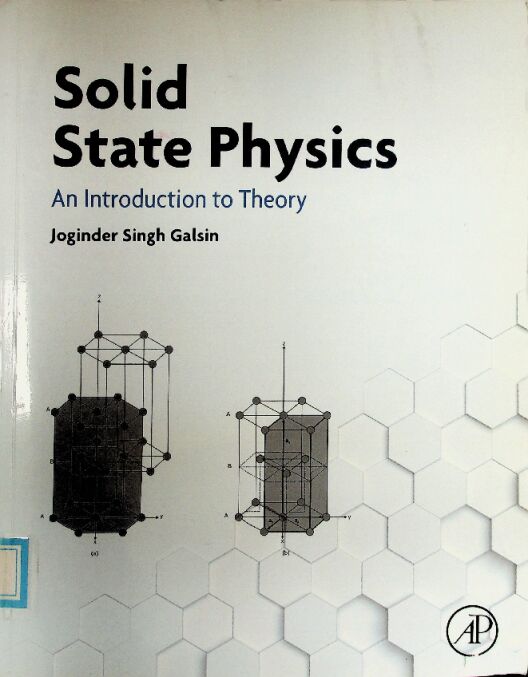
书名:Solid state physics
责任者:Joginder Singh Galsin | Department of Mathematics | Statistics and Physics | Punjab Agricultural University | Ludhiana | India.
ISBN\ISSN:9780128171035,0128171030
出版时间:2019
出版社:Academic Press, an imprint of Elsevier,
分类号:物理学
页数:xvi, 640 pages :
前言
For the past three decades, many scientists have been jumping onto the bandwagon of applied science, thereby hampering lhe development of basic science. If this emerging trend is permitted to persist over a long period of time, research in applied science will find itself at a crossroad. Recent years have been characterized by debates at the international level over attracting intelligent people to the basic sciences. During my entire professional career, which spans more than 40years in the field of theoretical solid state physics, I have found that textbooks on solid state physics greatly outnumber books on theoretical solid state physics. This unfortunate trend motivated me to write an elementary textbook on lheoreiical solid stale physics. A major portion of this book has been derived from lectures I delivered on solid state physics at various Indian universities over a period of three decades. I began writing this book in 2000 and it took me almost 17 years of concentrated effort to accomplish a task of such magnitude. Needless to say, the collection of material commenced much earlier.
Solid stale physics is such a diverse field that it cannot be covered in a single book. Further, the theory of solids is progressing al a very fast pace and is reaching an increased level of sophistication, greatly complicating the task of providing up-to-date knowledge of the whole subject. Therefore, I have tried to concentrate on the fundamentals of the theoretical aspects of those topics that are required in a first course for undergraduate students of physics, chemistry, mate�rials science, and engineering at various universities across the globe. There are two approaches involved in the devel�opment of a book on solid state physics. First is the phenomenological approach, which includes hypotheses and models that are important in the development of the subject. Second is the fundamental approach, based on quantum mechanics and statistical mechanics, which provides greater insight into the actual processes responsible for the various properties of solids. I have tried to present a unified quantum mechanical treatment for the different properties of solids, touching upon phenomenological models wherever necessary. Some of the salient features of the book are discussed later.
For the study of the various properties of solids, a general formalism for the fundamentals has been derived wherever possible. Detailed mathematical steps are presented to make it comprehensible even to students with a minimal mathe�matical background. The results for simple structures in one-, two-, and three-dimensional solids are derived for particular cases. All of the chapters of the book are coherently interrelated. Elementary courses in quantum mechanics and statistical mechanics may be considered prerequisites for understanding the subject matter.
Dirac's notation has been used, which highlights the physics contained in the mathematics in a befitting and compact manner.
More than 400 diagrams and geometrical constructions of the elementary processes present in solids have been used to enable studenis to easily comprehend the subject matter.
A considerable number of problems have been inserted at appropriate places in all the chapters with the aim of providing deeper insight into the subject. Throughout the text, bold letters represent vector quantities. Greek letters with arrows also represent vector quantities.
The book contains an elementary account of some recent topics, such as the quantum Hall effect, high-Tc supercon�ductivity, and nanomaterials. The topics of elasticity in solids, dislocations, polymers, point defects, and nanomaterials are of special interest for engineering students. The inclusion of abstract methods of quantum field theory, though important in many-body problems, have been deliberately avoided as they may not be very relevant to the diverse student commu�nities for whom this book was written.
At the end of the book, some elementary textbooks on solid state physics are listed for supplementary reading. Advanced books on the topics covered in the present text are also included in the list, which may be helpful to advanced learners in carrying out further work.
I am indebted to Professor K.N. Pathak, former Vice Chancellor of Panjab University, Chandigarh, for fostering and nurtLiring my interest in the subject of solid stale physics while I was a student. I am thankful to my daughters Amardeep Gaisin, Manveen Gaisin, my son-in-law Dr. Nirjhar Hore, and my son Damanjit Singh Gaisin, who have been a constant source of encouragement and support for me during the completion of this work. I am very grateful to my wife. Professor Surinder Kaur, for encouraging me to liberally devote time to the writing of this book and also for editing the technical aspects of the English language. I am grateful to Mr. Rakesh Kumar (Somalya Printers, Ludhiana) for undertaking the artwork for this book so diligently and efficiently. I am also thankful to all my loved ones, colleagues, and well-wishers especially Dr. Jagtar Singh Dhiman. Dr. Nathi Singh and Dr. Paramjit Singh, who silently urged me to move on toward the successful completion of this momentous project. Last but not least, my journey with the Elsevier team, from the submission of the manuscript to the finished product, has been very pleasant. The book has not been read by any subject expert, therefore, any omission or error is my sole responsibility. I would welcome and appreciate comments/suggestions/ feedback for the improvement of the book in the near future. A big thanks to Lord Almighty-our creator.
查看更多
目录
About the Author xiii
Preface xv
1. Crystal Structure of Solids
1.1. Close Packing of Atoms in Solids 1
1.2. Crystal Lattice and Basis 3
1.3. Periodicities in Crystalline Solids 5
1.3.1. Structural Periodicity 6
1.3.2 Rotational Symmetry 10
1.4. One-Dimensional Crystals 13
1.5. Two-Dimensional Crystals 14
1.6. Three-Dimensional Crystals 14
1.7. Simple Crystal Structures 17
1.7.1. Simple Cubic Structure 17
1.7.2. Body-Centered Cubic Structure 18
1.7.3. Face-Centered Cubic Structure 20
1.7.4. Hexagonal Structure 22
1.7.5. Hexagonal Close-packed Structure 24
1.8. Miller Indices 25
1.9. Other Structures 30
1.9.1. Zinc Sulfide Structure 30
1.9.2. Diamond Structure 31
1.9.3. Wurtzite Structure 31
1.9.4. Perovskite Structure 31
1.9.5. High-T_c Superconductors 33
1.10. Quasicrystals 33
Suggested Reading 36
2. Crystal Structure in Reciprocal Space
2.1. X-Ray Diffraction 37
2.1.1. Bragg's Law of X-Ray Diffraction 38
2.2. Electron Diffraction 38
2.3. Neutron Diffraction 39
2.4. Laue Scattering Theory 40
2.5. Reciprocal Lattice 42
2.5.1. Periodicity of Electron Density 43
2.5.2. Periodicity of Atomic Density 44
2.6. Primitive Cell in Reciprocal Space 46
2.6.1. Linear Monatomic Lattice 46
2.6.2. Square Lattice 47
2.6.3. sc Lattice 47
2.6.4. fcc Crystal Structure 50
2.6.5. Hexagonal Crystal Structure 51
2.7. Importance of Reciprocal Space and BZs 54
2.7.1. Bragg Reflection 54
2.7.2. Significant Wave Vectors 56
2.7.3. Construction of Reciprocal Lattice 57
2.8. Atomic Scattering Factor 57
2.9. Geometrical Structure Factor 58
2.9.1. sc Crystal Structure 58
2.9.2. fcc Crystal Structure 59
2.9.3. bcc Crystal Structure 59
References 60
Suggested Reading 60
3. Approximations in the Study of Solids
3.1. Separation of Ion-Core and Valence Electrons 61
3.2. Rigid Ion-Core Approximation 61
3.3. Self-Consistent Potential Approximation 62
3.4. The Born-Oppenheimer Approximation 62
3.5. One-Electron Approximation 63
3.6. Electron Exchange and Correlation Interactions 64
3.6.1. Electron Exchange Interactions 64
3.6.2. Electron Correlation Interactions 66
References 67
Suggested Reading 67
4. Bonding in Solids
4.1. Interactions Between Atoms 69
4.2. Cohesive Energy 73
4.3. Equilibrium Distance 73
4.4. Bulk Modulus and Compressibility 74
4.5. Inert Gas Crystals 75
4.5.1. Equilibrium Lattice Constant 76
4.5.2. Cohesive Energy of Inert Gas Crystals 77
4.5.3. Bulk Modulus 77
4.6. Ionic Bonding 78
4.6.1. Ionic-Bond Energy 78
4.6.2. Lattice Energy 79
4.6.3. Difference Between Bond Energy, Cohesive Energy, and Lattice Energy 80
4.6.4. Bulk Modulus of Ionic Crystals 80
4.6.5. Exponential Repulsive Potential 82
4.6.6. Calculation of the Madelung Constant 83
4.7. Covalent Bond 84
4.8. Mixed Bond 86
4.9. Metallic Bond 88
4.10. Hydrogen Bond 90
Suggested Reading 91
5. Elastic Properties of Solids
5.1. Strain Tensor 93
5.2. Dilation 95
5.3. Stress Tensor 96
5.4. Elastic Constants of Solids 96
5.5. Elastic Energy Density 97
5.6. Elastic Constants in Cubic Solids 98
5.7. Elastic Energy Density in Cubic Solids 102
5.8. Bulk Modulus in Cubic Solids 102
5.9. Elastic Waves in Cubic Solids 103
5.9.1. Elastic Waves in the [100] Direction 105
5.9.2. Elastic Waves in the [110] Direction 106
5.9.3. Elastic Waves in the [111] Direction 108
5.10. Isotropic Elasticity 110
5.11. Experimental Measurement of Elastic Constants 111
Suggested Reading 113
6. Lattice Vibrations-1
6.1. Vibrations in a Homogeneous Elastic Medium 115
6.2. Interatomic Potential in Solids 117
6.2.1. Square-Well Potential 119
6.2.2. Harmonic Interaction Potential 120
6.3. Lattice Vibrations in a Discrete One-Dimensional Lattice 121
6.3.1. Monatomic Linear Lattice 121
6.3.2. Diatomic Linear Lattice 124
6.4. Excitation of Ionic Lattice in Infrared Region 130
7. Lattice Vibrations-2
7.1. Equation of Motion of the Lattice 133
7.1.1. Restrictions on Atomic Force Constants 135
7.2. Normal Coordinate Transformation 136
7.3. Properties of Dynamical Matrix and Eigenvectors 137
7.4. Quantization of Lattice Hamiltonian 140
7.5. Simple Applications 141
7.5.1. Linear Monatomic Lattice 141
7.5.2. Linear Diatomic Lattice 142
7.5.3. Simple Cubic Lattice 144
7.6. Experimental Determination of Phonon Frequencies 146
7.6.1. Neutron Diffraction Technique 146
References 148
Suggested Reading 148
Further Reading 148
8. Specific Heat of Solids
8.1. Experimental Facts 150
8.2. Thermodynamical Definition 150
8.3. Phase Space 151
8.4. Classical Theories of Lattice Specific Heat 152
8.4.1. Free Atom Model 153
8.4.2. Fixed Classical Harmonic Oscillator Model 156
8.5. Quantum Mechanical Theories 158
8.5.1. Einstein Theory of Specific Heat 158
8.5.2. Debye Theory of Specific Heat 160
8.6. Effect of Electrons on Specific Heat 167
8.7. Ideal Phonon Gas 167
8.8. Interacting Phonon Gas 168
8.9. Thermal Expansion of Solids 169
8.10. Thermal Conductivity of Solids 171
8.10.1. Thermal Conductivity for an Ideal Gas of Atoms 172
8.10.2. Thermal Conductivity in Insulators and Dielectrics 173
8.10.3. Thermal Conductivity of Metals 174
Further Reading 176
9. Free-Electron Theory of Metals
9.1. Free-Electron Approximation 177
9.2. Three-Dimensional Free-Electron Gas 177
9.3. Two-Dimensional Free-Electron Gas 182
9.4. Cohesive Energy and Interatomic Spacing of Ideal Metal 184
9.5. The Fermi-Dirac Distribution Function 186
9.6. Specific Heat of Electron Gas 187
9.6.1. One-Dimensional Free-Electron Gas 188
9.6.2. Two-Dimensional Free-Electron Gas 189
9.6.3. Three-Dimensional Free-Electron Gas 190
9.7. Paramagnetic Susceptibility of Free-Electron Gas 192
9.7.1. One-Dimensional Free-Electron Gas 195
9.7.2. Two-Dimensional Free-Electron Gas 195
9.7.3. Three-Dimensional Free-Electron Gas 196
9.8. Classical Spin Susceptibility 197
Reference 197
Suggested Reading 198
10. Electrons in Electric and Magnetic Fields
10.1. Equation of Motion 199
10.2. Free Electrons in a Static Electric Field 200
10.3. Free Electrons in a Static Magnetic Field 201
10.4. Electrons in Static Electric and Magnetic Fields 202
10.5. The Hall Effect in Metals 204
10.6. Free Electrons in an Alternating Electric Field 206
10.7. Quantum Mechanical Theory of Electrons in Static Electric and Magnetic Fields 208
10.8. Quantum Hall Effect 212
10.8.1. Two-Dimensional Electron System 213
10.8.2. Classical Theory of Conductivity in a Magnetic Field 214
10.8.3. Quantum Theory of a 2D Free-Electron Gas in a Magnetic Field 215
10.8.4. Experimental Setup for QHE 217
10.8.5. Integral Quantum Hall Effect 219
10.8.6. Fractional Quantum Hall Effect 220
10.9. Wiedemann-Franz-Lorentz Law 220
References 221
Suggested Reading 221
11. Transport Phenomena
11.1. Velocity Distribution Function 223
11.2. Electric Current and Electrical Conductivity 223
11.2.1. Electrostatic Interactions 224
11.2.2. Collision Interactions 224
11.3. Heat Current and Thermal Conductivity 225
11.4. The Boltzmann Transport Equation 225
11.4.1. Classical Formulation 225
11.4.2. Quantum Formulation 227
11.5. Linearization of Boltzmann Equation 227
11.6. Electrical Conductivity 228
11.6.1. Classical Theory 230
11.6.2. Quantum Theory 231
11.7. Thermal Conductivity 232
11.7.1. Classical Theory 232
11.7.2. Quantum Theory 234
11.8. Hall Effect 237
11.9. Mobility of Charge Carriers in Solids 239
Suggested Reading 242
12. Energy Bands in Crystalline Solids
12.1. Bloch Theorem 243
12.1.1. One-Dimensional Solid 243
12.1.2. Three-dimensional Solid 245
12.2. The Kronig-Penney Model 247
12.3. Nearly Free-Electron Theory 251
12.3.1. Application to One-Dimensional Solid 255
12.4. Different Energy Zone Schemes 257
12.4.1. Extended Zone Scheme 257
12.4.2. Periodic Zone Scheme 257
12.4.3. Reduced Zone Scheme 258
12.5. Tight-Binding Theory 259
12.5.1. Linear Monatomic Lattice 263
12.5.2. Two-Dimensional Square Lattice 264
12.5.3. Three-Dimensional sc Lattice 266
12.6. Orthogonalized Plane Wave (OPW) Method 268
12.7. Augmented Plane Wave (APW) Method 270
12.8. Dynamics of Electrons in Energy Bands 272
12.8.1. Behavior of Electrons in Free-Electron Theory 274
12.8.2. Behavior of Electrons in Tight-Binding Approximation 274
12.9. Distinction Between Metals, Insulators, and Semiconductors 275
References 278
Suggested Reading 278
13. The Fermi Surfaces
13.1. Constant Energy Surfaces 279
13.2. The Fermi Surfaces 279
13.3. The Fermi Surface in the Free-Electron Approximation 279
13.3.1. Type I Fermi Surface 280
13.3.2. Type II Fermi Surface 281
13.3.3. Type III Fermi Surface 282
13.4. Harrisons Construction of the Fermi Surface 283
13.5. Nearly Free-Electron Approximation 285
13.6. The Actual Fermi Surfaces 287
13.6.1. Monovalent Metals 287
13.6.2. Polyvalent Metals 291
13.7. Experimental Methods in Fermi Surface Studies 293
13.7.1. de Haas-van Alphen Effect 293
13.7.2. Cyclotron Resonance 296
References 298
Suggested Reading 298
Further Reading 298
14. Semiconductors
14.1. Intrinsic Semiconductors 299
14.2. Extrinsic Semiconductors 301
14.2.1. n-Type Semiconductors 302
14.2.2. p-Type Semiconductors 302
14.3. Ionization Energy of Impurity 303
14.4. Carrier Mobility 304
14.5. Theory of Intrinsic Semiconductors 306
14.5.1. Concentration of Charge Carriers 306
14.6. Model for Extrinsic Semiconductors 309
14.6.1. n-Type Semiconductors 309
14.6.2. p-Type Semiconductors 310
14.7. Effect of Temperature on Carrier Density 311
14.8. Temperature Dependence of Mobility 312
14.9. The Hall Effect 313
14.10. Electrical Conductivity in Semiconductors 317
14.10.1. Intrinsic Semiconductors 317
14.10.2. Extrinsic Semiconductors 317
14.11. Nondegenerate Semiconductors 318
14.12. Degenerate Semiconductors 318
14.13. Compensated Semiconductors 319
Suggested Reading 319
15. Dielectric Properties of Nonconducting Solids
15.1. Nonpolar Solids 321
15.2. Polar Solids 321
15.3. Electric Dipole Moment 322
15.4. Macroscopic Electric Field 323
15.5. Potential due to an Electric Dipole 324
15.6. Depolarization Field due to Cuboid 324
15.7. Polarization 325
15.8. Dielectric Matrix 326
15.9. Experimental Measurement of Dielectric Constant 327
15.10. Local Electric Field at an Atom 328
15.11. Polarizability 330
15.12. Polarization 330
15.13. Types of Polarizabilities 331
15.14. Variation of Polarizability With Frequency 332
15.15. Orientational Polarizability 333
15.16. Classical Theory of Electronic Polarizability 335
Suggested Reading 337
16. Ferroelectric Solids
16.1. Classification of Ferroelectric Solids 340
16.1.1. Tartrate Group 340
16.1.2. Dihydrophosphates and Arsenates 342
16.1.3. Perovskite Structure 342
16.2. Theories of Ferroelectricity 343
16.2.1. Atomic Models 343
16.3. Thermodynamics of Ferroelectric Solids 348
16.3.1. Second-Order Transition in Ferroelectric Solids 349
16.3.2. First-Order Transition in Ferroelectric Solids 351
16.4. Ferroelectric Domains 353
Suggested Reading 354
17. Optical Properties of Solids
17.1. Plane Waves in a Nonconducting Medium 355
17.2. Reflection and Refraction at a Plane Interface 357
17.2.1. Kinematic Properties 357
17.2.2. Dynamic Properties 359
17.3. Electromagnetic Waves in a Conducting Medium 362
17.4. Reflectivity From Metallic Solids 365
17.5. Reflectivity and Conductivity 366
17.6. Kramers-Kronig Relations 367
17.7. Optical Models 368
17.7.1. Drude Model 369
17.7.2. Lorentz Model for Insulators 375
17.8. Lyddane-Sachs-Teller Relation 378
Suggested Reading 381
18. Magnetism
18.1. Atomic Magnetic Dipole Moment 383
18.1.1. Orbital Magnetic Moment 384
18.1.2. Spin Magnetic Moment 385
18.1.3. Nuclear Magnetic Moment 387
18.2. Magnetization 387
18.3. Magnetic Induction 387
18.4. Potential Energy of Magnetic Dipole Moment 387
18.5. Larmor Precession 388
18.6. Quantum Theory of Diamagnetism 389
18.7. Paramagnetism 392
18.7.1. Classical Theory of Paramagnetism 395
18.7.2. Quantum Theory of Paramagnetism 395
18.8. Hund's Rule 397
18.8.1. Applications of Hunds Rule 401
18.9. Crystal Field Splitting 401
18.9.1. Quenching of Orbital Angular Momentum 404
Suggested Reading 405
19. Ferromagnetism
19.1. Weiss Molecular Field Theory 407
19.2. Classical Theory of Ferromagnetism 408
19.3. Quantum Theory of Ferromagnetism 410
19.4. Comparison of Weiss Theory With Experiment 412
19.5. Heisenberg Theory of Ferromagnetism 414
19.6. Spin Waves 419
19.6.1. Bloch Theory of Spin Waves 420
19.6.2. Magnons in Monatomic Linear Lattice 423
19.6.3. Magnons in Square Lattice 423
19.6.4. Magnons in sc Lattice 424
19.7. Quantization of Spin Waves 425
19.8. Thermal Excitation of Magnons 428
19.9. Hysteresis Curve 429
Suggested Reading 430
20. Antiferromagnetism and Ferrimagnetism
20.1. Antiferromagnetism 431
20.1.1. Two-Sublattice Model 431
20.1.2. Spin Waves in Antiferromagnetism 437
20.2. Ferrimagnetism 441
20.2.1. Structure of Ferrites 441
20.2.2. Two-Sublattice Model 442
Reference 443
Suggested Reading 443
21. Magnetic Resonance
21.1. Nuclear Magnetic Moment 445
21.2. Zeeman Effect 446
21.3. Relaxation Phenomena 448
21.3.1. Spin-Lattice Relaxation 448
21.3.2. Spin-Spin Relaxation 450
21.4. Equation of Motion 450
21.5. Magnetic Resonance in the Absence of Relaxation Phenomena 452
21.6. Bloch Equations 454
21.6.1. Free Precession in Static Magnetic Field 455
21.7. Magnetic Broadening of Resonance Lines 457
21.8. Effect of Molecular Motion on Resonance 457
21.9. Electron Spin Resonance 458
21.10. Hyperfine Interactions 459
21.11. Knight Shift 460
21.12. Quadrupole Interactions in Magnetic Resonance 461
21.12.1. Nuclear Quadrupole Resonance 462
21.13. Ferromagnetic Resonance 464
21.14. Spin Wave Resonance 464
21.15. Antiferromagnetic Resonance 464
Reference 464
Suggested Reading 464
22. Superconductivity
22.1. Experimental Survey 465
22.1.1. Electrical Properties 465
22.1.2. Magnetic Properties 466
22.1.3. Thermal Properties 466
22.1.4. Isotopic Effect 469
22.2. Occurrence of Superconductivity 470
22.3. Theoretical Aspects of Superconductivity 471
22.3.1. Failure of Ohm's Law in Superconductors 471
22.3.2. London Theory 472
22.3.3. Penetration Depth 475
22.3.4. Coherence Length 476
22.3.5. Destruction of Superconductivity by Magnetic Field 477
22.3.6. Stabilization Energy 478
22.3.7. Classification of Superconductors 480
22.3.8. Persistent Currents 481
22.3.9. Thermodynamics of Superconductors 483
22.3.10. Bardeen-Cooper-Schrieffer (BCS) Theory 488
22.3.11. Criterion for the Existence of Superconductivity 494
22.3.12. Why Do Magnetic Impurities Lower T_c? 494
22.4. Superconducting Quantum Tunneling 494
22.4.1. Single-Electron Superconducting Tunneling 494
22.4.2. Josephson Tunneling 502
22.5. High-Tc Superconductivity 506
22.5.1. Chevrel Phases and Superconductivity 506
22.5.2. Perovskite Superconductivity 507
22.5.3. Cu-Oxide Superconductors 508
22.5.4. A2BX4 Superconductors 508
22.5.5. Quaternary Copper Oxides 509
22.5.6. Bismates and Thallates 508
References 511
Suggested Reading 511
23. Defects in Crystalline Solids
23.1. Point Defects in Solids 513
23.1.1. Solid Solutions 514
23.1.2. Types of Point Defects 514
23.1.3. Excitons 520
23.1.4. Statistical Distribution of Point Defects 522
23.2. Dislocations 525
23.2.1. Plastic Deformation of Crystals 525
23.2.2. Definition of Dislocation 525
23.2.3. Force Acting on Dislocations 527
23.2.4. Critical Shear Stress 528
23.2.5. Dislocation Density and Shear Strain 530
23.2.6. Types of Dislocations 530
23.2.7. Conservation of the Burgers Vector 533
23.2.8. Dislocation Energy 534
23.2.9. Growth of Slips: The Frank-Read Source 536
23.2.10. Grain Boundary 537
Suggested Reading 537
24. Amorphous Solids and Liquid Crystals 540
24.1. Structure of Amorphous Solids 541
24.1.1. Continuous Random Network Model 542
24.1.2. Random Close Packing 543
24.1.3. Long-Chain Molecular Compounds 544
24.1.4. Copolymers 544
24.1.5. Plasticizers 544
24.1.6. Elastomers 544
24.2. Characteristics of Amorphous Solids 545
24.3. Applications of Amorphous Solids 546
24.4. Liquid Crystals 547
24.4.1. The Building Blocks 548
24.4.2. Nematics and Cholesterics 549
24.4.3. Smectics 551
24.4.4. Long-Range Order in a System of Long Rods 552
24.4.5. Uses of Liquid Crystals 552
Suggested Reading 554
25. Physics of Nanomaterials
25.1. Reduction in Dimensionality 555
25.1.1. Quantum Well 556
25.1.2. Quantum Wire 562
25.1.3. Quantum Dot 566
25.1.4. Quantum Ring 567
25.2. Quantum Tunneling 568
25.3. Nanoparticles 570
25.3.1. Magnetic Nanoparticles 571
25.3.2. Structure of Nanoparticles 572
25.3.3. Methods of Synthesis of Nanoparticles 574
25.3.4. Nanostructured Materials 577
25.3.5. Computer Simulation Technique 578
25.4. Nanomaterials of Carbon 579
25.4.1. Nanoparticles of Carbon 579
25.4.2. Carbon Nanotubes 581
25.5. Microscopes Used for Nanomaterials 584
25.5.1. Scanning Tunneling Microscope 585
25.5.2. Atomic Force Microscope 586
25.5.3. Magnetic Force Microscope 588
25.6. Applications 589
25.6.1. Basic Sciences 589
25.6.2. Nanoelectronics 589
25.6.3. Smart Materials 589
25.6.4. Nanocomposite Materials 589
25.6.5. Nanopharmaceuticals 590
25.7. Future Thrust 590
References 590
Suggested Reading 591
Appendix A 593
Appendix B 595
Appendix C 597
Appendix D: Bose-Einstein Statistics 599
Appendix E: Density of Phonon States 601
Appendix F: Density of Electron States 605
Appendix G: Mean Displacement 609
Appendix H 611
Appendix I: The Fermi Distribution Function Integral 615
Appendix J: Electron Motion in Magnetic Field 617
Appendix K 619
Appendix L: Atomic Magnetic Dipole Moment 623
Appendix M: Larmor Precession 625
Further Reading 627
Index 631
查看PDF
查看更多
作者简介
Dr· Joginder Singh Gaisin is a physicist who was born in the north Indian city of Ludhiana, Punjab. After graduating in science, he went on to acquire an MSc (Honors School) degree and a PhD in theoretical solid state physics from Punjab University, Chandigarh. He later worked as a postdoctoral fellow for 1 year in the same departmeni.PF\He started his professional career in 1977 as an assistant professor of physics in Punjab Agricultural University, Ludhiana and, over the next 30 years, became a powerhouse in the Sciences Department there. In 2007, he retired from the University at the age of 60 as professor and head. Department of Mathematics, Statistics and Physics, with a brief stint as reader in physics at Guru Nanak Dev University, Amritsar, from 1984 to 1986. After his retirement, he served for another 7 years in three institutions in various capacities: as head, Department of Physics, Lovely Professional University, Jalandhar; as director, Gulzar Institute of Engineering & Technology, Khanna; and as professor, Ludhiana Institute of Engi�neering & Technology, Katani Kalan, Ludhiana. He eventually retired from service in 2014 at the age of 67 after 37 long years of committed and dedicated educative service in various educational institutions.PF\Over the course of his academic years, he was an external expert on various academic/professional committees, including lhe Board of Studies in Physics, Punjabi University, Patiala; the Faculty of Physical Sciences of Punjabi Uni�versity, Patiala, and M.D. University, Rohtak; and the Research Degree Committee of Guru Nanak Dev University, Amritsar. He was a member of lhe Academic Councils of Punjab Technical University, Jalandhar, and Lovely Professional University, Jalandhar.PF\He was awarded the Best Teacher Award in 1982 by The Punjab Agricultural University Teachers Association. He has more than 80 research papers in journals of national/intemational repute to his credit (41 in international and 39 in national joumals/conferences). The areas of his professional and personal experience and interest include the lattice dynamics of transition metals, band magnetism in metals, and the electronic structure of metallic alloys. He has supervised a number of MSc and MPhil students and jointly supervised PhD students in the above-mentioned fields. He attended a number of national and international conferences in the above-mentioned fields and delivered invited talks on various teachi ng and research topics, including nanotechnology.PF\He authored a book called Impurity Scattering in Metallic Alloys, which was published by Kluwer Academic/Plenum Publishers, New York, in 2002 (now with Springer). Il is a fulfilling moment to mention that the present book entitled Solid State Physics: An Introduction to Theory^ the outcome of 16 committed years, is sure lo be of immense value to the physics community.
查看更多
馆藏单位
中科院文献情报中心