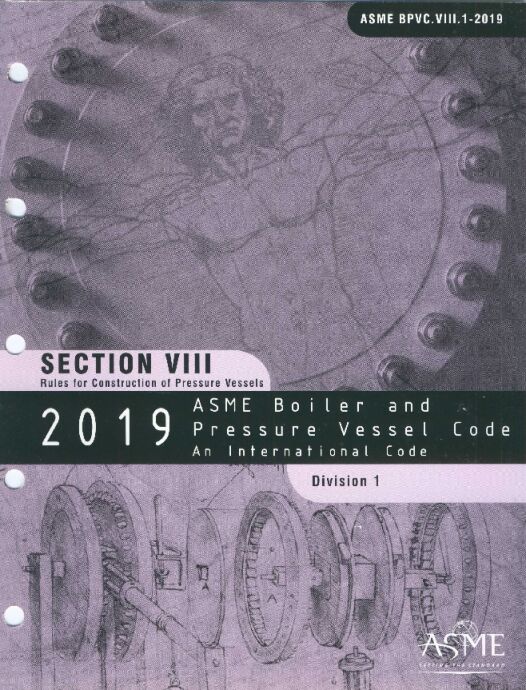
书名:Rules for construction of pressure vessels, Section VIII Division 1
责任者:ASME boiler and pressure vessel committee on pressure vessels
出版时间:2019
出版社:The American Society of Mechanical Engineers
分类号:机械、仪表工业
版次:2019 ed.
页数:715p
摘要
Errata to the BPV Code may be posted on the ASME website to provide corrections to incorrectly published items, or to correct typographical or grammatical errors in the BPV Code. Such Errata shall be used on the date posted.
Information regarding Special Notices and Errata is published by ASME at http://go.asme.org/BPVCerrata.Changes given below are identified on the pages by a margin note, (19), placed next to the affected area.
The Record Numbers listed below are explained in more detail in "List of Changes in Record Number Order" following this Summary of Changes.
查看更多
前言
In 1911, The American Society of Mechanical Engineers established the Boiler and Pressure Vessel Committee to formulate standard rules for the construction of steam boilers and other pressure vessels. In 2009, the Boiler and Pressure Vessel Committee was superseded by the following committees:
(a) Committee on Power Boilers (I) (b) Committee on Materials (II)
(c) Committee on Construction of Nuclear Facility Components (III) (d) Committee on Heating Boilers (IV)
(e) Committee on Nondestructive Examination (V) (f) Committee on Pressure Vessels (VIII)
(g) Committee on Welding, Brazing, and Fusing(IX)
(h) Committee on Fiber-Reinforced Plastic Pressure Vessels (X) (i) Committee on Nuclear Inservice Inspection(XI)
(j) Committee on Transport Tanks(XII)
(k) Technical Oversight Management Committee (TOMC)
Where reference is made to "the Committee" in this Foreword, each of these committees is included individually and collectively.
The Committee's function is to establish rules of safety relating only to pressure integrity, which govern the construction** of boilers, pressure vessels, transport tanks, and nuclear components, and the inservice inspection of nuclear components and transport tanks. The Committee also interprets these rules when questions arise regarding their intent. The technical consistency of the Sections of the Code and coordination of standards development activities of the Committees is supported and guided by the Technical Oversight Management Committee. This Code does not address other safety issues relating to the construction of boilers, pressure vessels, transport tanks, or nuclear components, or the inservice inspection of nuclear components or transport tanks. Users of the Code should refer to the pertinent codes, standards, laws, regulations, or other relevant documents for safety issues other than those relating to pressure integrity. Except for Sections XI and XII, and with a few other exceptions, the rules do not, of practical necessity, reflect the likelihood and consequences of deterioration in service related to specific service fluids or external operating environments. In formulating the rules, the Committee considers the needs of users, manufacturers, and inspectors of pressure vessels. The objective of the rules is to afford reasonably certain protection of life and property, and to provide a margin for deterioration in service to give a reasonably long, safe period of usefulness. Advancements in design and materials and evidence of experience have been recognized.
This Code contains mandatory requirements, specific prohibitions, and nonmandatory guidance for construction activities and inservice inspection and testing activities. The Code does not address all aspects of these activities and those aspects that are not specifically addressed should not be considered prohibited. The Code is not a handbook and cannot replace education, experience, and the use of engineering judgment. The phrase engineering judgment refers to technical judgments made by knowledgeable engineers experienced in the application of the Code. Engineering judgments must be consistent with Code philosophy, and such judgments must never be used to overrule mandatory requirements or specific prohibitions of the Code.
The Committee recognizes that tools and techniques used for design and analysis change as technology progresses and expects engineers to use good judgment in the application of these tools. The designer is responsible for complying with Code rules and demonstrating compliance with Code equations when such equations are mandatory. The Code neither requires nor prohibits the use of computers for the design or analysis of components constructed to the requirements of the Code. However, designers and engineers using computer programs for design or analysis are cautioned that they are responsible for all technical assumptions inherent in the programs they use and the application of these programs to their design.
*The information contained in this Foreword is not part of this American National Standard (ANS) and has not been processed in accordance with ANSI's requirements for an ANS. Therefore, this Foreword may contain material that has not been subjected to public review or a consensus process. In addition, it does not contain requirements necessary for conformance to the Code.
**Construction, as used in this Foreword, is an all-inclusive term comprising materials, design, fabrication, examination, inspection, testing, certification, and pressure relief.
The rules established by the Committee are not to be interpreted as approving, recommending, or endorsing any proprietary or specific design, or as limiting in any way the manufacturer's freedom to choose any method of design or any form of construction that conforms to the Code rules.
The Committee meets regularly to consider revisions of the rules, new rules as dictated by technological development, Code Cases, and requests for interpretations. Only the Committee has the authority to provide official interpretations of this Code. Requests for revisions, new rules, Code Cases, or interpretations shall be addressed to the Secretary in writing and shall give full particulars in order to receive consideration and action (see Submittal of Technical Inquiries to the Boiler and Pressure Vessel Standards Committees). Proposed revisions to the Code resulting from inquiries will be presented to the Committee for appropriate action. The action of the Committee becomes effective only after confirmation by ballot of the Committee and approval by ASME. Proposed revisions to the Code approved by the Committee are submitted to the American National Standards Institute (ANSI)and published at http://go.asme.org/BPVCPublicReview to invite comments from all interested persons. After public review and final approval by ASME, revisions are published at regular intervals in Editions of the Code.
The Committee does not rule on whether a component shall or shall not be constructed to the provisions of the Code. The scope of each Section has been established to identify the components and parameters considered by the Committee in formulating the Code rules.
Questions or issues regarding compliance of a specific component with the Code rules are to be directed to the ASME Certificate Holder (Manufacturer). Inquiries concerning the interpretation of the Code are to be directed to the Committee. ASME is to be notified should questions arise concerning improper use of the ASME Single Certification Mark.
When required by context in this Section, the singular shall be interpreted as the plural, and vice versa, and the feminine, masculine, or neuter gender shall be treated as such other gender as appropriate.
查看更多
目录
List of Sections xxxiii
Foreword xxxv
Statement of Policy on the Use of the ASME Single Certification Mark and Code Authorization in Advertising xxxvii
Statement of Policy on the Use of ASME Marking to Identify Manufactured Items xxxvii
Submittal of Technical Inquiries to the Boiler and Pressure Vessel Standards Committees xxxviii
Personnel xli
Summary of Changes lxiii
List of Changes in Record Number Order lxxi
Cross-Referencing and Stylistic Changes in the Boiler and Pressure Vessel Code lxxv
Introduction 1
U-l Scope 1
U-2 General 3
U-3 Standards Referenced by This Division 4
U-4 Units of Measurement 4
U-5 Tolerances 5
Subsection A General Requirements 7
Part UG General Requirements for All Methods of Construction and All Materials 7
UG-1 Scope 7
Materials 7
UG-4 General 7
UG-5 Plate 8
UG-6 Forgings 8
UG-7 Castings 8
UG-8 Pipe and Tubes 8
UG-9 Welding Materials 9
UG-10 Material Identified With or Produced to a Specification Not Permitted by This Division, and Material Not Fully Identified 9
UG-11 Prefabricated or Preformed Pressure Parts Furnished Without a Certification Mark 10
UG-12 Bolts and Studs 12
UG-13 Nuts and Washers 12
UG-14 Rods and Bars 12
UG-15 Product Specification 13
Design 13
UG-16 General 13
UG-17 Methods of Fabrication in Combination 14
UG-18 Materials in Combination 14
UG-19 Special Constructions 14
UG-20 Design Temperature 15
UG-21 Design Pressure 16
UG-22 Loadings 16
UG-23 Maximum Allowable Stress Values 16
UG-24 Castings 17
UG-25 Corrosion 18
UG-26 Linings 19
UG-27 Thickness of Shells Under Internal Pressure 19
UG-28 Thickness of Shells and Tubes Under External Pressure 19
UG-29 Stiffening Rings for Cylindrical Shells Under External Pressure 23
UG-30 Attachment of Stiffening Rings 27
UG-31 Tubes, and Pipe When Used as Tubes or Shells 27
UG-32 Formed Heads, and Sections, Pressure on Concave Side 27
UG-33 Formed Heads, Pressure on Convex Side 30
UG-34 Unstayed Flat Heads and Covers 33
UG-35 Other Types of Closures 37
Openings and Reinforcements 38
UG-36 Openings in Pressure Vessels 38
UG-37 Reinforcement Required for Openings in Shells and Formed Heads 41
UG-38 Flued Openings in Shells and Formed Heads 44
UG-39 Reinforcement Required for Openings in Flat Heads and Covers 45
UG-40 Limits of Reinforcement 47
UG-41 Strength of Reinforcement 47
UG-42 Reinforcement of Multiple Openings 50
UG-43 Methods of Attachment of Pipe and Nozzle Necks to Vessel Walls 50
UG-44 Flanges and Pipe Fittings 54
UG-45 Nozzle Neck Thickness 55
UG-46 Inspection Openings 55
Braced and Stayed Surfaces 57
UG-47 Braced and Stayed Surfaces 57
UG-48 Staybolts 58
UG-49 Location of Staybolts 58
UG-50 Dimensions of Staybolts 58
Ligaments 58
UG-53 Ligaments 58
UG-54 Supports 60
UG-55 Lugs for Platforms, Ladders, and Other Attachments to Vessel Walls 60
Fabrication 60
UG-75 General 60
UG-76 Cutting Plates and Other Stock 60
UG-77 Material Identification (see UG-85) 63
UG-78 Repair of Defects in Materials 63
UG-79 Forming Pressure Parts 63
UG-80 Permissible Out-of-Roundness of Cylindrical, Conical, and Spherical Shells 64
UG-81 Tolerance for Formed Heads 66
UG-82 Lugs and Fitting Attachments 66
UG-83 Holes for Screw Stays 66
UG-84 Charpy Impact Tests 66
UG-85 Heat Treatment 73
Inspection and Tests 73
UG-90 General 73
UG-91 The Inspector 74
UG-92 Access for Inspector 74
UG-93 Inspection of Materials 75
UG-94 Marking on Materials 76
UG-95 Examination of Surfaces During Fabrication 76
UG-96 Dimensional Check of Component Parts 76
UG-97 Inspection During Fabrication 76
UG-98 Maximum Allowable Working Pressure 76
UG-99 Standard Hydrostatic Test 77
UG-100 Pneumatic Test (see UW-50) 78
UG-101 Proof Tests to Establish Maximum Allowable Working Pressure • 79
UG-102 Test Gages 84
UG-103 Nondestructive Testing 84
Marking and Reports 84
UG-115 General 84
UG-116 Required Marking 84
UG-117 Certificates of Authorization and Certification Marks 86
UG-118 Methods of Marking 87
UG-119 Nameplates 88
UG-120 Data Reports 89
Overpressure Protection 91
UG-125 General 91
UG-126 Pressure Relief Valves 92
UG-127 Nonreclosing Pressure Relief Devices 92
UG-128 Liquid Pressure Relief Valves 94
UG-129 Marking 94
UG-130 Certification Mark 97
UG-131 Certification of Capacity of Pressure Relief Devices 97
UG-132 Certification of Capacity of Pressure Relief Valves in Combination With Nonreclosing Pressure Relief Devices 101
UG-133 Determination of Pressure-Relieving Requirements 102
UG-134 Pressure Settings and Performance Requirements 102
UG-135 Installation 103
UG-136 Minimum Requirements for Pressure Relief Valves 103
UG-137 Minimum Requirements for Rupture Disk Devices 108
UG-138 Minimum Requirements for Pin Devices 109
UG-140 Overpressure Protection by System Design 112
Subsection B Requirements Pertaining to Methods of Fabrication of Pressure Vessels 114
Part UW Requirements for Pressure Vessels Fabricated by Welding 114
General 114
UW-1 Scope 114
UW-2 Service Restrictions 114
UW-3 Welded Joint Category 115
Materials 116
UW-5 General 116
UW-6 Nonmandatory Guidelines for Welding Material Selections 117
Design 117
UW-8 General 117
UW-9 Design of Welded Joints 117
UW-10 Postweld Heat Treatment 119
UW-11 Radiographic and Ultrasonic Examination 119
UW-12 Joint Efficiencies 120
UW-13 Attachment Details 120
UW-14 Openings in or Adjacent to Welds 129
UW-15 Welded Connections 131
UW-16 Minimum Requirements for Attachment Welds at Openings 131
UW-17 Plug Welds 141
UW-18 Fillet Welds 141
UW-19 Welded Stayed Construction 141
UW-20 Tube-to-Tubesheet Welds 143
UW-21 ASME B16.5 Socket and Slip-on Flange Welds 145
Fabrication 145
UW-26 General 145
UW-27 Welding Processes 146
UW-28 Qualification of Welding Procedure 146
UW-29 Tests of Welders and Welding Operators 147
UW-30 Lowest Permissible Temperatures for Welding 147
UW-31 Cutting, Fitting, and Alignment 147
UW-32 Cleaning of Surfaces to Be Welded 148
UW-33 Alignment Tolerance 148
UW-34 Spin-Holes 148
UW-35 Finished Longitudinal and Circumferential Joints 148
UW-36 Fillet Welds 149
UW-37 Miscellaneous Welding Requirements 149
UW-38 Repair of Weld Defects 150
UW-39 Peening 150
UW-40 Procedures for Postweld Heat Treatment 150
UW-41 Sectioning of Welded Joints 152
UW-42 Surface Weld Metal Buildup 152
Inspection and Tests 152
UW-46 General 152
UW-47 Check of Welding Procedure 152
UW-48 Check of Welder and Welding Operator Qualifications 152
UW-49 Check of Postweld Heat Treatment Practice 152
UW-50 Nondestructive Examination of Welds on Pneumatically Tested Vessels 152
UW-51 Radiographic Examination of Welded Joints 153
UW-52 Spot Examination of Welded Joints 153
UW-53 Ultrasonic Examination of Welded Joints 154
UW-54 Qualification of Nondestructive Examination Personnel 154
Marking and Reports 154
UW-60 General 154
Part UF Requirements for Pressure Vessels Fabricated by Forging . 155
General 155
UF-1 Scope 155
Materials 155
UF-5 General 155
UF-6 Forgings 155
UF-7 Forged Steel Rolls Used for Corrugating Paper Machinery 155
Design 155
UF-12 General 155
UF-13 Head Design 155
UF-25 Corrosion Allowance 156
Fabrication 156
UF-26 General 156
UF-27 Tolerances on Body Forgings 156
UF-28 Methods of Forming Forged Heads 156
UF-29 Tolerance on Forged Heads 156
UF-30 Localized Thin Areas 156
UF-31 Heat Treatment 156
UF-32 Welding for Fabrication 157
UF-37 Repair of Defects in Material 158
UF-38 Repair of Weld Defects 158
UF-43 Attachment of Threaded Nozzles to Integrally Forged Necks and Thickened Heads on Vessels 158
Inspection and Tests 159
UF-45 General 159
UF-46 Acceptance by Inspector 159
UF-47 Parts Forging 159
UF-52 Check of Heat Treatment and Postweld Heat Treatment 159
UF-53 Test Specimens 159
UF-54 Tests and Retests 159
UF-55 Ultrasonic Examination 159
Marking and Reports 159
UF-115 General 159
Part UB Requirements for Pressure Vessels Fabricated by Brazing 160
General 160
UB-1 Scope 160
UB-2 Elevated Temperature 160
UB-3 Service Restrictions 160
Materials 160
UB-5 General 160
UB-6 Brazing Filler Metals 161
UB-7 Fluxes and Atmospheres 161
Design 161
UB-9 General 161
UB-10 Strength of Brazed Joints 161
UB-11 Qualification of Brazed Joints for Design Temperatures Up to the Maximum Shown in Column 1 of Table UB-2 161
UB-12 Qualification of Brazed Joints for Design Temperatures in the Range Shown in Column 2 of Table UB-2 161
UB-13 Corrosion 161
UB-14 Joint Efficiency Factors 161
UB-15 Application of Brazing Filler Metal 161
UB-16 Permissible Types of Joints 162
UB-17 Joint Clearance 162
UB-18 Joint Brazing Procedure 163
UB-19 Openings 163
UB-20 Nozzles 163
UB-21 Brazed Connections 163
UB-22 Low Temperature Operation 164
Fabrication 164
UB-30 General 164
UB-31 Qualification of Brazing Procedure 164
UB-32 Qualification of Brazers and Brazing Operators 164
UB-33 Buttstraps 165
UB-34 Cleaning of Surfaces to Be Brazed 165
UB-35 Clearance Between Surfaces to Be Brazed 165
UB-36 Postbrazing Operations 165
UB-37 Repair of Defective Brazing 165
Inspection and Tests 165
UB-40 General 165
UB-41 Inspection During Fabrication 165
UB-42 Procedure 165
UB-43 Brazer and Brazing Operator 165
UB-44 Visual Examination 166
UB-50 Exemptions 166
Marking and Reports 166
UB-55 General 166
Subsection C Requirements Pertaining to Classes of Materials 167
Part UCS Requirements for Pressure Vessels Constructed of Carbon and Low Alloy Steels 167
General 167
UCS-1 Scope 167
Materials 167
UCS-5 General 167
UCS-6 Steel Plates 167
UCS-7 Steel Forgings 168
UCS-8 Steel Castings 168
UCS-9 Steel Pipe and Tubes 168
UCS-10 Bolt Materials 168
UCS-11 Nuts and Washers 168
UCS-12 Bars and Shapes 168
Design 168
UCS-16 General 168
UCS-19 Welded Joints 169
UCS-23 Maximum Allowable Stress Values 169
UCS-27 Shells Made From Pipe 169
UCS-28 Thickness of Shells Under External Pressure 170
UCS-29 Stiffening Rings for Shells Under External Pressure 170
UCS-30 Attachment of Stiffening Rings to Shell 170
UCS-33 Formed Heads, Pressure on Convex Side 170
UCS-56 Requirements for Postweld Heat Treatment 170
UCS-57 Radiographic Examination 181
Low Temperature Operation 181
UCS-65 Scope 181
UCS-66 Materials 181
UCS-67 Impact Tests of Welding Procedures 197
UCS-68 Design 197
Fabrication 198
UCS-75 General 198
UCS-79 Forming Pressure Parts 198
UCS-85 Heat Treatment of Test Specimens 198
Inspection and Tests 200
UCS-90 General 200
Marking and Reports 200
UCS-115 General 200
Nonmandatory Appendix UCS-A 201
UCS-A-1 General 201
UCS-A-2 Creep-Rupture Properties of Carbon Steels 201
UCS-A-3 Vessels Operating at Temperatures Colder Than the MDMT Stamped on the Nameplate 201
Part UNF Requirements for Pressure Vessels Constructed of Nonferrous Materials 202
General 202
UNF-1 Scope 202
UNF-3 Uses 202
UNF-4 Conditions of Service 202
Materials 202
UNF-5 General 202
UNF-6 Nonferrous Plate 202
UNF-7 Forgings 202
UNF-8 Castings 202
UNF-12 Bolt Materials 202
UNF-13 Nuts and Washers 203
UNF-14 Rods, Bars, and Shapes 203
UNF-15 Other Materials 203
Design 203
UNF-16 General 203
UNF-19 Welded Joints 203
UNF-23 Maximum Allowable Stress Values 203
UNF-28 Thickness of Shells Under External Pressure 206
UNF-30 Stiffening Rings 206
UNF-33 Formed Heads, Pressure on Convex Side 206
UNF-56 Postweld Heat Treatment 206
UNF-57 Radiographic Examination 207
UNF-58 Liquid Penetrant Examination 207
UNF-65 Low Temperature Operation 207
Fabrication 207
UNF-75 General 207
UNF-77 Forming Shell Sections and Heads 208
UNF-78 Welding 208
UNF-79 Requirements for Postfabrication Heat Treatment Due to Straining 208
Inspection and Tests 208
UNF-90 General 208
UNF-91 Requirements for the Image Quality Indicator 208
UNF-95 Welding Test Plates 208
Marking and Reports 208
UNF-115 General 208
Nonmandatory Appendix UNF-A Characteristics of the Nonferrous Materials 210
UNF-A-1 Purpose 210
UNF-A-2 General 210
UNF-A-3 Properties 210
UNF-A-4 Magnetic Properties 210
UNF-A-5 Elevated Temperature Effects 210
UNF-A-6 Low Temperature Behavior 210
UNF-A-7 Thermal Cutting 210
UNF-A-8 Machining 210
UNF-A-9 Gas Welding 210
UNF-A-10 Metal Arc Welding 211
UNF-A-11 Inert Gas Metal Arc Welding 211
UNF-A-12 Resistance Welding 211
UNF-A-13 Corrosion 211
UNF-A-14 Special Comments 211
Part UHA Requirements for Pressure Vessels Constructed of High Alloy Steel 212
General 212
UHA-1 Scope 212
UHA-5 Uses 212
UHA-6 Conditions of Service 212
UHA-8 Material 212
Materials 212
UHA-11 General 212
UHA-12 Bolt Materials 212
UHA-13 Nuts and Washers 212
Design 213
UHA-20 General 213
UHA-21 Welded Joints 213
UHA-23 Maximum Allowable Stress Values 213
UHA-28 Thickness of Shells Under External Pressure 213
UHA-29 Stiffening Rings for Shells Under External Pressure 213
UHA-30 Attachment of Stiffening Rings to Shell 213
UHA-31 Formed Heads, Pressure on Convex Side 213
UHA-32 Requirements for Postweld Heat Treatment 213
UHA-33 Radiographic Examination 219
UHA-34 Liquid Penetrant Examination 219
Fabrication 219
UHA-40 General 219
UHA-42 Weld Metal Composition 219
UHA-44 Requirements for Postfabrication Heat Treatment Due to Straining 220
Inspection and Tests 220
UHA-50 General 220
UHA-51 Impact Tests 220
UHA-52 Welded Test Plates 224
Marking and Reports 224
UHA-60 General 224
Nonmandatory Appendix UHA-A Suggestions on the Selection and Treatment of Austenitic Chromium-Nickel and Ferritic and Martensitic High Chromium Steels 225
UHA-A-1 General 225
UHA-A-2 Dissimilar Weld Metal 225
UHA-A-3 Fabrication 225
UHA-A-4 Relaxation Cracking 225
Part UCI Requirements for Pressure Vessels Constructed of Cast Iron 227
General 227
UCI-1 Scope 227
UCI-2 Service Restrictions 227
UCI-3 Pressure-Temperature Limitations 227
Materials 227
UCI-5 General 227
UCI-12 Bolt Materials 227
Design 227
UCI-16 General 227
UCI-23 Maximum Allowable Stress Values 227
UCI-28 Thickness of Shells Under External Pressure 228
UCI-29 Dual Metal Cylinders 228
UCI-32 Heads With Pressure on Concave Side 228
UCI-33 Heads With Pressure on Convex Side 228
UCI-35 Spherically Shaped Covers (Heads) 228
UCI-36 Openings and Reinforcements 228
UCI-37 Corners and Fillets 229
Fabrication 229
UCI-75 General 229
UCI-78 Repairs in Cast Iron Materials 229
Inspection and Tests 230
UCI-90 General 230
UCI-99 Standard Hydrostatic Test 230
UCI-101 Hydrostatic Test to Destruction 230
Marking and Reports 230
UCI-115 General 230
Part UCL Requirements for Welded Pressure Vessels Constructed of Material With Corrosion Resistant Integral Cladding, Weld Metal Overlay Cladding, or Applied Linings 231
General 231
UCL-1 Scope 231
UCL-2 Methods of Fabrication 231
UCL-3 Conditions of Service 231
Materials 231
UCL-10 General 231
UCL-11 Integral and Weld Metal Overlay Clad Material 231
UCL-12 Lining 232
Design 232
UCL-20 General 232
UCL-23 Maximum Allowable Stress Values 232
UCL-24 Maximum Allowable Working Temperature 233
UCL-25 Corrosion of Cladding or Lining Material 233
UCL-26 Thickness of Shells and Heads Under External Pressure 233
UCL-27 Low Temperature Operations 233
Fabrication 233
UCL-30 General 233
UCL-31 Joints in Integral or Weld Metal Overlay Cladding and Applied Linings 233
UCL-32 Weld Metal Composition 233
UCL-33 Inserted Strips in Clad Material 233
UCL-34 Postweld Heat Treatment 234
UCL-35 Radiographic Examination 234
UCL-36 Examination of Chromium Stainless Steel Cladding or Lining 234
UCL-40 Welding Procedures 234
UCL-42 Alloy Welds in Base Metal 234
UCL-46 Fillet Welds 234
Inspection and Tests 235
UCL-50 General 235
UCL-51 Tightness of Applied Lining 235
UCL-52 Hydrostatic Test 235
Marking and Reports 235
UCL-55 General 235
Part UCD Requirements for Pressure Vessels Constructed of Cast Ductile Iron 236
General 236
UCD-1 Scope 236
UCD-2 Service Restrictions 236
UCD-3 Pressure-Temperature Limitations 236
Materials 236
UCD-5 General 236
UCD-12 Bolt Materials 236
Design 236
UCD-16 General 236
UCD-23 Maximum Allowable Stress Values 236
UCD-28 Thickness of Shells Under External Pressure 236
UCD-32 Heads With Pressure on Concave Side 237
UCD-33 Heads With Pressure on Convex Side 237
UCD-35 Spherically Shaped Covers (Heads) 237
UCD-36 Openings and Reinforcements 237
UCD-37 Corners and Fillets 237
Fabrication 237
UCD-75 General 237
UCD-78 Repairs in Cast Ductile Iron Material 237
Inspection and Tests 238
UCD-90 General 238
UCD-99 Standard Hydrostatic Test 238
UCD-101 Hydrostatic Test to Destruction 239
Marking and Reports 239
UCD-115 General 239
Part UHT Requirements for Pressure Vessels Constructed of Ferritic Steels With Tensile Properties Enhanced by Heat
Treatment 240
General 240
UHT-1 Scope 240
Materials 240
UHT-5 General 240
UHT-6 Test Requirements 240
Design 241
UHT-16 General 241
UHT-17 Welded Joints 241
UHT-18 Nozzles 242
UHT-19 Conical Sections 242
UHT-20 Joint Alignment 242
UHT-23 Maximum Allowable Stress Values 242
UHT-25 Corrosion Allowance 242
UHT-27 Thickness of Shells Under External Pressure 245
UHT-28 Structural Attachments and Stiffening Rings 245
UHT-29 Stiffening Rings for Shells Under External Pressure 245
UHT-30 Attachment of Stiffening Rings to Shells 245
UHT-32 Formed Heads, Pressure on Concave Side 245
UHT-33 Formed Heads, Pressure on Convex Side 246
UHT-34 Hemispherical Heads 246
UHT-40 Materials Having Different Coefficients of Expansion 246
UHT-56 Postweld Heat Treatment 246
UHT-57 Examination 246
Fabrication 248
UHT-75 General 248
UHT-79 Forming Pressure Parts 248
UHT-80 Heat Treatment 248
UHT-81 Heat Treatment Verification Tests 248
UHT-82 Welding 249
UHT-83 Methods of Metal Removal 250
UHT-84 Weld Finish 250
UHT-85 Structural and Temporary Welds 250
UHT-86 Marking on Plates and Other Materials 250
Inspection and Tests 250
UHT-90 General 250
Marking and Reports 250
UHT-115 General 250
Part ULW Requirements for Pressure Vessels Fabricated by Layered Construction 251
Introduction 251
ULW-1 Scope 251
ULW-2 Nomenclature 251
Material 251
ULW-5 General 251
Design 251
ULW-16 General 251
ULW-17 Design of Welded Joints 254
ULW-18 Nozzle Attachments and Opening Reinforcement 254
ULW-20 Welded Joint Efficiency 262
ULW-22 Attachments 262
ULW-26 Postweld Heat Treatment 262
Welding 262
ULW-31 Welded Joints 262
ULW-32 Welding Procedure Qualification 266
ULW-33 Performance Qualification 266
Nondestructive Examination of Welded Joints 266
ULW-50 General 266
ULW-51 Inner Shells and Inner Heads 266
ULW-52 Layers — Welded Joints 266
ULW-53 Layers — Step Welded Girth Joints 268
ULW-54 Butt Joints 268
ULW-55 Flat Head and Tubesheet Weld Joints 269
ULW-56 Nozzle and Communicating Chambers Weld Joints 269
ULW-57 Random Spot Examination and Repairs of Weld 269
Fabrication 272
ULW-75 General 272
ULW-76 Vent Holes 272
ULW-77 Contact Between Layers 272
ULW-78 Alternative to Measuring Contact Between Layers During Construction 272
Inspection and Testing 273
ULW-90 General 273
Marking and Reports 273
ULW-115 General 273
Part ULT Alternative Rules for Pressure Vessels Constructed of Materials Having Higher Allowable Stresses at Low Temperature 274
General 274
ULT-1 Scope 274
ULT-2 Conditions of Service 274
ULT-5 General 274
Design 275
ULT-16 General 275
ULT-17 Welded Joints 275
ULT-18 Nozzles and Other Connections 275
ULT-23 Maximum Allowable Stress Values 275
ULT-27 Thickness of Shells 275
ULT-28 Thickness of Shells Under External Pressure 275
ULT-29 Stiffening Rings for Shells Under External Pressure 275
ULT-30 Structural Attachments 275
ULT-56 Postweld Heat Treatment 279
ULT-57 Examination 279
Fabrication 279
ULT-75 General 279
ULT-79 Forming Shell Sections and Heads 279
ULT-82 Welding 279
ULT-86 Marking on Plate and Other Materials 280
Inspection and Tests 281
ULT-90 General 281
ULT-99 Hydrostatic Test 281
ULT-100 Pneumatic Test 282
Marking and Reports 282
ULT-115 General 282
Overpressure Protection 282
ULT-125 General 282
Part UHX Rules for Shell-and-Tube Heat Exchangers 283
UHX-1 Scope 283
UHX-2 Materials and Methods of Fabrication 283
UHX-3 Terminology 283
UHX-4 Design 283
UHX-8 Tubesheet Effective Bolt Load, W* 286
UHX-9 Tubesheet Extension 286
UHX-10 General Conditions of Applicability for Tubesheets 287
UHX-11 Tubesheet Characteristics 288
UHX-12 Rules for the Design of U-Tube Tubesheets 290
UHX-13 Rules for the Design of Fixed Tubesheets 301
UHX-14 Rules for the Design of Floating Tubesheets 319
UHX-16 Bellows Expansion Joints 330
UHX-17 Flexible Shell Element Expansion Joints 331
UHX-18 Pressure Test Requirements 332
UHX-19 Heat Exchanger Marking and Reports 332
UHX-20 Examples 333
Part UIG Requirements for Pressure Vessels Constructed of Impregnated Graphite 334
Nonmandatory Introduction 334
General 334
UIG-1 Scope 334
UIG-2 Equipment and Service Limitations 334
UIG-3 Terminology 335
Materials 335
UIG-5 Raw Material Control 335
UIG-6 Certified Material Control 335
UIG-7 Additional Properties 336
UIG-8 Tolerances for Impregnated Graphite Tubes 336
Design 336
UIG-22 Loadings 336
UIG-23 Maximum Allowable Stress Values for Certified Material 336
UIG-27 Thickness of Cylindrical Shells Made of Certified Materials Under Internal Pressure 336
UIG-28 External Pressure 337
UIG-29 Euler Buckling of Extruded Graphite Tubes 337
UIG-34 Calculating Flat Heads, Covers, and Tubesheets 337
UIG-36 Openings and Reinforcements 344
UIG-45 Nozzle Neck Thickness 344
UIG-60 Lethal Service 344
Fabrication 354
UIG-75 General Requirements 354
UIG-76 Procedure and Personnel Qualification 354
UIG-77 Certified Material Specification 354
UIG-78 Certified Cement Specification 360
UIG-79 Certified Cementing Procedure Specification 360
UIG-80 Cementing Technician Qualification 360
UIG-81 Repair of Materials 360
UIG-84 Required Tests 360
Inspection and Tests 361
UIG-90 General 361
UIG-95 Visual Examination 362
UIG-96 Qualification of Visual Examination Personnel 362
UIG-97 Acceptance Standards and Documentation 362
UIG-99 Pressure Tests 362
UIG-112 Quality Control Requirements 362
UIG-115 Markings and Reports 362
UIG-116 Required Markings 362
UIG-120 Data Reports 363
UIG-121 Records 363
Mandatory Appendix 1 Supplementary Design Formulas 376
1-1 Thickness of Cylindrical and Spherical Shells 376
1-2 Cylindrical Shells 376
1-3 Spherical Shells 376
1-4 Formulas for the Design of Formed Heads Under Internal Pressure 376
1-5 Rules for Conical Reducer Sections and Conical Heads Under Internal Pressure 379
1-6 Dished Covers (Bolted Heads) 382
1-7 Large Openings in Cylindrical and Conical Shells 384
1-8 Rules for Reinforcement of Cones and Conical Reducers Under External Pressure 387
Mandatory Appendix 2 Rules for Bolted Flange Connections With Ring Type Gaskets 391
2-1 Scope 391
2-2 Materials 391
2-3 Notation 392
2-4 Circular Flange Types 393
2-5 Bolt Loads 394
2-6 Flange Moments 400
2-7 Calculation of Flange Stresses 403
2-8 Allowable Flange Design Stresses 403
2-9 Split Loose Flanges 403
2-10 Noncircular Shaped Flanges With Circular Bore 410
2-11 Flanges Subject to External Pressures 410
2-12 Flanges With Nut-Stops 410
2-13 Reverse Flanges 410
2-14 Flange Rigidity 413
2-15 Qualification of Assembly Procedures and Assemblers 413
Mandatory Appendix 3 Definitions 414
3-1 Introduction 414
3-2 Definitions of Terms 414
Mandatory Appendix 4 Rounded Indications Charts Acceptance Standard for Radio-graphically Determined Rounded Indications in Welds 417
4-1 Applicability of These Standards 417
4-2 Terminology 417
4-3 Acceptance Criteria 417
Mandatory Appendix 5 Flexible Shell Element Expansion Joints 425
5-1 General 425
5-2 Materials 425
5-3 Design 425
5-4 Fabrication 426
5-5 Inspection and Tests 428
5-6 Marking and Reports 428
Mandatory Appendix 6 Methods for Magnetic Particle Examination (MT) 429
6-1 Scope 429
6-2 Certification of Competency for Nondestructive Examination Personnel 429
6-3 Evaluation of Indications 429
6-4 Acceptance Standards 429
6-5 Repair Requirements 429
Mandatory Appendix 7 Examination of Steel Castings 431
7-1 Scope 431
7-2 Examination Techniques 431
7-3 Examination Requirements 431
7-4 Repairs 432
7-5 Identification and Marking 433
Mandatory Appendix 8 Methods for Liquid Penetrant Examination (PT) 434
8-1 Scope 434
8-2 Certification of Competency of Nondestructive Examination Personnel 434
8-3 Evaluation of Indications 434
8-4 Acceptance Standards 434
8-5 Repair Requirements 434
Mandatory Appendix 9 Jacketed Vessels 436
9-1 Scope 436
9-2 Types of Jacketed Vessels 436
9-3 Materials 436
9-4 Design of Jacket Shells and Jacket Heads 436
9-5 Design of Closure Member of Jacket to Vessel 436
9-6 Design of Penetrations Through Jackets 442
9-7 Design of Partial Jackets 442
9-8 Fabrication 444
9-10 Inspection 444
Mandatory Appendix 10 Quality Control System 445
10-1 General 445
10-2 Outline of Features to Be Included in the Written Description of the Quality Control System 445
10-3 Authority and Responsibility 445
10-4 Organization 445
10-5 Drawings, Design Calculations, and Specification Control 445
10-6 Material Control 446
10-7 Examination and Inspection Program 446
10-8 Correction of Nonconformities 446
10-9 Welding 446
10-10 Nondestructive Examination 446
10-11 Heat Treatment 446
10-12 Calibration of Measurement and Test Equipment 446
10-13 Records Retention 446
10-14 Sample Forms 447
10-15 Inspection of Vessels and Vessel Parts 447
10-16 Inspection of Pressure Relief Valves 447
10-17 Certifications 447
Mandatory Appendix 11 Capacity Conversions for Safety Valves 448
11-1 448
11-2 451
Mandatory Appendix 12 Ultrasonic Examination of Welds (UT) 452
12-1 Scope 452
12-2 Certification of Competence of Nondestructive Examiner 452
12-3 Acceptance-Rejection Standards 452
12-4 Report of Examination 452
Mandatory Appendix 13 Vessels of Noncircular Cross Section 453
13-1 Scope 453
13-2 Types of Vessels 453
13-3 Materials 453
13-4 Design of Vessels of Noncircular Cross Section 457
13-5 Nomenclature 460
13-6 Ligament Efficiency of Multidiameter Holes in Plates 462
13-7 Unreinforced Vessels of Rectangular Cross Section 463
13-8 Reinforced Vessels of Rectangular Cross Section 465
13-9 Stayed Vessels of Rectangular Cross Section [Figure 13-2(a), Sketches (7)and (8)] 470
13-10 Unreinforced Vessels Having an Obround Cross Section [Figure 13-2(b),Sketch (1)] 473
13-11 Reinforced Vessels of Obround Cross Section [Figure 13-2(b),Sketch (2)] 473
13-12 Stayed Vessels of Obround Cross Section [Figure 13-2(b), Sketch (3)] 474
13-13 Vessels of Circular Cross Section Having a Single Diametral Staying Member [Figure 13-2(c)] 475
13-14 Vessels of Noncircular Cross Section Subject to External Pressure 476
13-15 Fabrication 478
13-16 Inspection 478
13-17 Examples 478
13-18 Special Calculations 478
Mandatory Appendix 14 Integral Flat Heads With a Large, Single, Circular, Centrally Located Opening 482
14-1 Scope 482
14-2 Nomenclature 482
14-3 Design Procedure 482
14-4 Data Reports 484
Mandatory Appendix 17 Dimpled or Embossed Assemblies 485
17-1 Scope 485
17-2 Service Restrictions 485
17-3 Materials 485
17-4 Thickness Limitations 486
17-5 Maximum Allowable Working Pressure (MAWP) 486
17-6 Design Limitations 486
17-7 Welding Control 486
17-8 Quality Control 488
17-9 Records 488
17-10 Data Reports 489
Mandatory Appendix 18 Adhesive Attachment of Nameplates 497
18-1 Scope 497
18-2 Nameplate Application Procedure Qualification 497
Mandatory Appendix 19 Electrically Heated or Gas-Fired Jacketed Steam Kettles 498
19-1 Scope 498
19-2 Service Restrictions 498
19-3 Materials 498
19-4 Design 498
19-5 Inspection and Stamping 498
19-6 Pressure Relief 498
19-7 Appurtenances and Controls 498
19-8 Data Reports 498
Mandatory Appendix 20 Hubs Machined From Plate 499
20-1 Scope 499
20-2 Material 499
20-3 Examination Requirements 499
20-4 Data Reports 499
Mandatory Appendix 21 Jacketed Vessels Constructed of Work-Hardened Nickel 500
21-1 Scope 500
21-2 Design Requirements 500
21-3 Fabrication 500
21-4 Data Reports 500
Mandatory Appendix 22 Integrally Forged Vessels 501
22-1 Scope 501
22-2 Material 501
22-3 Design 501
22-4 Heat Treatment 502
22-5 Marking 502
22-6 Data Reports 502
Mandatory Appendix 23 External Pressure Design of Copper, Copper Alloy, and Titanium Alloy Condenser and Heat Exchanger Tubes With Integral Fins 503
23-1 Scope 503
23-2 Materials 503
23-3 Test Procedure 503
23-4 Criteria 503
23-5 Data Reports 504
Mandatory Appendix 24 Design Rules for Clamp Connections 505
24-1 Scope 505
24-2 Materials 505
24-3 Notation 505
24-4 Bolt Loads 509
24-5 Hub Moments 510
24-6 Calculation of Hub Stresses 510
24-7 Calculation of Clamp Stresses 510
24-8 Allowable Design Stresses for Clamp Connections 510
Mandatory Appendix 26 Bellows Expansion Joints 511
26-1 Scope 511
26-2 Conditions of Applicability 511
26-3 Nomenclature 511
26-4 Design Considerations 515
26-5 Materials 518
26-6 Design of U-Shaped Unreinforced Bellows 518
26-7 Design of U-Shaped Reinforced Bellows 523
26-8 Design of Toroidal Bellows 526
26-9 Bellows Subjected to Axial, Lateral, or Angular Displacements 528
26-10 Fabrication 531
26-11 Examination 531
26-12 Pressure Test Requirements 532
26-13 Marking and Reports 533
26-14 Examples 533
26-15 Polynomial Approximation for Coefficients C_p, C_f, C_d 533
Mandatory Appendix 27 Alternative Requirements for Glass-Lined Vessels 541
27-1 Scope 541
27-2 Permissible Out-of-Roundness of Cylindrical Shells Under Internal Pressure 541
27-3 Permissible Tolerance for Hemispherical or 2:1 Ellipsoidal Heads 541
27-4 Hydrostatic Test 541
27-5 Heat Treatment of Test Specimens 542
27-6 Low Temperature Operation 542
27-7 Postweld Heat Treatment 542
27-8 Data Reports 542
Mandatory Appendix 30 Rules for Drilled Holes Not Penetrating Through Vessel Wall 543
30-1 Scope 543
30-2 Supplementary Requirements 543
30-3 Nomenclature 543
Mandatory Appendix 31 Rules for Cr-Mo Steels With Additional Requirements for Welding and Heat Treatment 545
31-1 Scope 545
31-2 Postweld Heat Treatment 545
31-3 Test Specimen Heat Treatment 547
31-4 Welding Procedure Qualification and Welding Consumables Testing 547
31-5 Toughness Requirements 547
Mandatory Appendix 32 Local Thin Areas in Cylindrical Shells and in Spherical Segments of Shells 548
32-1 Scope 548
32-2 General Requirements 548
32-3 Nomenclature 548
32-4 Allowable Locations for Local Thin Areas 549
32-S Blend Grinding Requirements for Local Thin Areas 550
32-6 Single Local Thin Areas in Cylindrical Shells 550
32-7 Multiple Local Thin Areas in Cylindrical Shells 551
32-8 Single Local Thin Areas in Spherical Segments of Shells 551
32-9 Multiple Local Thin Areas in Spherical Segments of Shells 551
32-10 Data Reports 551
Mandatory Appendix 33 Standard Units for Use in Equations 552
Mandatory Appendix 34 Requirements for Use of High Silicon Stainless Steels for Pressure Vessels 553
34-1 Scope 553
34-2 Heat Treatment 553
34-3 Weld Procedure Qualification 553
34-4 Toughness Requirements 554
34-5 Additional Requirements 554
Mandatory Appendix 35 Rules for Mass Production of Pressure Vessels 555
35-1 Introduction 555
35-2 Scope 555
35-3 General 555
35-4 Quality Control Procedures 555
35-5 Data Reports 556
35-6 Pneumatic Testing 556
35-7 Hydrostatic Testing 557
Mandatory Appendix 36 Standard Test Method for Determining the Flexural Strength of Certified Materials Using Three-Point Loading 558
36-1 Scope 558
36-2 Terminology 558
36-3 Apparatus 558
36-4 Test Specimen 558
36-5 Procedure 558
36-6 Test Data Record 558
36-7 Calculation 558
36-8 Report 559
Mandatory Appendix 37 Standard Test Method for Determining the Tensile Strength of Certified Impregnated Graphite Materials 560
37-1 Scope 560
37-2 Terminology 560
37-3 Apparatus 560
37-4 Test Specimens 560
37-5 Procedure 560
37-6 Test Data Record 560
37-7 Calculations 560
37-8 Reports 561
Mandatory Appendix 38 Standard Test Method for Compressive Strength of Impregnated Graphite 562
38-1 Scope 562
38-2 Referenced Documents 562
38-3 Terminology 562
38-4 Significance and Use 562
38-5 Apparatus 562
38-6 Sampling 562
38-7 Test Specimen 562
38-8 Procedure 562
38-9 Calculation 563
38-10 Report 563
38-11 Precision and Bias 563
Mandatory Appendix 39 Testing the Coefficient of Permeability of Impregnated Graphite 564
39-1 Scope and Field of Application 564
39-2 Concept 564
39-3 Principle 564
39-4 Apparatus 564
39-5 Specimens 565
39-6 Procedure 565
39-7 Test Report 565
39-8 Precision 565
Mandatory Appendix 40 Thermal Expansion Test Method for Graphite and Impregnated Graphite 566
40-1 Scope 566
40-2 Test Method 566
40-3 Equipment 566
40-4 Test Specimen 566
40-5 Testing Process 567
40-6 Thermal Expansion Factor 567
Mandatory Appendix 41 Electric Immersion Heater Element Support Plates 569
41-1 Scope 569
41-2 Materials and Methods of Fabrication 569
41-3 Terminology 569
41-4 Conditions of Applicability for EIH Support Plates 569
41-5 Nomenclature 569
41-6 Design Considerations 571
41-7 Calculation Procedure 571
41-8 Pressure Test Requirement 572
41-9 Data Reports 572
41-10 Example 572
Mandatory Appendix 42 Diffusion Bonding 574
42-1 General 574
42-2 Diffusion Bonding Procedure Specification (DBPS) 574
42-3 Diffusion Bonding Procedure Qualification Record (PQR) 574
42-4 Diffusion Bonding Performance Qualification (DBPQ) 574
42-5 Diffusion Bonding Variables 574
42-6 Mechanical Testing of DBPQ and DBPS Diffusion Bonded Blocks . 574
42-7 Production Diffusion Bond Examination 575
42-8 Design 575
Mandatory Appendix 43 Establishing Governing Code Editions and Cases for Pressure Vessels and Parts 576
43-1 General 576
43-2 Construction 576
43-3 Materials 576
Mandatory Appendix 44 Cold Stretching of Austenitic Stainless Steel Pressure Vessels 577
44-1 Scope 577
44-2 General Requirements 577
44-3 Nomenclature 577
44-4 Materials and Allowable Design Stress 577
44-5 Design 577
44-6 Fabrication Process 578
44-7 Stamping and Certification 579
Mandatory Appendix 45 Plate Heat Exchangers 580
45-1 Scope 580
45-2 Materials of Construction 580
45-3 Terminology 580
45-4 Conditions of Applicability 581
45-5 Design Considerations 581
45-6 Calculation Procedure 582
45-7 Pressure Test Requirements 582
45-8 Manufacturer's Data Reports 582
Mandatory Appendix 46 Rules for Use of Section VIII, Division 2 583
46-1 Scope 583
46-2 Allowable Design Stress and Other Material Rules 583
46-3 Design by Rule 583
46-4 Design by Analysis 583
Nonmandatory Appendix A Basis for Establishing Allowable Loads for Tube-to-Tubesheet Joints 585
A-l General 585
A-2 Maximum Axial Loadings 586
A-3 Shear Load Test 587
A-4 Acceptance Standards forf_r Determined by Test 591
A-5 Acceptance Standards for Proposed Operating Temperatures Determined by Test 591
Nonmandatory Appendix C Suggested Methods for Obtaining the Operating Temperature of Vessel Walls in Service 592
C-1 Thermocouple Installation 592
C-2 Alternative Thermocouple Installation 592
Nonmandatory Appendix D Suggested Good Practice Regarding Internal Structures 593
D-1 Introduction 593
D-2 Internal Structures Support 593
D-3 Internal Structures Support Guidelines 593
Nonmandatory Appendix E Suggested Good Practice Regarding Corrosion Allowance 594
E-1 General 594
E-2 Predictable Corrosion Rate 594
E-3 Indeterminate Corrosion Rate 594
E-4 Negligible Corrosion Rate 594
E-5 Corrosive Service 594
E-6 External Attachment Corrosion Rate 594
Nonmandatory Appendix F Suggested Good Practice Regarding Linings 595
F-1 General 595
F-2 Metal Linings 595
F-3 Paint 595
F-4 Hydrotest Considerations for Metal Linings 595
Nonmandatory Appendix G Suggested Good Practice Regarding Piping Reactions and Design of Supports and Attachments 596
G-1 General 596
G-2 Supports Considerations 596
G-3 Vertical Vessels, Post Supported 596
G-4 Vertical Vessels Supported at Shell 596
G-5 Vertical Vessels, Skirt Supported 596
G-6 Horizontal Vessel Supports 597
G-7 Horizontal Gas Storage Tank Supports 597
G-8 Attachments Subject to Cyclic Loading 597
G-9 Additional References 597
Nonmandatory Appendix H Guidance to Accommodate Loadings Produced by Deflagration 598
H-1 Scope 598
H-2 General 598
H-3 Design Limitations 598
H-4 Design Criteria 598
H-5 References 599
Nonmandatory Appendix K Sectioning of Welded Joints 600
K-1 Etch Tests 600
K-2 Closure of Openings Resulting From Sectioning 600
K-3 Preheating 601
Nonmandatory Appendix L Application of Rules for Joint Efficiency in Shells and Heads of Vessels With Welded Joints 602
L-l Vessels Under Internal Pressure 602
Nonmandatory Appendix M Installation and Operation 607
M-1 Introduction 607
M-2 Corrosion 607
M-3 Marking on the Vessel 607
M-4 Pressure-Relieving Devices 607
M-5 Stop Valves Located in the Relief Path 607
M-6 Inlet Pressure Drop for High Lift, Top-Guided Safety, Safety Relief, and Pilot-Operated Pressure Relief Valves in Compressible Fluid Service 609
M-7 Discharge Lines From Pressure Relief Devices 610
M-8 Pressure Drop, Nonreclosing Pressure Relief Devices 610
M-9 General Advisory Information on the Characteristics of Pressure Relief Devices Discharging Into a Common Header 610
M-10 Pressure Differentials for Pressure Relief Valves 610
M-11 Installation of Safety and Safety Relief Valves 611
M-12 Reaction Forces and Externally Applied Loads 611
M-13 Sizing of Pressure Relief Devices for Fire Conditions 612
M-14 Pressure-Indicating Device 612
Nonmandatory Appendix P Basis for Establishing Allowable Stress Values for UCI, UCD, and ULT Materials 613
P-1 613
Nonmandatory Appendix R Preheating 614
Introduction 614
R-1 P-No. 1 Group Nos. 1, 2, and 3 614
R-2 P-No. 3 Group Nos. 1, 2, and 3 614
R-3 P-No. 4 Group Nos. 1 and 2 614
R-4 P-Nos. 5A and 5B Group No. 1 614
R-5 P-No. 6 Group Nos. 1, 2, and 3 614
R-6 P-No. 7 Group Nos. 1 and 2 614
R-7 P-No. 8 Group Nos. 1 and 2 614
R-8 P-No. 9 Groups 614
R-9 P-No. 10 Groups 614
R-10 P-No. 11 Groups 614
R-11 P-No. 15E Group No. 1 615
Nonmandatory Appendix S Design Considerations for Bolted Flange Connections 616
S-1 Bolting 616
Nonmandatory Appendix T Temperature Protection 618
Nonmandatory Appendix W Guide for Preparing Manufacturer's Data Reports 619
W-1 Guide for Preparing Manufacturer's Data Reports 619
W-2 Guide for Preparing Supplemental Data Reports for Parts Constructed of Graphite 619
Nonmandatory Appendix Y Flat Face Flanges With Metal-to-Metal Contact Outside the Bolt Circle 651
Y-1 General 651
Y-2 Materials 652
Y-3 Notation 652
Y-4 Bolt Loads 656
Y-5 Classification of Assemblies and Categorization of Individual Flanges 656
Y-6 Flange Analysis 658
Y-7 Allowable Flange Design Stresses 662
Y-8 Prestressing the Bolts 662
Y-9 Estimating Flange Thicknesses and Bolting 662
Y-10 664
Nonmandatory Appendix DD Guide to Information Appearing on Certificate of Authorization 665
Nonmandatory Appendix EE Half-Pipe Jackets 666
EE-1 General 666
EE-2 Half-Pipe Jackets 666
EE-3 Jackets With Other Geometries 666
Nonmandatory Appendix FF Guide for the Design and Operation of Quick-Actuating and Quick-Opening Closures 671
FF-1 Introduction 671
FF-2 Responsibilities 671
FF-3 Design 671
FF-4 Installation 672
FF-5 Maintenance 672
FF-6 Inspection 672
FF-7 Training 672
FF-8 Administrative Controls 673
Nonmandatory Appendix GG Guidance for the Use of U.S. Customary and SI Units in the ASME Boiler and Pressure Vessel Code 674
GG-1 Use of Units in Equations 674
GG-2 Guidelines Used to Develop SI Equivalents 674
GG-3 Soft Conversion Factors 676
Nonmandatory Appendix HH Tube Expanding Procedures and Qualification 677
HH-1 General 677
HH-2 Scope 677
HH-3 Terms and Definitions 677
HH-4 Tube Expanding Procedure Specification (TEPS) 678
HH-5 Tube Expanding Procedure Qualification 678
HH-6 Tube Expanding Performance Qualification (TEPQ) 678
HH-7 Tube Expanding Variables 678
Nonmandatory Appendix JJ Flowcharts Illustrating Toughness Testing Requirements and Exemptions From Toughness Testing by the Rules of UHA-51 686
JJ-1 UHA-51 Toughness Test Requirements for High Alloy Vessels 686
Nonmandatory Appendix KK Guide for Preparing User's Design Requirements 692
KK-1 Introduction 692
Nonmandatory Appendix LL Graphical Representations of F_(t,min) and F_(t,max) 698
Nonmandatory Appendix MM Alternative Marking and Stamping of Graphite Pressure Vessels 701
MM-1 General Requirements 701
MM-2 Application of the Certification Mark 701
MM-3 Application of Characters Directly to Graphite 701
MM-4 Acceptance Criterion 701
Nonmandatory Appendix NN Guidance to the Responsibilities of the User and Designated Agent 702
NN-1 Introduction 702
NN-2 Information Regarding the "User" Designation 702
NN-3 Information Regarding the User's "Designated Agent" 702
NN-4 Common Scenarios Involving the "User" or "Designated Agent" Responsibilities 703
NN-5 Examples Illustrating the NN-4 Common Scenarios Involving the "User or His Designated Agent" 703
NN-6 Specific Code-Assigned Responsibilities 703
FIGURES
UG-28 Diagrammatic Representation of Variables for Design of Cylindrical Vessels Subjected to External Pressure 20
UG-28.1 Diagrammatic Representation of Lines of Support for Design of Cylindrical Vessels Subjected to External Pressure 21
UG-29.1 Various Arrangements of Stiffening Rings for Cylindrical Vessels Subjected to External Pressure 25
UG-29.2 Maximum Arc of Shell Left Unsupported Because of Gap in Stiffening Ring of Cylindrical Shell Under External Pressure 26
UG-30 Some Acceptable Methods of Attaching Stiffening Rings 28
UG-33.1 Length L_c of Some Typical Conical Sections for External Pressure 31
UG-34 Some Acceptable Types of Unstayed Flat Heads and Covers 34
UG-36 Large Head Openings — Reverse-Curve and Conical Shell-Reducer Sections 39
UG-37 Chart for Determining Value of F, as Required in UG-37 42
UG-37.1 Nomenclature and Formulas for Reinforced Openings 43
UG-38 Minimum Depth for Flange of Flued-In Openings 44
UG-39 Openings in Flat Heads and Covers 46
UG-40 Some Representative Configurations Describing the Reinforcement Dimension t_e and the Opening Dimension d 48
UG-41.1 Nozzle Attachment Weld Loads and Weld Strength Paths to Be Considered 51
UG-42 Examples of Multiple Openings 53
UG-47 Acceptable Proportions for Ends of Stays 57
UG-53.1 Example of Tube Spacing With Pitch of Holes Equal in Every Row 59
UG-53.2 Example of Tube Spacing With Pitch of Holes Unequal in Every Second Row 59
UG-53.3 Example of Tube Spacing With Pitch of Holes Varying in Every Second and Third Row 60
UG-53.4 Example of Tube Spacing With Tube Holes on Diagonal Lines 60
UG-53.5 Diagram for Determining the Efficiency of Longitudinal and Diagonal Ligaments Between Openings in Cylindrical Shells 61
UG-53.6 Diagram for Determining Equivalent Longitudinal Efficiency of Diagonal Ligaments Between Openings in Cylindrical Shells 62
UG-80.1 Maximum Permissible Deviation From a Circular Form e for Vessels Under External Pressure 65
UG-80.2 Example of Differences Between Maximum and Minimum Inside Diameters in Cylindrical, Conical, and Spherical Shells 65
UG-84 Simple Beam Impact Test Specimens (Charpy Type Test) 66
UG-84.1 Charpy V-Notch Impact Test Requirements for Full-Size Specimens for Carbon and Low Alloy Steels, Having a Specified Minimum Tensile Strength of Less Than 95 ksi, Listed in Table UCS-23 68
UG-84.1M Charpy V-Notch Impact Test Requirements for Full-Size Specimens for Carbon and Low Alloy Steels, Having a Specified Minimum Tensile Strength of Less Than 655 MPa, Listed in Table UCS-23 69
UG-84.5 HAZ Impact Specimen Removal 71
UG-116 Official Certification Mark to Denote the American Society of Mechanical Engineers' Standard 85
UG-118 Form of Stamping 88
UG-129.1 Official Certification Mark to Denote the American Society of Mechanical Engineers' Standard for Pressure Relief Valves 95
UG-129.2 Official Certification Mark to Denote the American Society of Mechanical Engineers' Standard for Nonreclosing Pressure Relief Devices 95
UW-3 Illustration of Welded Joint Locations Typical of Categories A, B, C, and D 116
UW-9-1 Butt Welding of Plates of Unequal Thickness 118
UW-9-2 Butt Welding of Components to Thickened Neck Nozzles 118
UW-13.1 Heads Attached to Shells 122
UW-13.2 Attachment of Pressure Parts to Flat Plates to Form a Corner Joint 125
UW-13.3 Typical Pressure Parts With Butt-Welded Hubs 130
UW-13.4 Nozzle Necks Attached to Piping of Lesser Wall Thickness 130
UW-13.5 Fabricated Lap Joint Stub Ends for Lethal Service 131
UW-16.1 Some Acceptable Types of Welded Nozzles and Other Connections to Shells, Heads, etc. 132
UW-16.2 Some Acceptable Types of Small Standard Fittings 139
UW-16.3 Some Acceptable Types of Small Bolting Pads 140
UW-19.1 Typical Forms of Welded Staybolts 142
UW-19.2 Use of Plug and Slot Welds for Staying Plates 142
UW-20.1 Some Acceptable Types of Tube-to-Tubesheet Strength Welds 144
UW-21 Welds of Socket Weld Flanges to Nozzle Necks 146
UB-14 Examples of Filler Metal Application 162
UB-16 Some Acceptable Types of Brazed Joints 163
UCS-66 Impact Test Exemption Curves 182
UCS-66M Impact Test Exemption Curves 185
UCS-66.1 Reduction in Minimum Design Metal Temperature Without Impact Testing 190
UCS-66.1M Reduction in Minimum Design Metal Temperature Without Impact Testing 191
UCS-66.2 Diagram of UCS-66 Rules for Determining Lowest Minimum Design Metal Temperature (MDMT) Without Impact Testing 192
UCS-66.3 Some Typical Vessel Details Showing the Governing Thicknesses as Defined in UCS-66 194
UHA-51-1 Weld Metal Delta Ferrite Content 222
UHT-6.1 Charpy V-Notch Impact Test Requirements 241
UHT-6.1M Charpy V-Notch Impact Test Requirements 241
UHT-18.1 Acceptable Welded Nozzle Attachment Readily Radiographed to Code Standards 243
UHT-18.2 Acceptable Full Penetration Welded Nozzle Attachments Radiographable With Difficulty and Generally Requiring Special Techniques Including Multiple Exposures to Take Care of Thickness Variations 244
ULW-2.1 Some Acceptable Layered Shell Types 252
ULW-2.2 Some Acceptable Layered Head Types 253
ULW-17.1 Transitions of Layered Shell Sections 255
ULW-17.2 Some Acceptable Solid Head Attachments to Layered Shell Sections 256
ULW-17.3 Some Acceptable Flat Heads and Tubesheets With Hubs Joining Layered Shell Sections 258
ULW-17.4 Some Acceptable Flanges for Layered Shells 259
ULW-17.5 Some Acceptable Layered Head Attachments to Layered Shells 260
ULW-17.6 Some Acceptable Welded Joints of Layered-to-Layered and Layered-to-Solid Sections 261
ULW-18.1 Some Acceptable Nozzle Attachments in Layered Shell Sections 263
ULW-22 Some Acceptable Supports for Layered Vessels 265
ULW-32.1 Solid-to-Layered and Layered-to-Layered Test Plates 267
ULW-32.2 268
ULW-32.3 268
ULW-32.4 269
ULW-54.1 270
ULW-54.2 271
ULW-77 273
UHX-3 Terminology of Heat Exchanger Components 284
UHX-4-1 Nozzles Adjacent to Tubesheets 285
UHX-9 Some Representative Configurations Describing the Minimum Required Thickness of the Tubesheet Flanged Extension, h_r 288
UHX-10 Integral Channels 289
UHX-11.3-1 Tubesheet Geometry 291
UHX-11.3-2 Typical Untubed Lane Configurations 292
UHX-11.3-3 Location of Tubesheet Metal Temperature, T', at Rim 293
UHX-11.5.2-1 Curves for the Determination of E*/E and v* (Equilateral Triangular Pattern) 294
UHX-11.5.2-2 Curves for the Determination of E*/E and v* (Square Pattern) 295
UHX-12.1 U-Tube Tubesheet Configurations 296
UHX-12.2 Tube Layout Perimeter 297
UHX-13.1 Fixed Tubesheet Configurations 304
UHX-13.2 Z_d, Z_v, Z_w, and Z_m Versus X_a 307
UHX-13.4 Different Shell Thicknesses and/or Material Adjacent to the Tubesheets 308
UHX-13.5.7-1 F_m Versus X_a (0.0 ≤ Q_3 ≤ 0.8) 310
UHX-13.5.7-2 F_m Versus X_a (-0.8 ≤Q_3≤ 0.0) 311
UHX-13.10.3-1 Kettle Shell 318
UHX-14.1 Floating Tubesheet Heat Exchangers 320
UHX-14.2 Stationary Tubesheet Configurations 321
UHX-14.3 Floating Tubesheet Configurations 323
UIG-34-1 Typical Graphite Shell and Tube Heat Exchanger 338
UIG-34-2 Fixed Tubesheet Configurations 338
UIG-34-3 Floating Tubesheet Configurations 339
UIG-34-4 Tubesheet Geometry 346
UIG-36-1 Unacceptable Nozzle Attachment Details 349
UIG-36-2 Some Acceptable Nozzle Attachment Details in Impregnated Graphite Pressure Vessels 350
UIG-76-1 Tension Test Specimen 355
UIG-76-2 Cement Material Tension Test Specimen 356
UIG-76-3 Tube-to-Tubesheet Tension Test Specimen 357
UIG-76-4 Tube Cement Joint Tension Test Specimen 358
UIG-76-5 Tube Tension Test Specimen 359
1-4 Principal Dimensions of Typical Heads 378
1-6 Dished Covers With Bolting Flanges 383
1-7-1 386
1-7-2 386
2-4 Types of Flanges 395
2-7.1 Values of T, U, Y, and Z (Terms Involving K) 404
2-7.2 Values of F (Integral Flange Factors) 405
2-7.3 Values of V (Integral Flange Factors) 406
2-7.4 Values of F_L (Loose Hub Flange Factors) 407
2-7.5 Values of V_L (Loose Hub Flange Factors) 407
2-7.6 Values of f (Hub Stress Correction Factor) 408
2-13.1 Reverse Flange 411
2-13.2 Loose Ring Type Reverse Flange 412
4-1 Aligned Rounded Indications 418
4-2 Groups of Aligned Rounded Indications 419
4-3 Charts for t Equal to 1/8 in. to 1/4 in. (3 mm to 6 mm), Inclusive 420
4-4 Charts for t Over 1/4 in. to 3/8 in. (6 mm to 10 mm), Inclusive 421
4-5 Charts for t Over 3/8 in. to 3/4 in. (10 mm to 19 mm), Inclusive 421
4-6 Charts for t Over 3/4 in. to 2 in. (19 mm to 50 mm), Inclusive 422
4-7 Charts for t Over 2 in. to 4 in. (50 mm to 100 mm), Inclusive 423
4-8 Charts for t Over 4 in. (100 mm) 424
5-1 Typical Flexible Shell Element Expansion Joints 426
5-2 Typical Nozzle Attachment Details Showing Minimum Length of Straight Flange or Outer Shell Element 427
9-2 Some Acceptable Types of Jacketed Vessels 437
9-5 Some Acceptable Types of Jacket Closures 439
9-6 Some Acceptable Types of Penetration Details 443
9-7 444
11-1 Constant, C, for Gas or Vapor Related to Ratio of Specific Heats (k = c_p/c_v) 449
11-1M Constant, C, for Gas or Vapor Related to Ratio of Specific Heats (k = c_p/c_v) 449
11-2 Flow Capacity Curve for Rating Nozzle-Type Safety Valves on Saturated Water (Based on 10% Overpressure) 451
11-2M Flow Capacity Curve for Rating Nozzle-Type Safety Valves on Saturated Water (Based on 10% Overpressure) 451
13-2(a) Vessels of Rectangular Cross Section 454
13-2(b) Vessels of Obround Cross Section 458
13-2(c) Vessel of Circular Cross Section With Central Dividing Plate 459
13-6 Plate With Multidiameter Hole Pattern 463
13-14(a) 477
13-14(b) Orientation of Panel Dimensions and Stresses 477
14-1 Integral Flat Head With Large Central Opening 483
17-1 Two Embossed Plates 489
17-2 Two Dimpled Plates 489
17-3 Embossed Plate to Plain Plate 489
17-4 Arc-Spot-Welded Two-Layer Assembly 490
17-5 Dimpled Plate Welded to Plain Plate 490
17-6 Three-Ply Assemblies 490
17-7 Single-Spot-Weld Tension Specimen, Two-Ply Joint 490
17-8 Seam-Weld Specimen for Tension and Macrosection, Two-Ply Joint 491
17-9 Single Spot-Weld Tension Specimen for Three-Ply Joint 491
17-10 Seam-Weld Specimen for Tension and Macrosection for Three-Ply Joint 491
17-11 Gas Metal Arc-Spot-Weld Block for Macrosections and Strength Tests 492
17-12 Gas Metal Arc-Spot-Weld Block for Bend Tests 493
17-13 Gas Tungsten-Arc Seam Weld, Plasma-Arc Seam Weld, Submerged-Arc Seam Weld, and Laser Beam Seam Weld Test Specimen for Bend Tests 494
17-14 495
17-15 495
17-16 Peel Test 495
17-17 Complete Penetration Welding Per 17-1(c) 496
22-1 Typical Sections of Special Seamless Vessels 501
24-1 Typical Hub and Clamp 506
24-2 Typical Clamp Lug Configurations 507
26-1-1 Typical Bellows Expansion Joints 512
26-1-2 Starting Points for the Measurement of the Length of Shell on Each Side of the Bellows 513
26-2 Dimensions to Determine I_(xx) 515
26-3 Possible Convolution Profile in the Neutral Position 518
26-4 Coefficient C_p 519
26-5 Coefficient C_f 520
26-6 Coefficient C_d 524
26-7 Bellows Subjected to an Axial Displacement x 527
26-8 Bellows Subjected to a Lateral Deflection y 530
26-9 Bellows Subjected to an Angular Rotation θ 530
26-10 Cyclic Displacements 532
26-11 Cyclic Displacements 533
26-12 Cyclic Displacements 533
26-13 Some Typical Expansion Bellows to Weld End Details 534
26-14 Toroidal Bellows Manufacturing Tolerances 535
30-1 Thickness Ratio Versus Diameter Ratio 543
31-1 546
32-3 Nomenclature 548
32-4-1 Limits for Torispherical Head 549
32-4-2 Limits for Ellipsoidal Head 550
32-4-3 Limits for Hemispherical Head 550
32-5-1 LTA Blend Grinding 551
36-4-1 Test Specimen Arrangement 559
39-4-1 Schematic Diagram of Vacuum Apparatus 565
40-3-1 Typical Equipment (Dilometer) for Thermal Expansion Test 566
40-6-1 Typical Recording Curve in Thermal Expansion Test, ΔL_t =f(θ) 567
41-1-1 EIH Support Plate Gasketed With Mating Flange 569
41-4-1 Typical EIH Support Plate and Element Geometry 570
41-5-1 Some Representative Configurations Describing the Minimum Required Thickness of the EIH Support Plate Flanged Extension, h_r 571
45-3.1-1 Typical Plate Heat Exchanger 581
A-2 Some Acceptable Types of Tube-to-Tubesheet Welds 589
A-3 Typical Test Fixtures for Expanded or Welded Tube-to-Tubesheet Joints 590
K-2 Some Acceptable Types of Filler Plugs 601
L-1.4-1 Joint Efficiency and Weld Joint Type — Cylinders and Cones 603
L-1.4-2 Joint Efficiency and Weld Joint Type — Heads 604
L-1.4-3 Joint Efficiencies for Category A and D Welded Joints in Shells, Heads, or Cones 605
L-1.4-4 Joint Efficiencies for Category B and C Welded Joints in Shells or Cones 606
W-3.1 Example of the Use of Form U-4 646
Y-3.1 654
Y-3.2 Flange Dimensions and Forces 655
Y-5.1.1 Class 1 Flange Assembly (Identical Flange Pairs) 657
Y-5.1.2 Class 2 Flange Assembly 657
Y-5.1.3 Class 3 Flange Assembly 658
EE-1 NPS 2 Pipe Jacket 667
EE-2 NPS 3 Pipe Jacket 668
EE-3 NPS 4 Pipe Jacket 669
EE-4 670
EE-5 670
JJ-1.2-1 Austenitic Stainless Steel Base Metal and HAZ Toughness Testing Requirements 687
JJ-1.2-2 Welding Procedure Qualification With Toughness Testing Requirements for Austenitic Stainless Steel 688
JJ-1.2-3 Welding Consumable Pre-Use Testing Requirements for Austenitic Stainless Steel 689
JJ-1.2-4 Production Toughness Testing Requirements for Austenitic Stainless Steel 690
JJ-1.2-5 Austenitic-Ferritic Duplex, Ferritic Chromium, and Martensitic Stainless Steel Toughness Testing Requirements 691
LL-1 Graphical Representation of F_(t,min) 699
LL-2 Graphical Representation of F_(t,max) 700
TABLES
U-3 Year of Acceptable Edition of Referenced Standards in This Division 5
U-4-1 Standard Units for Use in Equations 6
UG-33.1 Values of Spherical Radius Factor K_0 for Ellipsoidal Head With Pressure on Convex Side … 31
UG-37 Values of Spherical Radius Factor K_1 44
UG-43 Minimum Number of Pipe Threads for Connections 53
UG-44-1 Moment Factor, F_M 55
UG-45 Nozzle Minimum Thickness Requirements 56
UG-79-1 Equations for Calculating Forming Strains 63
UG-84.2 Charpy Impact Test Temperature Reduction Below Minimum Design Metal Temperature 70
UG-84.3 Specifications for Impact Tested Materials in Various Product Forms 70
UG-84.4 Impact Test Temperature Differential 70
UG-84.6 Required HAZ Impact Test Specimen Set Removal 71
UW-12 Maximum Allowable Joint Efficiencies for Welded Joints 121
UW-16.1 Minimum Thickness Requirements for Fittings 138
UW-33 148
UB-2 Maximum Design Temperatures for Brazing Filler Metal 160
UB-17 Recommended Joint Clearances at Brazing Temperature 163
UCS-23 Carbon and Low Alloy Steel 169
UCS-56-1 Postweld Heat Treatment Requirements for Carbon and Low Alloy Steels - P-No. 1 172
UCS-56-2 Postweld Heat Treatment Requirements for Carbon and Low Alloy Steels - P-No. 3 173
UCS-56-3 Postweld Heat Treatment Requirements for Carbon and Low Alloy Steels - P-No. 4 174
UCS-56-4 Postweld Heat Treatment Requirements for Carbon and Low Alloy Steels - P-Nos. 5A, 5B, and 5C 175
UCS-56-5 Postweld Heat Treatment Requirements for Carbon and Low Alloy Steels - P-No. 9A 176
UCS-56-6 Postweld Heat Treatment Requirements for Carbon and Low Alloy Steels - P-No. 9B 177
UCS-56-7 Postweld Heat Treatment Requirements for Carbon and Low Alloy Steels - P-No. 10A . 178
UCS-56-8 Postweld Heat Treatment Requirements for Carbon and Low Alloy Steels - P-No. 10B 178
UCS-56-9 Postweld Heat Treatment Requirements for Carbon and Low Alloy Steels - P-No. 10C 179
UCS-56-11 Postweld Heat Treatment Requirements for Carbon and Low Alloy Steels - P-No. 15E 180
UCS-56.1 Alternative Postweld Heat Treatment Requirements for Carbon and Low Alloy Steels 181
UCS-57 Thickness Above Which Full Radiographic Examination of Butt-Welded Joints Is Mandatory 181
UCS-66 Tabular Values for Figure UCS-66 and Figure UCS-66M 188
UCS-79-1 Post-Cold-Forming Strain Limits and Heat Treatment Requirements for P-No. 15E Materials 199
UNF-23.1 Nonferrous Metals - Aluminum and Aluminum Alloy Products 204
UNF-23.2 Nonferrous Metals - Copper and Copper Alloys 204
UNF-23.3 Nonferrous Metals — Nickel, Cobalt, and High Nickel Alloys 205
UNF-23.4 Nonferrous Metals - Titanium and Titanium Alloys 206
UNF-23.5 Nonferrous Metals - Zirconium 206
UNF-79 Postfabrication Strain Limits and Required Heat Treatment 209
UHA-23 High Alloy Steel 214
UHA-32-1 Postweld Heat Treatment Requirements for High Alloy Steels — P-No. 6 216
UHA-32-2 Postweld Heat Treatment Requirements for High Alloy Steels — P-No. 7 217
UHA-32-3 Postweld Heat Treatment Requirements for High Alloy Steels — P-No. 8 217
UHA-32-4 Postweld Heat Treatment Requirements for High Alloy Steels — P-No. 10H 218
UHA-32-5 Postweld Heat Treatment Requirements for High Alloy Steels — P-No. 101 218
UHA-32-6 Postweld Heat Treatment Requirements for High Alloy Steels — P-No. 10K 219
UHA-32-7 Postweld Heat Treatment Requirements for High Alloy Steels — P-No. 45 219
UHA-44 Postfabrication Strain Limits and Required Heat Treatment 221
UCI-23 Maximum Allowable Stress Values in Tension for Cast Iron 228
UCI-78.1 229
UCI-78.2 229
UCD-23 Maximum Allowable Stress Values in Tension for Cast Ductile Iron, ksi (MPa) 237
UCD-78.1 238
UCD-78.2 238
UHT-23 Ferritic Steels With Properties Enhanced by Heat Treatment 245
UHT-56 Postweld Heat Treatment Requirements for Materials in Table UHT-23 247
ULT-23 V001 Maximum Allowable Stress Values in Tension for 5%, 7%, 8%, and 9% Nickel Steels; Types 304 and 316 Stainless Steels; and 5083-0 Aluminum Alloy at Cryogenic Temperatures for Welded and Nonwelded Construction 276
ULT-82 Minimum Tensile Strength Requirements for Welding Procedure Qualification Tests on Tension Specimens Conforming to Section IX, Figures QW-462.1(a) Through QW-462.1(e) 280
ULT-82M Minimum Tensile Strength Requirements for Welding Procedure Qualification Tests on Tension Specimens Conforming to Section IX, Figures QW-462.1(a) Through QW-462.1(e) 281
UHX-8.1 Tubesheet Effective Bolt Load, W* 286
UHX-12.4-1 298
UHX-13.1 Formulas for Determination of Z_d, Z_v, Z_m, Z_w, and F_m 305
UHX-13.2 Formulas for Determination of F_(t,min) and F_(t,max) 306
UHX-13.4-1 307
UHX-13.4-2 308
UHX-13.8.4-1 315
UHX-14.4-1 324
UHX-14.6.4-1 329
UHX-17 Flexible Shell Element Expansion Joint Load Cases and Stress Limits 331
UIG-6-1 Properties of Certified Material 336
UIG-34-1 342
UIG-34-2 Values for Determining E*/E and v* Equilateral Triangular Pattern 345
UIG-34-3 Values for Determining E*/E and v* Equilateral Square Pattern 345
UIG-34-4 Formulas for Determination of Z_d, Z_v, Z_m, Z_w, and F_m 347
UIG-34-5 Formulas for Determination of F_(t,min) and F_(t,max) 348
UIG-84-1 Test Frequency for Certified Materials 361
1-4.1 Values of Factor K 378
1-4.2 Values of Factor M 379
1-4.3 Maximum Metal Temperature 379
1-4.4 Values of Knuckle Radius, r 380
1-5.1 Values of Δ for Junctions at the Large Cylinder for α ≤ 30 deg 380
1-5.2 Values of Δ for Junctions at the Small Cylinder for α ≤ 30 deg 381
1-8.1 Values of Δ for Junctions at the Large Cylinder for α ≤ 60 deg 388
2-4 Recommended Minimum Gasket Contact Widths for Sheet and Composite Gaskets 398
2-5.1 Gasket Materials and Contact Facings 399
2-5.2 Effective Gasket Width 401
2-6 Moment Arms for Flange Loads Under Operating Conditions 402
2-7.1 Flange Factors in Formula Form 409
2-14 Flange Rigidity Factors 413
4-1 417
11-1 Molecular Weights of Gases and Vapors 450
13-8(d) 465
13-8(e) 470
13-13(c) 476
13-18.1 480
13-18(b) 481
24-8 Allowable Design Stress for Clamp Connections 510
26-2-1 Maximum Design Temperatures for Application of the Rules of Mandatory Appendix 26 513
26-8 Tabular Values for Coefficients B_1, B_2, B_3 529
26-10-1 U-Shaped Unreinforced and Reinforced Bellows Manufacturing Tolerances 532
26-15.1a Polynomial Coefficients α_i for the Determination of C_p When C_1 ≤ 0.3 535
26-15.lb Polynomial Coefficients α_i for the Determination of C_p When C_1 > 0.3 535
26-15.2 Polynomial Coefficients β_i for the Determination of C_f 536
26-15.3 Polynomial Coefficients γ_i for the Determination of C_d 536
31-1 Material Specifications 545
31-2 Composition Requirements for 21/44Cr-1Mo-1/4V Weld Metal 546
34-1 Material Specifications 553
34-2 Additional Requirements 554
42-5.1-1 575
44-4-1 Allowable Materials and Design Stress 577
A-2 Efficiencies f_r 588
P-1 Criteria for Establishing Allowable Stress Values 613
W-3 Instructions for the Preparation of Manufacturer's Data Reports 641
W-3.1 Supplementary Instructions for the Preparation of Manufacturer's Data Reports for Layered Vessels 647
W-3.2 Supplementary Instructions for the Preparation of Manufacturer's or Assembler's Certificate of Conformance Forms UV-1 and UD-1 650
Y-6.1 Summary of Applicable Equations for Different Classes of Assemblies and Different Categories of Flanges 658
Y-9.1 Trial Flange Thickness and Area of Bolting for Various Classes of Assemblies and Flange Categories 663
QEXP-1 Instructions for Filling Out TEPS Form 682
KK-1 Instructions for the Preparation of User's Design Requirements 697
NN-6-1 Responsibilities of the User 705
NN-6-2 Matters of Agreement Between the User and the Manufacturer 706
NN-6-3 The Manufacturer's Responsibility to the User 706
NN-6-4 Recommendations to the User 707
NN-6-5 Responsibilities of the User or His Designated Agent 707
NN-6-6 Matters of Agreement Between the User or His Designated Agent and the Manufacturer 707
NN-6-7 The Manufacturer's Responsibility to the User or His Designated Agent 708
NN-6-8 Recommendations to the User or His Designated Agent 708
NN-6-9 Cautionary Advice Provided to the User 708
NN-6-10 Guidance Code to Users and Their Designated Agents 709
NN-6-11 User-Manufacturer Rules 709
FORMS
CMQ Certified Material Qualification Form 364
CCQ Certified Cement Qualification Form 371
CPQ Cementing Procedure Qualification Form 373
CTQ Cementing Technician Qualification Form 375
26-1 Specification Sheet for ASME Section VIII, Division 1 Mandatory Appendix 26 Bellows Expansion Joints 537
26-1M Specification Sheet for ASME Section VIII, Division 1 Mandatory Appendix 26 Bellows Expansion Joints 539
U-1 Manufacturer's Data Report for Pressure Vessels 620
U-1A Manufacturer's Data Report for Pressure Vessels 623
U-1B Manufacturer's Supplementary Data Report for Graphite Pressure Vessels 625
U-1P Manufacturer's Data Report for Plate Heat Exchangers 626
U-2 Manufacturer's Partial Data Report 628
U-2A Manufacturer's Partial Data Report (Alternative Form) 631
U-3 Manufacturer's Certificate of Compliance Covering Pressure Vessels to Be Stamped With the UM Designator [See U-l(j)] 633
U-3A Manufacturer's Certificate of Compliance (Alternative Form) Covering Pressure Vessels to Be Stamped With the UM Designator [See U-1(j)] 635
U-3P Manufacturer's Certificate of Compliance for Plate Heat Exchangers Covering Pressure Vessels to Be Stamped With the UM Designator [See U-1(j)] 637
U-4 Manufacturer's Data Report Supplementary Sheet 639
U-5 Manufacturer's Data Report Supplementary Sheet Shell-and-Tube Heat Exchangers 640
UV-1 Manufacturer's or Assembler's Certificate of Conformance for Pressure Relief Valves 648
UD-1 Manufacturer's Certificate of Conformance for Nonreclosing Pressure Relief Devices 649
QEXP-1 Tube Expanding Procedure Specification (TEPS) 680
QEXP-2 Suggested Format for Tube-to-Tubesheet Expanding Procedure Qualification Record for Test Qualification (TEPQR) 684
U-DR-1 User's Design Requirements for Single-Chamber Pressure Vessels 693
U-DR-2 User's Design Requirements for Multichamber Pressure Vessels 695
ENDNOTES 711
查看PDF
查看更多
馆藏单位
中国标准化研究院国家标准馆